
Wideband tuning is changing the way car enthusiasts and professionals measure and improve engine performance.
Everyone talks about horsepower and torque numbers, but the real magic lies in what you can actually see and control with modern tech. Wideband systems offer air fuel ratio measurements with far greater precision than traditional narrow band sensors, covering a much broader voltage range. That means what used to be hidden inside your engine is now visible and adjustable, opening up a whole new level of performance and reliability.
Table of Contents
- Defining Wideband Tuning: The Basics
- The Importance of Wideband Tuning in Automotive Performance
- How Wideband Tuning Works: Technology and Principles
- Key Concepts in Wideband Tuning: Sensors, Calibration, and Adjustments
- Real-World Applications of Wideband Tuning in Vehicle Enhancement
Quick Summary
| Takeaway | Explanation |
|---|---|
| Wideband tuning enhances engine performance | This technology allows simultaneous operation across multiple frequency ranges, improving flexibility and potential performance. |
| Real-time monitoring enables precise adjustments | Technicians can optimize fuel delivery and ignition timing instantly based on accurate data, leading to improved performance. |
| Advanced sensors provide critical insights | Unlike narrow band systems, wideband sensors capture detailed air fuel ratio measurements, allowing for informed calibration. |
| Safety and longevity of engines are prioritized | Continuous monitoring can detect potential mechanical issues early, helping prevent engine damage and ensuring longevity. |
| Applicable in various automotive settings | Professionals and enthusiasts use wideband tuning for everything from racing to daily driving performance improvements. |
Defining Wideband Tuning: The Basics
Wideband tuning represents a sophisticated approach to optimizing electronic and automotive performance systems by enabling broader signal processing and frequency range capabilities. At its core, wideband tuning allows devices and systems to operate effectively across multiple frequency ranges simultaneously, providing enhanced flexibility and performance potential.
Understanding Wideband Signal Processing
In automotive performance contexts, wideband tuning specifically relates to how engine control units (ECUs) process and interpret signals from various sensors, particularly oxygen sensors. Traditional narrow band systems provide limited insights, typically operating within a narrow voltage range. Wideband systems dramatically expand this range, offering precise air fuel ratio measurements and more comprehensive engine performance data.
According to University of Minnesota’s Electronic Systems Research, wide-tuning range technologies enable more sophisticated signal detection and interpretation across multiple frequency spectrums. The key advantages include:
- Enhanced signal resolution
- More accurate sensor readings
- Improved real-time performance monitoring
Practical Applications in Performance Tuning
For automotive enthusiasts and professional tuners, wideband tuning provides unprecedented insights into engine performance. By capturing detailed air fuel ratio measurements across a broader range, technicians can make more precise adjustments to fuel delivery, ignition timing, and overall engine calibration.
The technology allows for real-time monitoring and adjustment, ensuring optimal engine performance under varying conditions. Whether dealing with stock configurations or highly modified vehicles, wideband tuning offers a level of precision that traditional narrow band systems cannot match.
Professional tuners utilize wideband systems to:
- Optimize fuel efficiency
- Maximize horsepower and torque output
- Reduce potential engine damage from improper air fuel mixtures
Ultimately, wideband tuning represents a significant advancement in performance optimization, providing deeper insights and more sophisticated control over complex automotive systems.
To clarify the fundamental differences between wideband and narrowband tuning systems mentioned throughout the article, the following comparison table summarizes their key features and benefits.
| Aspect | Wideband Tuning | Narrowband Tuning |
|---|---|---|
| Measurement Range | Broad, covers multiple air-fuel ratio values | Limited, detects only near stoichiometric AFR |
| Signal Resolution | High, provides detailed data | Low, limited detail |
| Real-Time Monitoring | Yes, precise and immediate data | Basic, less accurate |
| Engine Calibration Potential | Allows precise adjustments to fuel/ignition | Limited calibration options |
| Engine Health Monitoring | Early detection of issues and better longevity | Potentially slower issue detection |
| Primary Users | Professionals, enthusiasts (racing and street) | Basic factory systems, less customization |
The Importance of Wideband Tuning in Automotive Performance
Wideband tuning transcends traditional performance optimization by providing automotive professionals and enthusiasts with an unprecedented level of precision and control over engine dynamics. This advanced technological approach enables comprehensive performance analysis that goes far beyond conventional monitoring techniques.
Performance Optimization Through Precision Measurement
In automotive engineering, precision is paramount. Wideband tuning delivers critical insights into engine performance by offering real-time, high-resolution measurements of air fuel ratios. These measurements allow technicians to understand complex engine behaviors under varying operational conditions.
Research from SAE International highlights how intake tuning mechanisms can significantly influence engine performance by leveraging air flow harmonics at specific engine speeds. By utilizing wideband technologies, professionals can:
- Detect minute variations in fuel mixture
- Identify potential performance bottlenecks
- Make data-driven calibration adjustments
Engine Health and Performance Monitoring
Beyond performance enhancement, wideband tuning plays a crucial role in maintaining long-term engine health. By providing granular data about combustion processes, these systems help prevent potential mechanical issues before they escalate. Learn more about optimizing fuel efficiency through advanced monitoring techniques.
The comprehensive nature of wideband tuning means that professionals can assess engine performance across multiple parameters simultaneously. This holistic approach enables:
- Early detection of potential mechanical stress
- Optimization of fuel consumption
- Precise calibration for maximum efficiency
Ultimately, wideband tuning represents a transformative approach to automotive performance management, offering unprecedented levels of insight and control for both professional tuners and automotive enthusiasts.
How Wideband Tuning Works: Technology and Principles
Wideband tuning represents a sophisticated electronic signal processing technology that enables comprehensive performance monitoring across multiple frequency ranges. By utilizing advanced sensor interpretation and signal analysis techniques, this approach provides unprecedented insights into complex system behaviors.
Signal Processing and Sensor Integration
At the core of wideband tuning are advanced electronic sensors capable of capturing and interpreting signals across a broader spectrum compared to traditional narrow band systems. These sensors use complex electronic circuits that can dynamically adjust their sensitivity and measurement range in real time.
According to Virginia Tech’s Electronic Systems Research, modern receiver design enables large multiband tuning capabilities through innovative front-end technologies. The key technological components include:
- Multiplexer systems for handling multiple signal channels
- Advanced signal amplification circuits
- Dynamic frequency range adapters
Automotive Performance Signal Analysis
In automotive contexts, wideband tuning focuses on transforming raw sensor data into actionable performance insights. Engine control units (ECUs) utilize these advanced signal processing techniques to interpret oxygen sensor readings with unprecedented precision. Check out our guide on throttle response optimization to understand related performance enhancement strategies.
The technological principles behind wideband tuning involve:
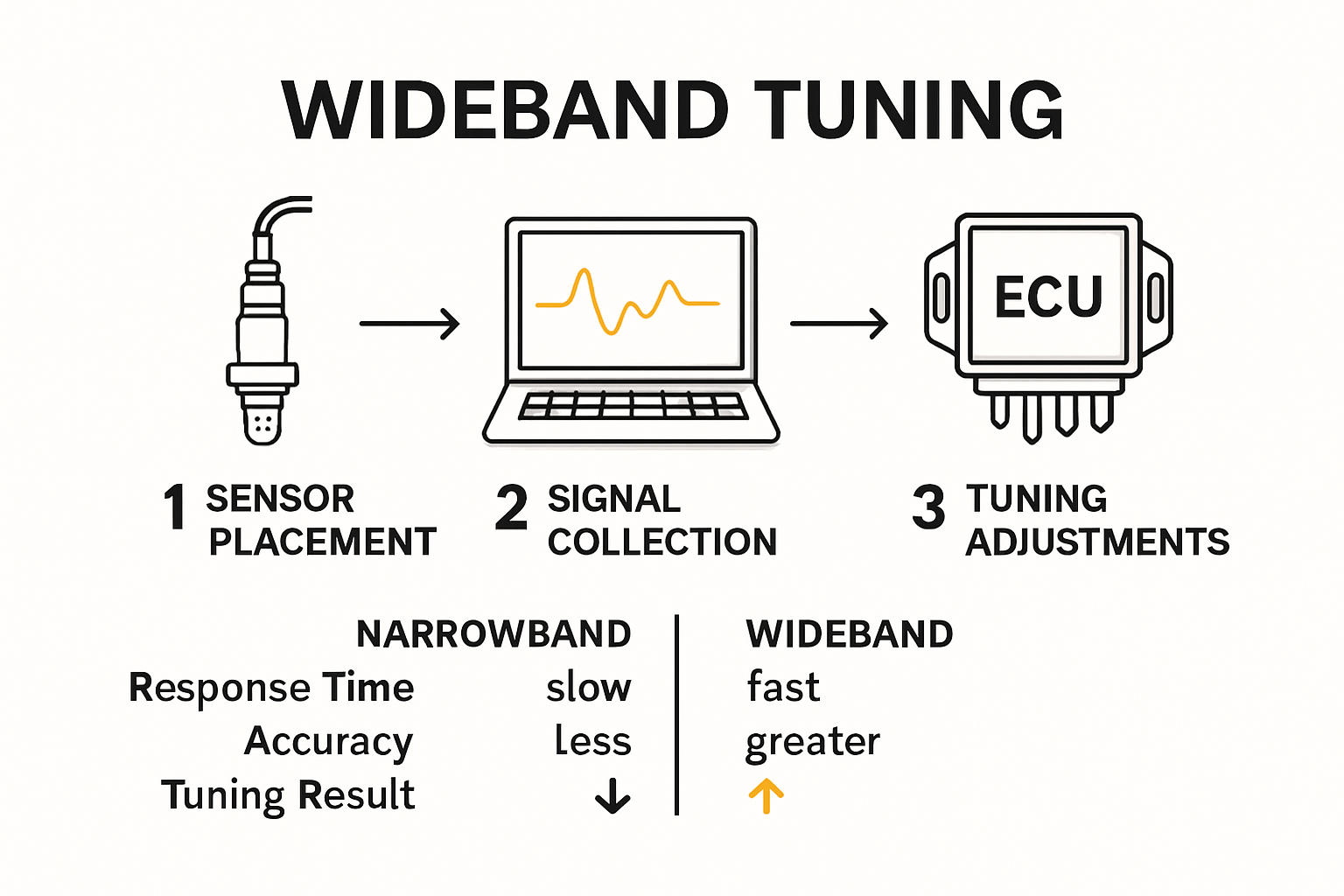
- High-resolution analog-to-digital conversion
- Real-time signal filtering and noise reduction
- Computational algorithms for data interpretation
By capturing minute variations in air fuel ratios and engine parameters, wideband tuning provides a comprehensive view of automotive performance that traditional monitoring systems cannot match. This technology enables professionals to make data-driven decisions about engine calibration, ensuring optimal performance and longevity.
To help readers quickly understand the main components and characteristics that define wideband tuning technology, the table below organizes the core features and their functions discussed in the article.
| Feature / Component | Description |
|---|---|
| Advanced Sensors | High-resolution sensors that capture broad air-fuel ratios |
| Signal Processing Circuits | Enable real-time, accurate sensor data interpretation |
| Dynamic Frequency Range Adapter | Adjusts measurement range to accommodate various engine conditions |
| Analog-to-Digital Conversion | Converts sensor signals for ECU analysis |
| Real-Time Data Monitoring | Facilitates immediate adjustments to enhance performance |
| Calibration Protocols | Fine-tunes sensors and engine parameters for optimal accuracy |
| Multiplexer Systems | Processes multiple signal channels simultaneously |
Key Concepts in Wideband Tuning: Sensors, Calibration, and Adjustments
Wideband tuning relies on sophisticated sensor technologies and precise calibration techniques to deliver comprehensive performance insights. By understanding the intricate mechanisms behind sensor integration and signal processing, automotive professionals can unlock unprecedented levels of engine performance optimization.
Advanced Sensor Technologies
Wideband sensors represent the foundation of modern performance tuning. Unlike traditional narrow band sensors, these advanced technologies can capture and interpret signals across multiple frequency ranges with exceptional precision. The sensor’s ability to dynamically adjust sensitivity enables real-time monitoring of complex engine parameters.
According to National Institutes of Health Research, calibration methodologies play a critical role in minimizing measurement errors and extending sensor reliability. Learn more about precise sensor calibration to understand the nuances of effective performance tuning.
Key characteristics of advanced wideband sensors include:
- High-resolution signal interpretation
- Adaptive frequency range capabilities
- Minimal signal interference
Calibration and Performance Optimization
Calibration represents the critical process of fine-tuning sensors to achieve maximum accuracy and performance. Automotive professionals utilize sophisticated computational techniques to translate raw sensor data into actionable performance insights. This process involves intricate adjustments across multiple engine parameters.
The calibration process encompasses several crucial elements:
- Establishing baseline performance metrics
- Identifying potential performance bottlenecks
- Implementing precision adjustment protocols
By understanding and implementing advanced wideband tuning principles, automotive enthusiasts and professional tuners can transform raw sensor data into meaningful performance enhancements, ensuring optimal engine efficiency and longevity.
Real-World Applications of Wideband Tuning in Vehicle Enhancement
Wideband tuning transforms theoretical performance concepts into tangible automotive improvements, providing professionals and enthusiasts with powerful tools to optimize vehicle performance across multiple domains. By translating advanced sensor data into actionable insights, this technology enables unprecedented levels of precision engineering.
Performance Optimization in Professional Racing
In competitive motorsports, wideband tuning represents a critical technological advantage. Racing teams utilize these advanced systems to extract maximum performance from engines, making minute adjustments that can mean the difference between victory and defeat. Precision becomes the ultimate competitive parameter.
According to U.S. Department of Defense Research, autonomous vehicle development increasingly relies on advanced self-calibration techniques that mirror wideband tuning principles. These technologies enable real-time performance adjustments with minimal human intervention.
Key racing performance applications include:
- Optimizing air fuel mixture under extreme conditions
- Monitoring engine stress in real time
- Enabling rapid diagnostic assessments
Automotive Performance and Efficiency Enhancement
Beyond racing, wideband tuning plays a crucial role in everyday vehicle performance and efficiency. Explore our comprehensive guide to fuel economy tuning to understand how these technologies can transform vehicle economics.
Practical automotive applications encompass:
- Reducing fuel consumption
- Extending engine longevity
- Improving overall vehicle responsiveness
Professional tuners leverage wideband technologies to create comprehensive performance profiles that adapt to diverse driving conditions, ensuring optimal vehicle performance across different operational scenarios. By transforming raw sensor data into precise mechanical adjustments, wideband tuning represents a sophisticated approach to automotive engineering that bridges theoretical potential and practical performance.
Ready to Take Control of Your Performance Tuning?
If you have felt limited by basic tuning tools and crave the real advantages of wideband tuning, you are not alone. This article highlighted how inaccurate air fuel measurement and generic calibration can hold your build back. Precision, real-time data, and truly professional adjustments are what every enthusiast and serious tuner needs. Your next step starts with the right files, sensors, and expertise.

ECUFlashFiles.com bridges your new technical knowledge with practical solutions. Our platform is built for professionals and enthusiasts who want accurate ECU file management, instant access to verified calibration files, and direct support for wideband projects. Whether you need original files, DAMOS data, or custom performance files, we provide secure, rapid delivery and 20 years of expertise so you can start fine-tuning immediately. Do not settle for guesswork. Browse ECUFlashFiles.com now and get the advanced resources your wideband system demands.
Frequently Asked Questions
What is wideband tuning in automotive performance?
Wideband tuning is an advanced method of optimizing engine performance by allowing for broader signal processing and accurate measurement of air-fuel ratios across multiple frequency ranges. This results in enhanced engine performance and efficiency.
How do wideband systems differ from narrowband systems?
Wideband systems provide a much wider range of air-fuel ratio measurements compared to narrowband systems, which offer limited insights. This enables more precise tuning and better real-time performance monitoring of the engine.
What are the benefits of using a wideband tuning system?
The benefits of wideband tuning include improved signal resolution, accurate sensor readings, the ability to optimize fuel efficiency, maximize horsepower and torque output, and maintain engine health by preventing issues from improper air-fuel mixtures.
How does wideband tuning contribute to better fuel efficiency?
Wideband tuning allows for precise adjustments to fuel delivery and ignition timing, ensuring the engine operates at optimal conditions. By monitoring air-fuel ratios in real time, it helps to make necessary adjustments that improve fuel consumption and overall engine efficiency.