
Turbo lag can ruin the thrill of acceleration and leave even high-performance engines feeling sluggish. Yet most drivers do not realize that simply upgrading to a bigger turbo is not the answer. A professional ball bearing turbo can reduce lag by up to 30 percent compared to standard setups. That sounds impressive, right? Most surprising of all, expert tuners know that the real secret starts long before bolting on new parts. Smart assessment and targeted changes can unlock performance gains you never expected.
Table of Contents
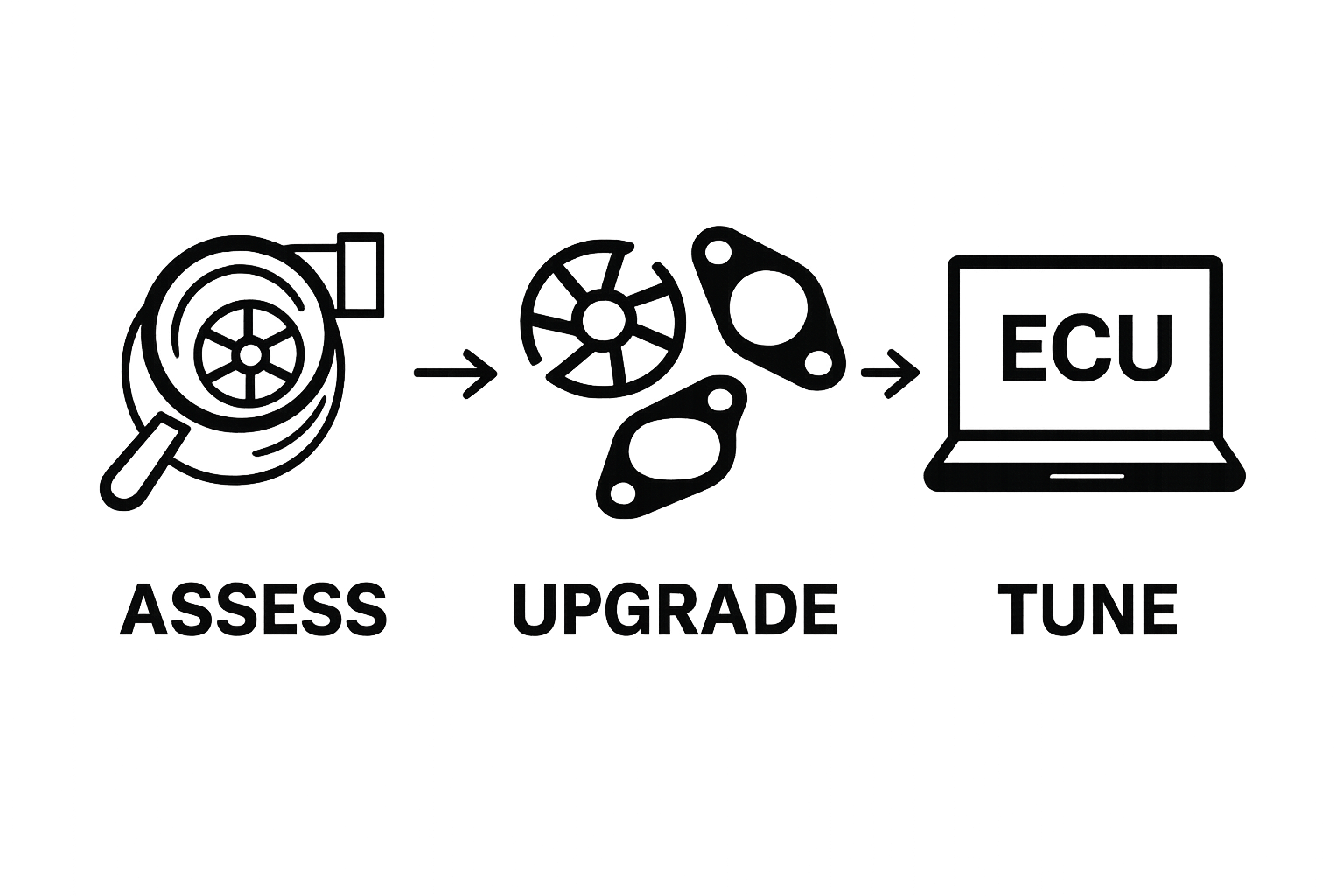
- Step 1: Assess Your Current Turbo Setup
- Step 2: Upgrade Turbocharger Components
- Step 3: Adjust Engine Tuning Parameters
- Step 4: Optimize Airflow and Intercooling Systems
- Step 5: Test and Analyze Performance Changes
Quick Summary
| Key Point | Explanation |
|---|---|
| 1. Assess your turbo setup first | Understand your current turbo configuration to pinpoint specific issues contributing to turbo lag. Accurate measurements will guide future upgrades. |
| 2. Upgrade to lightweight components | Replace existing turbocharger wheels with lighter, precision-engineered alternatives to reduce rotational inertia and improve spool-up times. |
| 3. Fine-tune your ECU parameters | Adjust ECU settings like boost pressure and fuel injection timing for a more responsive system, effectively minimizing turbo lag during operation. |
| 4. Optimize airflow systems | Enhance your intake and intercooling systems to ensure cooler air reaches the turbocharger, improving density and response time. |
| 5. Conduct systematic performance testing | Use a dynamometer to analyze changes post-modifications, focusing on key metrics like spool-up timing and boost pressure for clear performance validation. |
Step 1: Assess Your Current Turbo Setup
Reducing turbo lag starts with a comprehensive assessment of your current turbocharger system. Before implementing any performance modifications, understanding your existing setup is critical for targeted improvements. Professional automotive tuners know that a methodical evaluation provides the foundation for effective turbo lag reduction.
Diagnostic Baseline Assessment
Begin by gathering detailed information about your vehicle’s turbocharger configuration. You’ll want to inspect the turbo system’s current specifications, including compressor wheel size, turbine housing design, and wastegate characteristics. These components directly influence turbo response time and lag performance. Learn more about advanced ECU tuning techniques that can complement your turbo system assessment.
Precise measurement tools are essential for this evaluation. A professional diagnostic scanner will help you record critical parameters such as boost pressure, compressor efficiency, and spool-up times. Some key metrics to track include:
- Boost pressure at different RPM ranges
- Turbocharger shaft speed during acceleration
- Exhaust gas temperature during load changes
- Intercooler efficiency
Consider consulting a professional automotive performance specialist who can perform a comprehensive diagnostic scan. According to research from the Society of Automotive Engineers, detailed diagnostic assessments can reveal nuanced performance characteristics that aren’t immediately apparent during standard inspections.
The goal of this assessment is to establish a performance baseline that will guide subsequent turbo lag reduction strategies. By understanding your current turbocharger’s strengths and limitations, you can develop a targeted approach to minimize lag and optimize overall engine performance. Careful documentation of these initial measurements will serve as a critical reference point for evaluating the effectiveness of future modifications.
Below is a checklist table designed to help you track key diagnostic metrics during your baseline assessment. Use this as a reference while documenting your vehicle’s turbo performance.
| Diagnostic Metric | Purpose | How to Measure |
|---|---|---|
| Boost pressure at different RPM ranges | Tracks boost delivery across engine speeds | Use a diagnostic scanner during acceleration |
| Turbocharger shaft speed | Monitors turbo responsiveness | Attach speed sensor or check ECU logs |
| Exhaust gas temperature during load changes | Assesses engine and turbo health | Use an EGT probe while varying throttle |
| Intercooler efficiency | Evaluates air cooling effectiveness | Compare intake temps before and after intercooler |
Step 2: Upgrade Turbocharger Components
Reducing turbo lag requires strategic component upgrades that optimize your turbocharger’s performance. This step focuses on selecting and installing precision components designed to minimize response time and improve overall system efficiency. Explore advanced tuning techniques that complement these mechanical improvements.
The most critical upgrade involves replacing your existing turbocharger’s compressor and turbine wheels with lightweight, high-precision alternatives. According to research from the Society of Automotive Engineers, using advanced materials like titanium alloy or ceramic composites can significantly reduce rotational inertia, enabling faster spool-up times.
When selecting replacement components, prioritize smaller diameter wheels with optimized blade geometry. Smaller compressor wheels accelerate more quickly, reducing the time required to generate boost pressure. Professional automotive tuners recommend choosing wheels with the following characteristics:
- Reduced blade thickness
- Enhanced aerodynamic profile
- Lightweight material construction
- Precision-balanced design
Additionally, consider upgrading your turbocharger’s bearing system. Traditional journal bearings create more friction and slower response compared to modern ball bearing designs. Ball bearing turbochargers provide reduced rotational resistance, allowing the turbine to spool up faster and more efficiently. This upgrade can decrease turbo lag by approximately 20-30% in many performance applications.
Professional installation is crucial during these component upgrades. Improper mounting or alignment can negate potential performance gains and potentially damage your turbocharging system. Ensure that all new components are precisely matched to your specific engine configuration and that professional tuning follows the physical upgrades to maximize performance potential.
Here is a summary table comparing key turbocharger component upgrade options for reducing turbo lag. Use this table to quickly review material choices and their impact on performance.
| Component / Upgrade | Recommended Material | Benefit | Estimated Lag Reduction |
|---|---|---|---|
| Compressor wheel | Titanium alloy / Ceramic | Lower rotational inertia for faster spool-up | Up to 20% |
| Turbine wheel | Lightweight alloy / Ceramic | Improved acceleration of turbo | Up to 20% |
| Ball bearing system | Steel/Ceramic ball bearings | Less friction vs. journal bearings | 20-30% |
| Smaller diameter wheels | High-strength lightweight alloys | Quicker boost response | 10-15% |
Step 3: Adjust Engine Tuning Parameters
Fine-tuning your engine’s electronic control unit (ECU) represents the most precise method of reducing turbo lag. This critical step transforms your turbocharger’s performance by recalibrating fundamental parameters that influence boost response and power delivery. Learn about comprehensive ECU tuning techniques to maximize your performance potential.
According to research from Michigan State University, strategic ECU parameter adjustments can dramatically improve turbocharger response times. The primary focus involves modifying boost pressure ramp rates, wastegate control strategies, and fuel injection timing to create a more responsive system.
Professional tuners concentrate on several key performance parameters during ECU recalibration. Adjust the wastegate duty cycle to allow faster boost buildup by reducing the exhaust pressure required to initiate turbocharger rotation. This modification enables quicker spool-up times and more immediate power delivery. Simultaneously, reconfigure the fuel injection timing to align precisely with the turbocharger’s accelerating compressor wheel, ensuring optimal air-fuel mixture during transition phases.
The most effective ECU tuning requires specialized diagnostic equipment and advanced programming skills. Essential tools for this process include:
- Professional-grade ECU programming interface
- Real-time data logging equipment
- Dynamometer for performance verification
- Laptop with specialized tuning software
Careful calibration demands incremental adjustments. Start by making modest changes to boost pressure parameters, typically increasing target boost pressure by 2-3 PSI at lower RPM ranges. Monitor engine response closely during these modifications, watching for signs of potential stress or inefficient power delivery. The goal is creating a smooth, responsive power curve that minimizes turbo lag without compromising overall engine reliability.
Successful ECU tuning ultimately produces a more immediate throttle response, reduced turbo lag, and improved overall power delivery. Verification involves conducting multiple dyno runs to confirm performance improvements and ensuring that all modified parameters function harmoniously across different engine operating conditions.
Step 4: Optimize Airflow and Intercooling Systems
Optimizing airflow and intercooling systems represents a critical strategy for reducing turbo lag and enhancing overall engine performance. This step focuses on creating a more efficient path for incoming air, ensuring cooler, denser charge delivery that dramatically improves turbocharger response. Explore advanced performance tuning strategies to complement these airflow improvements.
According to research from ACS Omega, strategic modifications to intake and intercooling systems can significantly reduce turbo lag by improving air density and temperature management. Professional automotive tuners recommend starting with a comprehensive assessment of your current intake and intercooling configuration.
The primary focus should be upgrading your intercooler to a high-performance unit with increased core volume and improved heat exchange capabilities. Aluminum bar-and-plate intercoolers typically offer superior performance compared to stock tube-and-fin designs. Look for intercoolers with larger cross-sectional areas and optimized internal flow channels that minimize pressure drop while maximizing cooling efficiency.
Key components to consider during your airflow optimization include:
- High-flow intake manifold
- Larger diameter intake piping
- Lightweight, low-restriction air filters
- Performance intercooler with improved core design
- Ceramic-coated intake components
Professional installation requires precise measurement and alignment of all components. Ensure that new intake and intercooler systems maintain proper alignment with existing turbocharger mounting points. Modifications should create a smooth, unrestricted airflow path that minimizes turbulence and pressure losses. Pay special attention to eliminating sharp bends and reducing the number of connection points in your intake system.
Verification of successful optimization involves conducting comprehensive performance testing. Use a dynamometer to measure boost response times, intake air temperatures, and overall power delivery.
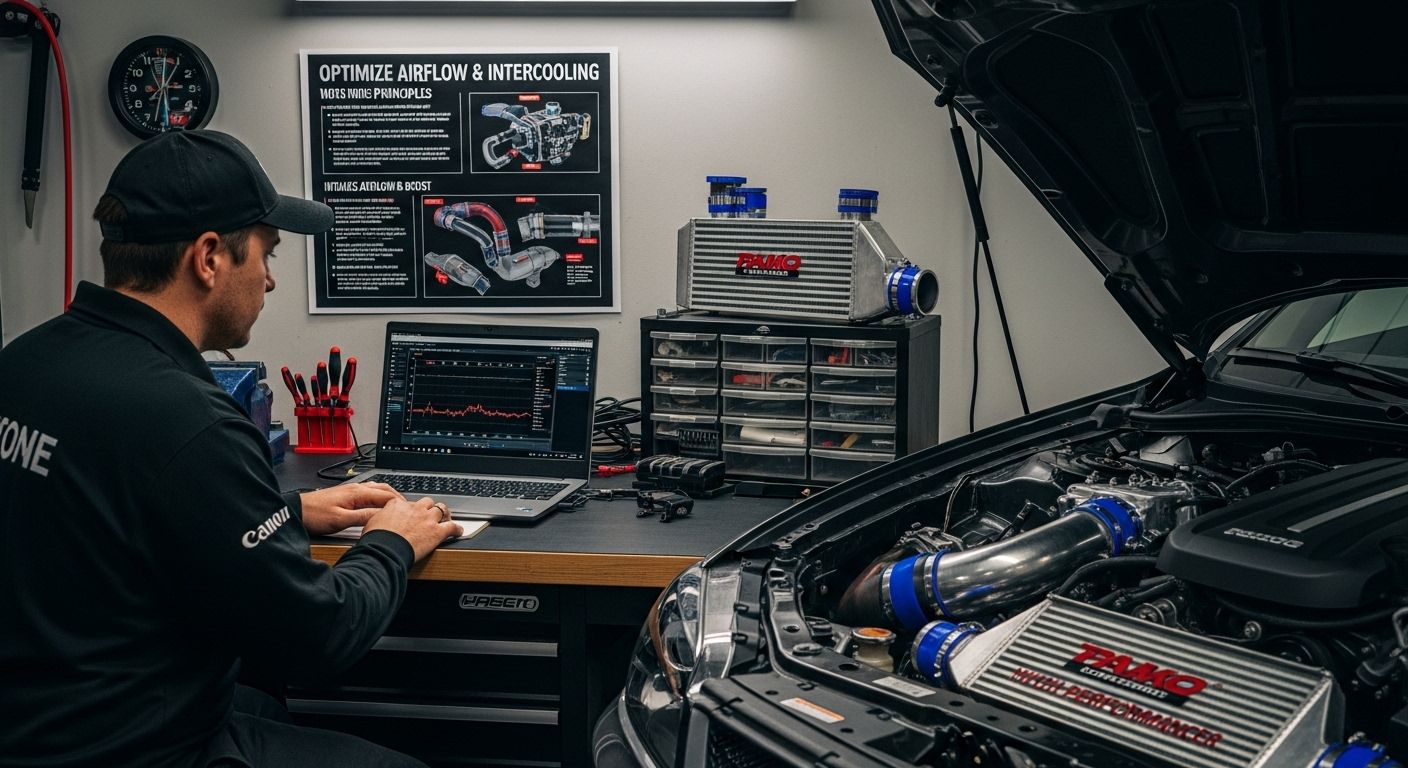
Successful modifications will demonstrate a noticeable reduction in turbo lag, with improved throttle response and more consistent power distribution across different RPM ranges.
Step 5: Test and Analyze Performance Changes
Testing and analyzing performance changes represents the critical final stage in reducing turbo lag, transforming theoretical modifications into measurable improvements. This step validates the effectiveness of your previous upgrades and provides comprehensive insights into your turbocharging system’s enhanced capabilities. Learn more about advanced automotive data logging techniques to support your performance analysis.
According to research from SAE International, systematic performance testing is essential for quantifying turbocharger response improvements. Professional automotive tuners recommend utilizing a dynamometer for precise, controlled performance measurements that reveal nuanced changes in boost response and power delivery.
The primary testing methodology involves conducting multiple dyno runs under controlled conditions. Begin by establishing a baseline performance measurement before your modifications, then compare subsequent runs after each upgrade. Pay close attention to critical performance metrics such as boost pressure ramp rates, turbocharger spool-up times, and overall power curve characteristics. Professional testing equipment allows you to track millisecond-level changes in turbocharger response, providing granular insights into your performance improvements.
Essential testing equipment and metrics include:
- High-precision dynamometer
- Exhaust gas temperature sensors
- Boost pressure monitoring equipment
- Torque and horsepower measurement tools
- Real-time data logging systems
Careful analysis requires more than just raw numbers. Examine the entire performance envelope, looking for improvements in low-end torque, mid-range responsiveness, and top-end power delivery. Unexpected variations might indicate the need for further fine-tuning or component adjustments. Professional tuners typically recommend multiple testing sessions, allowing for incremental refinements and comprehensive performance validation.
Successful testing ultimately demonstrates a clear reduction in turbo lag through quantifiable performance metrics. Look for improvements such as faster boost buildup, more consistent power delivery, and reduced time between throttle input and full turbocharger response. Document all test results meticulously, creating a comprehensive performance profile that validates your turbocharging system modifications.
Unlock Instant Turbo Response With Verified ECU Solutions
You have invested serious time and effort into reducing turbo lag, but real performance gains depend on precise ECU management. Frustrated by slow spool-up even after mechanical modifications? Hesitant to push your turbo setup because of unreliable software or limitations in your stock ECU files? At ECUFlashFiles.com, we understand that eliminating turbo lag is not just about hardware. True control starts with the right ECU calibration, matched specifically to your engine and turbo configuration.
Take control of your turbocharger’s response using our performance-tuned ECU files. Access original, modified, or DAMOS data with instant delivery and professional support. Ready to translate all your upgrades into proven results? Visit ECUFlashFiles.com and start downloading verified files now. Turbo lag will not wait and neither should you.
Frequently Asked Questions
How can I assess my current turbo setup before making modifications?
Start by inspecting your turbocharger’s specifications, including compressor wheel size, turbine housing design, and wastegate characteristics. Use a professional diagnostic scanner to record metrics like boost pressure and spool-up times. This assessment establishes a baseline for performance improvement.
What component upgrades are best for reducing turbo lag?
Upgrading to lightweight, high-precision compressor and turbine wheels, as well as switching to a ball-bearing design, can significantly reduce turbo lag. Smaller diameter wheels with optimized blade geometry accelerate faster, improving spool time.
How do I adjust ECU tuning parameters to minimize turbo lag?
Adjusting the wastegate duty cycle allows for quicker boost buildup, while modifying fuel injection timing aligns with the turbo’s response. Incremental changes in boost pressure at lower RPMs can also improve throttle response without compromising engine reliability.
What airflow optimizations can I make to enhance turbocharger performance?
Upgrading to a high-performance intercooler, using a high-flow intake manifold, and installing larger diameter intake piping can improve airflow efficiency. Ensuring proper alignment and minimizing turbulence in the intake system are also crucial steps to enhance turbocharger response.