
Chip tuning sounds like something only race teams or car geeks might care about. But get this. A simple ECU tweak can boost your engine’s power by up to 25%—no wrenches required. Most people think squeezing extra power out of your car means expensive new parts, yet the real secret sits quietly inside the software your engine already uses.
Table of Contents
- What Is Chip Tuning And Its Purpose?
- The Importance Of Chip Tuning In Automotive Performance
- How Chip Tuning Works: The Technical Foundation
- Key Concepts Behind Chip Tuning And Engine Management
- Real-World Implications Of Chip Tuning For Drivers
Quick Summary
| Takeaway | Explanation |
|---|---|
| Chip tuning enhances vehicle performance | Chip tuning optimizes engine control unit settings to increase horsepower and torque significantly. |
| ECU recalibration is key | Recalibrating the ECU adjusts parameters like fuel injection and ignition timing for improved efficiency. |
| Tuning can reduce operating costs | Improved fuel efficiency through chip tuning can decrease long-term fuel expenses. |
| Customization for driver preferences | Drivers can tailor their vehicle’s performance characteristics to match individual driving styles and conditions. |
| Professional tuning is recommended | Engaging professional tuners ensures modifications maintain engine reliability and meet performance goals. |
What is Chip Tuning and its Purpose?
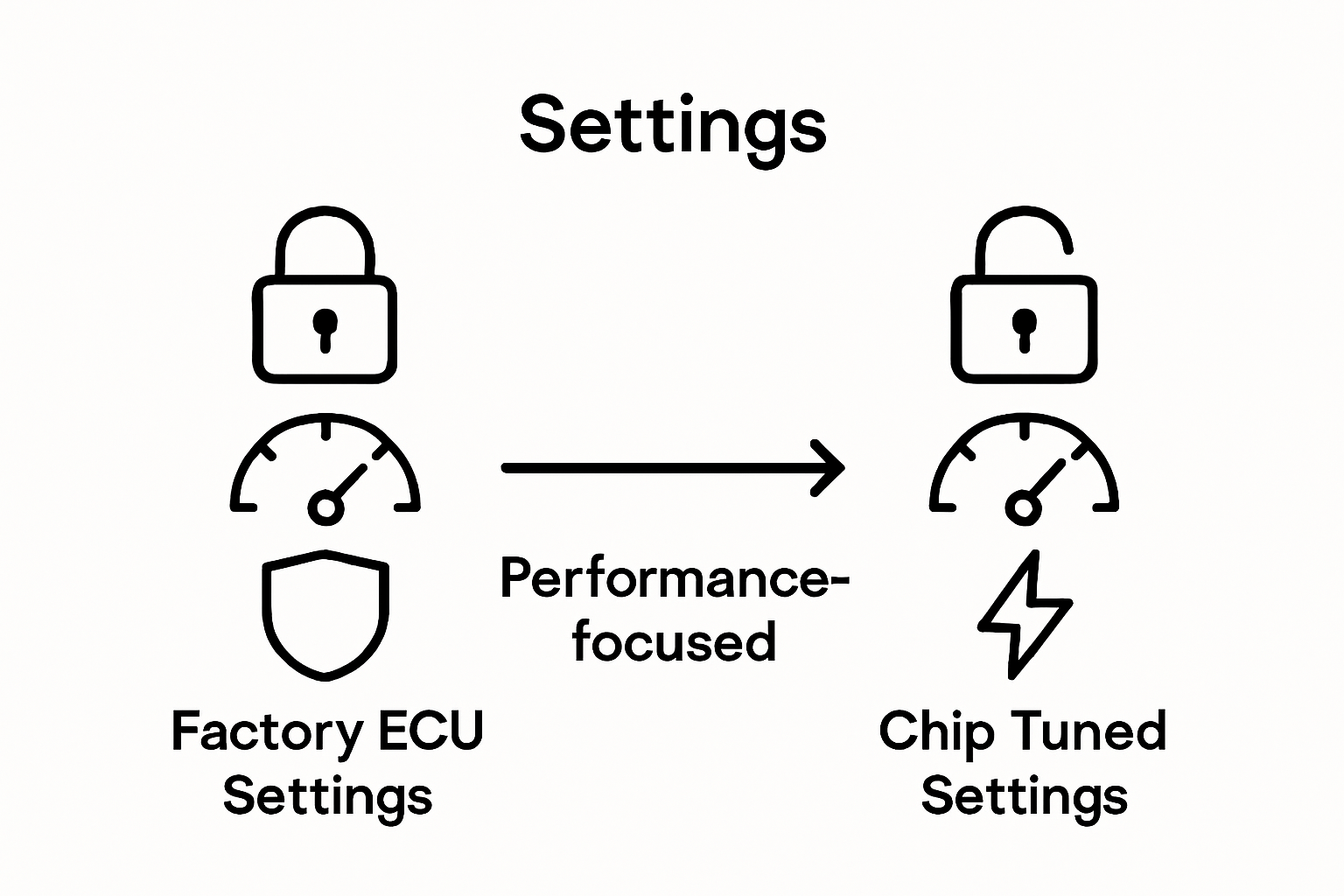
Chip tuning represents a sophisticated automotive performance enhancement technique targeting the electronic control unit (ECU) of modern vehicles. The primary objective of this process is to optimize an engine’s operational parameters beyond the manufacturer’s conservative default settings. By carefully reprogramming the vehicle’s ECU software, automotive enthusiasts and professional tuners can unlock significant performance potential that remains untapped in standard configurations.
Understanding ECU Performance Limitations
Manufacturers typically program vehicle ECUs with generalized settings designed to accommodate diverse global conditions, varying fuel qualities, and broad maintenance requirements. These default configurations prioritize engine longevity, emissions compliance, and reliability over maximum performance. Chip tuning strategically addresses these limitations by recalibrating critical engine management parameters such as:
- Fuel injection timing
- Boost pressure for turbocharged engines
- Ignition advance
- Throttle response characteristics
Performance Enhancement Mechanisms
The chip tuning stage involves precision modifications to the engine’s digital control systems. According to automotive performance research, this process can yield substantial improvements in several key performance metrics. Professional tuners utilize specialized diagnostic tools to read the existing ECU file, analyze its configuration, and develop customized performance maps that optimize the engine’s potential.
While traditional chip tuning once required physically replacing hardware components, modern approaches leverage advanced software remapping techniques. Read more about ECU tuning fundamentals to understand how digital modifications can transform a vehicle’s performance profile without invasive mechanical alterations. The goal remains consistent: extracting maximum efficiency and power from the existing mechanical platform through intelligent electronic optimization.
The Importance of Chip Tuning in Automotive Performance
Chip tuning transcends simple performance enhancement, representing a sophisticated approach to unlocking a vehicle’s inherent mechanical potential through intelligent electronic optimization. This process enables automotive enthusiasts and professional tuners to bridge the gap between manufacturer-imposed limitations and true engine performance capabilities.
Performance and Efficiency Optimization
Modern vehicles are engineered with complex electronic control systems that frequently restrict an engine’s full performance envelope. Chip tuning addresses these constraints by recalibrating critical parameters, delivering substantial improvements in several key areas:
- Increased horsepower and torque output
- Enhanced throttle response and acceleration
- Improved fuel efficiency
- Refined engine characteristics
Economic and Performance Benefits
Beyond raw performance gains, chip tuning offers significant economic advantages for vehicle owners. Understand the minimum system requirements for automotive tuning to appreciate the technical nuances involved. Professional tuning can result in improved fuel consumption, reducing long-term operational costs while simultaneously enhancing the driving experience.
According to automotive performance research, strategic electronic modifications can yield performance improvements ranging from 10% to 25% without requiring extensive mechanical alterations. This approach represents a cost-effective method for extracting additional performance from an existing powertrain, making chip tuning an attractive option for performance enthusiasts seeking measurable gains without significant financial investment.
How Chip Tuning Works: The Technical Foundation
Chip tuning represents a precise electronic modification process that involves strategic manipulation of a vehicle’s engine control unit (ECU) software to optimize performance parameters. This sophisticated technique goes beyond simple hardware modifications, focusing instead on recalibrating the digital brain controlling the vehicle’s core mechanical systems.
Electronic Control Unit Mapping
The ECU functions as a complex computational system that manages multiple engine parameters through intricate software mapping. These digital maps control critical performance elements such as:
- Fuel injection timing and quantity
- Ignition advance
- Turbocharger boost pressure
- Throttle response characteristics
- Air-fuel mixture ratios
Professional tuners utilize specialized diagnostic tools to read the existing ECU file, creating a comprehensive digital blueprint of the engine’s current operational configuration. Explore our beginner’s guide to ECU tuning to understand the fundamental principles behind this complex process.
Software Remapping Techniques
Modern chip tuning employs advanced software remapping techniques that allow precise electronic modifications without physical component replacement. According to automotive performance research, these digital interventions can optimize an engine’s performance by adjusting microsecond-level parameters that dramatically influence overall vehicle dynamics. The process involves creating custom performance profiles that unlock the latent potential within the existing mechanical platform, transforming standard manufacturer settings into high-performance configurations tailored to specific driving requirements and environmental conditions.
Key Concepts Behind Chip Tuning and Engine Management
Engine management represents a complex technological ecosystem where digital precision intersects with mechanical performance. Chip tuning serves as an advanced intervention strategy that manipulates this intricate system, transforming standard vehicle configurations into high-performance platforms through intelligent electronic modifications.
Fundamental Performance Parameters
At the core of chip tuning lie several critical performance parameters that professional tuners meticulously adjust. These parameters form the foundational elements determining an engine’s operational characteristics:
The table below summarizes the key engine performance parameters that are adjusted during professional chip tuning, along with their main functions and how optimizing them impacts your vehicle’s behavior.
| Parameter | Main Function | Impact When Optimized |
|---|---|---|
| Fuel injection timing/volume | Controls when and how much fuel is injected | Delivers efficient power, improves combustion |
| Ignition advance/spark timing | Determines spark ignition point in cycle | Increases power, enhances throttle response |
| Turbocharger boost pressure | Regulates air pressure delivered to intake | Boosts horsepower and torque |
| Air-fuel mixture optimization | Balances fuel and air for combustion | Improves efficiency and reduces emissions |
| Throttle response sensitivity | Adjusts how engine responds to pedal input | Provides faster, more responsive acceleration |
Fuel injection timing and volume
Ignition advance and spark duration
Turbocharger boost pressure regulation
Air-fuel mixture optimization
Throttle response sensitivity
Electronic Control System Architecture
Explore the fundamentals of chip tuning to understand the sophisticated electronic control system architecture. Modern vehicle engines rely on intricate networks of sensors and computational algorithms that continuously monitor and adjust performance parameters in real time. These systems collect data from multiple input sources, enabling precise management of engine operational conditions.
According to automotive engineering research, successful chip tuning requires a comprehensive understanding of the delicate balance between performance enhancement and mechanical system integrity. Professional tuners must navigate complex trade-offs, ensuring that performance modifications do not compromise engine reliability or exceed manufacturer-specified operational tolerances. The process demands advanced diagnostic tools, deep technical knowledge, and a nuanced approach to electronic system manipulation.
Real-World Implications of Chip Tuning for Drivers
Chip tuning transcends theoretical performance enhancements, delivering tangible real-world benefits that directly impact a driver’s daily automotive experience. By strategically optimizing electronic control systems, drivers can experience transformative improvements in vehicle responsiveness, efficiency, and overall driving dynamics.
Performance and Efficiency Dynamics
Drivers considering chip tuning can expect a comprehensive range of practical advantages that extend beyond simple power increases. These performance modifications deliver measurable improvements across multiple driving parameters:
Enhanced acceleration and throttle response
Improved fuel efficiency and reduced consumption
Smoother power delivery across different engine RPM ranges
More responsive transmission characteristics
Potential reduction in long-term maintenance costs
Driving Experience Transformation
Learn about advanced performance tuning solutions to understand the nuanced impact of electronic modifications on driving dynamics. Chip tuning enables drivers to customize their vehicle’s performance profile, adapting the car’s characteristics to specific driving conditions or personal preferences.
According to transportation behavior research, driver behavior significantly influences vehicle performance and efficiency. Professional chip tuning can help mitigate inefficiencies introduced by individual driving styles, providing a more consistent and optimized driving experience. The strategic electronic modifications allow for a more predictable and controlled interaction between driver inputs and the vehicle’s mechanical systems, ultimately enhancing both performance and safety.

Unlock Your Vehicle’s True Performance Potential with Verified ECU Files
If you have ever felt held back by the conservative settings of your factory ECU, you are not alone. Many readers exploring chip tuning want reliable ways to achieve better horsepower, improved throttle response, and optimized engine efficiency without compromising safety or reliability. The challenge is finding tested, trustworthy ECU files that deliver real results and help you unlock your vehicle’s capacity for performance gains described in this article.

Stop leaving power on the table and take control of your engine management. With ECUFlashFiles.com, you get secure access to a wide library of original, tuned, and performance-optimized ECU files suitable for your car’s make, model, and variant. All files are backed by over 20 years of experience and instantly delivered for your projects. Do not wait—get started now and experience professional results. Visit our main website to find your perfect ECU tuning solution today.
Frequently Asked Questions
What is chip tuning?
Chip tuning is a performance enhancement technique that involves reprogramming the vehicle’s electronic control unit (ECU) to optimize engine parameters for increased performance, efficiency, and throttle response.
How does chip tuning improve engine performance?
Chip tuning improves engine performance by recalibrating critical parameters such as fuel injection timing, turbocharger boost pressure, and ignition advance, unlocking additional horsepower and torque while enhancing overall responsiveness.
Are there any risks associated with chip tuning?
While chip tuning can provide significant performance benefits, it must be approached with caution. Incorrect modifications can lead to engine reliability issues or exceed manufacturer tolerances, making it essential to use experienced professionals for the tuning process.
Can chip tuning improve fuel efficiency?
Yes, chip tuning can enhance fuel efficiency by optimizing the air-fuel mixture and engine operation, potentially reducing fuel consumption while simultaneously improving performance.