
Fine-tuning how fast your car reacts when you hit the gas can completely reshape your driving experience. Most drivers do not realize that a simple adjustment of the engine’s electronic settings can change laggy pedal response into lightning-fast acceleration. In fact, using the right diagnostic tools and ECU tuning software can unlock throttle upgrades that make your car feel brand new, and even small tweaks can mean big thrills behind the wheel.
Table of Contents
- Step 1: Assess Your Current Throttle Response Settings
- Step 2: Select Appropriate Tuning Tools and Software
- Step 3: Adjust ECU Parameters for Throttle Mapping
- Step 4: Test Vehicle Response with Adjusted Settings
- Step 5: Analyze Data and Fine-tune Further if Necessary
Quick Summary
| Key Point | Explanation |
|---|---|
| 1. Assess Your Throttle Response | Begin by evaluating your vehicle’s current throttle behavior to create a performance baseline. |
| 2. Choose the Right Tools | Invest in professional diagnostic scanners and ECU tuning software for effective modifications. |
| 3. Adjust ECU Throttle Mapping | Calibrate your ECU parameters carefully to improve engine responsiveness according to your preferences. |
| 4. Test After Adjustments | Conduct systematic tests post-tuning to ensure throttle responsiveness has improved without issues. |
| 5. Analyze Data for Refinements | Use logged data to identify further tuning opportunities, ensuring smoother power delivery and responsiveness. |
Step 1: Assess Your Current Throttle Response Settings
Before diving into throttle response improvements, understanding your vehicle’s current performance baseline is crucial. Throttle response represents how quickly your engine responds when you press the accelerator, directly impacting acceleration, power delivery, and overall driving experience. Precise assessment requires a systematic approach that combines diagnostic tools, driving evaluation, and technical analysis.
To begin your assessment, you’ll need several key diagnostic tools. Specialized automotive diagnostic scanners are essential for retrieving precise electronic data from your vehicle’s Engine Control Unit (ECU). Professional-grade scanners can provide detailed information about throttle position sensors, electronic throttle control performance, and real-time engine parameters. For most enthusiasts, investing in a versatile scanner that supports multiple vehicle makes and models will provide comprehensive insights.
During your initial evaluation, perform a series of controlled acceleration tests to understand your current throttle response characteristics. Start by driving on a flat, safe road with minimal traffic. Accelerate from a complete stop to a moderate speed, paying close attention to how the vehicle responds to different levels of accelerator pedal input. **Look for specific performance indicator
Here is a checklist table summarizing key vehicle performance indicators to look for when assessing your current throttle response. Use this table during your evaluation to systematically track potential issues.
| Performance Indicator | Typical Symptom | What to Watch For |
|---|---|---|
| Lag Time | Delay after pressing pedal | Slow engine response |
| Inconsistent Acceleration Curve | Acceleration feels uneven | Fluctuating power delivery |
| Hesitation or Jerking | Jerky movement during acceleration | Sudden surges or drops in power |
| Uneven Power Distribution (RPM Range) | Different power at various RPMs | Loss of power in certain RPM zones |
| Throttle Position Sensor Readout | Irregular sensor values | Sensor not matching pedal angle |
| Electronic Throttle Control Issues | Error codes/log entries | Warnings from diagnostic tools |
s**:
- Lag between pedal depression and engine power delivery
- Inconsistent acceleration curve
- Perceived hesitation or jerking during acceleration
- Uneven power distribution across different RPM ranges
To gain more technical insights, explore our comprehensive guide on throttle response tuning which provides advanced diagnostic techniques. Professional automotive technicians often recommend documenting these observations through data logging, which allows for precise comparative analysis before and after performance modifications.
Successful assessment means identifying specific areas where your vehicle’s throttle response can be enhanced. By methodically evaluating your current settings, you create a solid foundation for targeted performance improvements in the subsequent tuning stages.
Step 2: Select Appropriate Tuning Tools and Software
Selecting the right tuning tools and software represents a critical junction in your throttle response enhancement journey. Your choice will determine the precision, effectiveness, and ultimately the success of your performance modifications. Professional-grade electronic tuning requires a strategic approach that balances technical capabilities, compatibility, and your specific vehicle requirements.
Professional diagnostic scanners and ECU tuning software form the backbone of your throttle response optimization process. Modern automotive performance enthusiasts typically require multi-function devices capable of real-time data logging, parameter adjustment, and comprehensive vehicle system analysis. When evaluating potential tools, prioritize options that offer extensive vehicle make and model coverage, robust firmware update capabilities, and intuitive user interfaces. Look for software platforms that provide granular control over throttle mapping, allowing precise adjustments to parameters like throttle sensitivity, pedal response curves, and electronic throttle control characteristics.
Your selection process should include careful consideration of several key factors. Vehicle compatibility is paramount. Not all tuning tools work universally across different automotive platforms, so confirm comprehensive support for your specific vehicle make, model, and engine type. Professional tuners recommend investing in versatile diagnostic platforms that can interface with multiple vehicle electronic systems. Learn more about advanced ECU tuning techniques to understand the nuanced approach required for successful modifications.
Consider the following essential criteria when selecting your tuning toolkit:
- Comprehensive vehicle make and model coverage
- Real-time data logging capabilities
- Precise throttle mapping adjustment options
- Firmware update support
- User-friendly interface design
- Technical support and community resources
Budget considerations play a significant role in tool selection. While professional-grade systems can represent substantial investments, they provide the most reliable and precise throttle response tuning capabilities. Hobbyist and entry-level performance enthusiasts might start with more affordable, specialized diagnostic tools that offer essential functionality without overwhelming complexity. Ultimately, your chosen toolset should provide the technical depth necessary to make meaningful performance enhancements while remaining accessible to your skill level and technical expertise.
Use this overview table to compare different types of diagnostic tools and ECU tuning software features mentioned in the article. This will help you select equipment that matches your technical needs and budget.
| Tool/Software Type | Key Features | Ideal For | Notes |
|---|---|---|---|
| Professional Diagnostic Scanner | Multi-make/model support, real-time data, detailed ECU info | Advanced users & tuners | Supports data logging and wide compatibility |
| Basic Diagnostic Tool | Essential ECU codes, limited adjustment | Beginners, hobbyists | Lower cost, limited functionality |
| ECU Tuning Software (Advanced) | Granular throttle mapping, firmware update support | Performance enthusiasts & professionals | Allows precise throttle and parameter tuning |
| ECU Tuning Software (Entry-level) | Basic interface, essential adjustments | New tuners or budget shoppers | Easy to use but less configurable |
Step 3: Adjust ECU Parameters for Throttle Mapping
Adjusting ECU parameters for throttle mapping represents the most critical phase of performance enhancement, transforming your vehicle’s responsiveness through precise electronic calibration. This process involves recalibrating the electronic throttle control system to optimize the relationship between accelerator pedal input and actual engine power delivery. Professional tuners understand that throttle mapping is not a one-size-fits-all solution but a nuanced adjustment tailored to specific driving preferences and vehicle characteristics.
Begin by connecting your diagnostic tool to the vehicle’s ECU and accessing the electronic throttle control configuration menu. Throttle sensitivity curves are the primary focus of your modifications, allowing you to reshape how the engine responds to different levels of pedal input. Most advanced tuning software provides graphical interfaces that enable you to modify these curves with precision. Learn more about advanced throttle response techniques to understand the intricate details of electronic performance optimization.
Careful parameter adjustment requires a methodical approach. Start by identifying the default throttle mapping settings and creating a backup of the original configuration. Professional tuners recommend incremental modifications, adjusting parameters in small percentages to observe their direct impact on vehicle performance. Key areas of focus include:
- Pedal sensitivity at low throttle positions
- Acceleration response rate
- Throttle opening characteristics
- Interpolation between different throttle angles
Understanding the subtle interactions between different ECU parameters is crucial. Aggressive modifications can lead to unintended consequences, such as jerky acceleration, increased fuel consumption, or potential damage to the drivetrain. Experienced performance enthusiasts recommend using data logging tools to monitor real-time engine parameters during your adjustment process. This allows you to validate each modification and ensure that your throttle mapping changes produce the desired performance improvements without compromising vehicle reliability.
Successful ECU parameter adjustment means achieving a noticeable improvement in throttle response while maintaining smooth, predictable engine behavior. The goal is to create a more direct connection between your accelerator pedal input and the engine’s power delivery, resulting in a more engaging and responsive driving experience. Verification involves multiple test drives under various conditions, carefully assessing the changes in acceleration characteristics, engine smoothness, and overall vehicle dynamics.
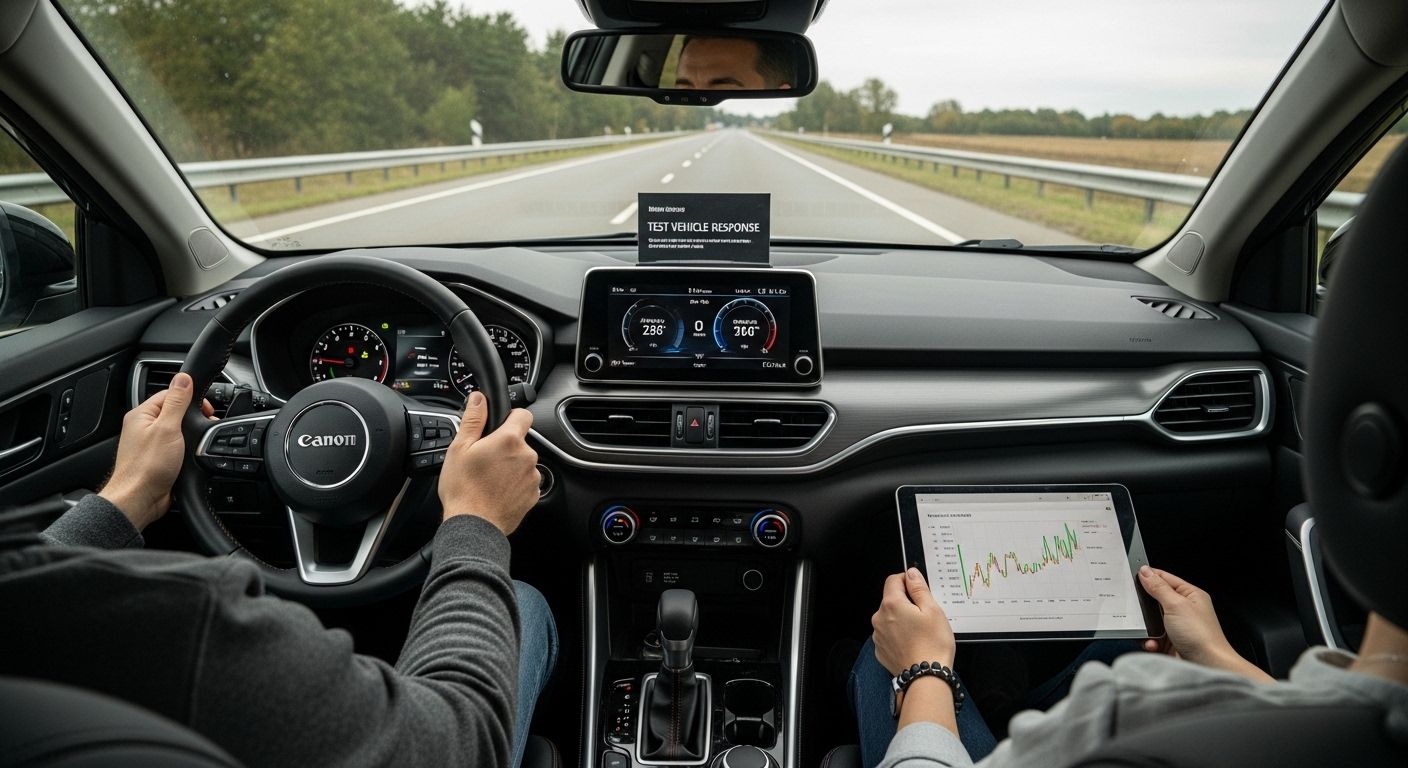
Step 4: Test Vehicle Response with Adjusted Settings
Testing vehicle response after throttle mapping adjustments is a critical validation phase that transforms theoretical modifications into real-world performance improvements. This step determines whether your ECU parameter changes have genuinely enhanced throttle responsiveness or require further refinement. Systematic and controlled testing provides the empirical evidence needed to confirm the success of your tuning efforts.
Begin your testing protocol by selecting a safe, controlled environment that allows comprehensive performance evaluation. Professional tuners recommend a multi-stage testing approach that progressively challenges the vehicle’s modified throttle response under varying driving conditions. Explore advanced performance testing techniques to understand the nuanced methodologies used by automotive performance experts.
Your testing sequence should incorporate several critical assessment scenarios to comprehensively evaluate throttle response. Initial low-speed urban testing helps identify any potential issues with idle and low-throttle performance, such as unexpected lurching or inconsistent acceleration. Subsequent highway testing allows you to assess high-speed throttle characteristics, examining how the modified mapping performs during sustained acceleration and quick throttle transitions.
Pay attention to these key performance indicators during your test drives:
- Smoothness of acceleration across different RPM ranges
- Responsiveness to partial and full throttle inputs
- Consistency of power delivery
- Absence of hesitation or unexpected engine behavior
- Fuel efficiency changes
Utilize your diagnostic tool’s data logging capabilities throughout the testing process. Real-time monitoring provides invaluable insights into how your ECU parameter modifications translate into actual vehicle performance. Professional tuners often recommend recording multiple test runs, comparing the logged data against the original baseline measurements to quantify improvements objectively.
Successful testing results in a noticeable improvement in throttle response without compromising vehicle reliability or creating unintended performance characteristics. If the testing reveals any inconsistencies or unsatisfactory performance, return to your ECU parameter settings and make incremental adjustments.
Remember that fine-tuning is an iterative process requiring patience and methodical approach. The ultimate goal is achieving a perfect balance between enhanced responsiveness and smooth, predictable engine behavior.
Step 5: Analyze Data and Fine-tune Further if Necessary
Data analysis represents the culmination of your throttle response optimization journey, transforming raw performance measurements into actionable insights. Comprehensive data interpretation allows you to identify subtle performance nuances that might have escaped initial testing, providing opportunities for precise refinement of your vehicle’s electronic throttle control system. Professional tuners understand that this phase is not about achieving perfection in a single attempt, but iteratively improving performance through methodical evaluation.
Begin your analysis by comparing the logged performance data against your original baseline measurements. Look for quantitative and qualitative changes in throttle response characteristics, paying close attention to acceleration curves, throttle sensitivity, and overall engine responsiveness. Explore advanced data logging techniques to enhance your analytical approach and gain deeper insights into vehicle performance metrics.
Professional diagnostic software provides graphical representations of throttle behavior, allowing you to visualize subtle variations in electronic throttle control parameters. Detailed graphical analysis helps identify potential areas requiring further adjustment. Focus on interpreting data points that reveal inconsistencies in power delivery, such as unexpected throttle lag, non-linear acceleration, or variations in throttle sensitivity across different RPM ranges.
Consider these critical analysis parameters during your evaluation:
- Throttle response time across different engine speeds
- Consistency of acceleration curve
- Power delivery smoothness
- Potential fuel efficiency changes
- Electronic system stability
Successful fine-tuning requires a balanced approach that considers both performance gains and overall vehicle reliability. Minor adjustments often yield more significant improvements than radical parameter changes. Professional tuners recommend making incremental modifications, typically adjusting parameters by small percentages and re-testing to observe their specific impact. This methodical approach minimizes the risk of introducing unintended performance complications while progressively optimizing throttle response.
Ultimately, your data analysis should provide a clear roadmap for further improvements or confirm that your current throttle mapping configuration represents an optimal balance between enhanced responsiveness and reliable performance. Remember that vehicle tuning is an ongoing process of continuous refinement, with each iteration bringing you closer to your desired driving experience.
Bring Your Throttle Response Up to Professional Standards
If you are frustrated with slow acceleration, unpredictable pedal feel, or uneven power delivery, you are not alone. The article laid out the step-by-step process for assessing, tuning, and testing your throttle mapping. Yet achieving optimal throttle response requires more than basic tools—it demands expertly calibrated ECU files and precision tuning data that matches your car’s unique setup. Whether you are looking for DAMOS calibration, original manufacturer settings, or performance upgrades, generic solutions will not fully address hesitation or maximize drivability. When every millisecond counts, you need a reliable source for tested and verified ECU remapping resources.
Give your tuning workflow a professional edge. Visit ECUFlashFiles.com to access an extensive library of original, tuned, and DAMOS files with instant delivery. You can search by make and model and take advantage of rapid file sourcing and expert technical support. Your journey to sharper throttle response and peak engine performance can begin today, so do not settle for guesswork—get the files trusted by professional tuners and achieve real, measurable improvements now.
Frequently Asked Questions
What is throttle response, and why is it important?
Throttle response refers to how quickly your engine reacts when you press the accelerator pedal. It directly affects acceleration, power delivery, and the overall driving experience, making it a key area for performance enhancements.
How can I assess my car’s current throttle response settings?
To assess your vehicle’s throttle response, use a specialized automotive diagnostic scanner to retrieve data from your ECU. Perform controlled acceleration tests to identify lag, inconsistent acceleration curves, and other performance indicators.
What factors should I consider when selecting tuning tools for throttle response?
When choosing tuning tools, consider vehicle compatibility, real-time data logging capabilities, user-friendly interfaces, firmware update support, and the level of control offered over throttle mapping and parameters.
What steps should I take to fine-tune my vehicle’s throttle response after adjustments?
After making adjustments, conduct systematic tests in controlled environments, focusing on key performance indicators like acceleration smoothness and responsiveness. Analyze data from logged tests to identify areas for further refinement and make incremental adjustments based on your findings.