
Car engines might seem mysterious, but the science behind their performance is surprisingly precise. The lambda value can pinpoint if your mixture is too rich or too lean with just a single number. Most drivers never realize that tuning for the right lambda can mean the difference between a sluggish ride and peak efficiency. This simple ratio turns out to be the hidden language that separates everyday engines from true high performers.
Table of Contents
- What Is Lambda And Its Role In Vehicle Performance?
- Why Lambda Measurements Matter For Tuning Cars
- How Does The Lambda Sensor Function And Affect Combustion?
- Key Concepts Behind Lambda Values And Air-Fuel Ratio
- Real-World Applications Of Lambda In Automotive Tuning
Quick Summary
| Takeaway | Explanation |
|---|---|
| Lambda measures air-fuel mixture efficiency | A lambda value of 1.0 means optimal combustion, with fuel fully burned. A ratio below or above affects performance and emissions. |
| Precise lambda control enhances engine performance | Adjusting the lambda value allows tuners to improve power output, fuel efficiency, and reduce emissions significantly. |
| Lambda sensors provide real-time feedback | These sensors monitor oxygen levels in exhaust, giving critical data for immediate adjustments to the air-fuel mixture by the ECU. |
| Lambda influences compliance with emissions standards | By maintaining the right lambda values, vehicles can operate within environmental regulations, reducing harmful emissions effectively. |
| Understanding lambda aids in performance diagnostics | Lambda measurements help identify issues, enabling better calibration of the fuel system and improving combustion dynamics. |
What is Lambda and Its Role in Vehicle Performance?
In the complex world of automotive performance, lambda represents a critical measurement that determines the efficiency and optimization of an engine’s air-fuel mixture. Lambda is a dimensionless numerical ratio that indicates how close an engine’s actual air-fuel mixture is to its theoretical ideal stoichiometric point.
Understanding Lambda Fundamentals
The lambda value provides automotive tuners and engineers with a precise method to assess combustion efficiency. A lambda value of 1.0 signifies the perfect balance between air and fuel molecules, where every molecule of fuel is completely combusted. Research from the Clemson Vehicular Electronics Laboratory confirms that oxygen sensors play a pivotal role in measuring and maintaining this delicate balance.
Key characteristics of lambda measurement include:
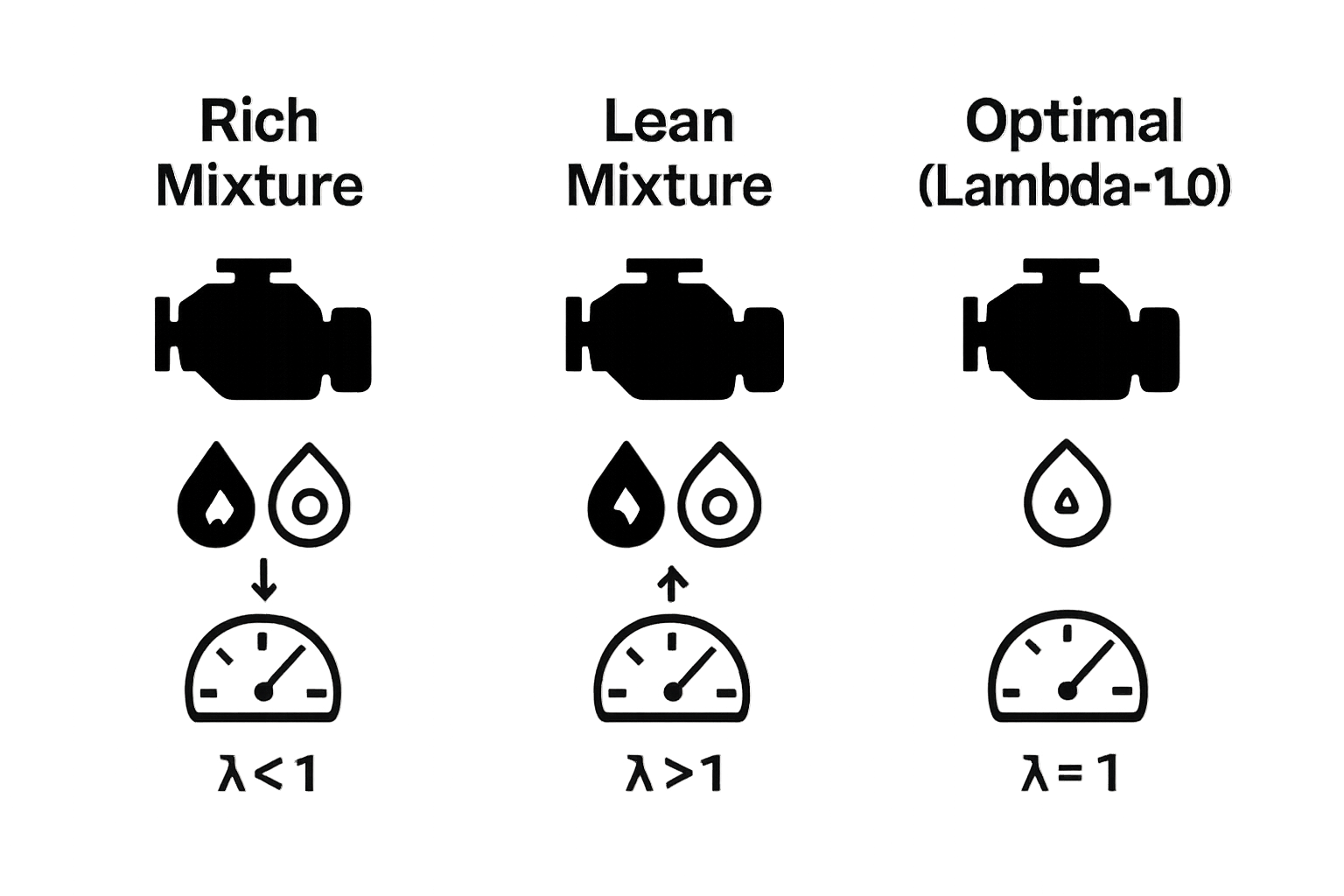
- Lambda values below 1.0 indicate a rich fuel mixture
- Lambda values above 1.0 represent a lean air mixture
- Precise lambda control enables optimal engine performance and reduced emissions
Performance and Tuning Implications
Professional automotive tuners leverage lambda measurements to fine-tune engine performance. By precisely controlling the air-fuel ratio, they can optimize fuel efficiency, enhance power output, and reduce unnecessary emissions. For those interested in diving deeper into vehicle performance techniques, read more about wideband tuning solutions.
The lambda measurement is not just a theoretical concept but a practical tool for automotive engineers and performance enthusiasts to understand and improve engine combustion dynamics. Through careful analysis and adjustment of lambda values, tuners can unlock significant improvements in vehicle performance, fuel economy, and overall engine efficiency.
Why Lambda Measurements Matter for Tuning Cars
Lambda measurements are far more than just technical numbers automotive professionals track. They represent a critical diagnostic and optimization tool that directly impacts vehicle performance, fuel efficiency, and environmental sustainability.
Critical Performance Parameters
In automotive tuning, lambda measurements provide an immediate window into the engine’s combustion efficiency. By precisely tracking the air-fuel mixture ratio, tuners can make granular adjustments that transform vehicle performance. According to the U.S. Department of Energy, lambda sensors enable closed-loop fuel control, allowing real-time monitoring that is essential for meeting strict emissions standards and achieving peak engine optimization.
Key performance implications of lambda measurements include:
- Detecting potential mechanical issues before they become serious problems
- Enabling precise fuel system calibration
- Providing immediate feedback on combustion dynamics
- Supporting advanced emissions control strategies
Economic and Environmental Implications
Beyond pure performance metrics, lambda measurements have profound economic and environmental significance. Precise air-fuel ratio control leads to reduced fuel consumption, lower emissions, and enhanced engine longevity. Professional tuners recognize that even minor adjustments based on lambda readings can yield substantial improvements in overall vehicle efficiency.
For automotive enthusiasts looking to dive deeper into performance optimization techniques, check out our beginner’s guide to ECU tuning, which explores how lambda measurements integrate into comprehensive vehicle performance strategies.
Ultimately, lambda measurements represent the language of engine efficiency. By understanding and responding to these precise ratios, automotive professionals can unlock remarkable improvements in vehicle performance, transforming raw mechanical potential into intelligent, responsive automotive engineering.
How Does the Lambda Sensor Function and Affect Combustion?
Lambda sensors, also known as oxygen sensors, are sophisticated electronic devices that play a critical role in modern automotive engine management systems. They serve as the engine’s primary feedback mechanism for monitoring and regulating the air-fuel mixture during combustion.
Operational Mechanics of Lambda Sensors
At its core, a lambda sensor operates by measuring the oxygen concentration in the exhaust stream, which provides a direct indication of the combustion process efficiency.
The sensor generates an electrical voltage that varies based on the difference between the oxygen levels in the exhaust gases and the ambient air. According to research on on-board diagnostics, this voltage signal allows the Engine Control Unit (ECU) to make real-time adjustments to the fuel injection system.
Key functional characteristics of lambda sensors include:
The following table summarizes the main characteristics and functions of lambda sensors as described in the article, making it easier to understand their role in modern engine management.
| Feature | Description |
|---|---|
| Primary Function | Measures oxygen concentration in exhaust gases |
| Key Output | Generates electrical voltage for ECU feedback |
| Response Time | Rapid, enabling real-time adjustments |
| Environmental Resistance | Designed to operate in extreme engine temperatures |
| Impact on Combustion | Enables microsecond-level air-fuel ratio corrections |
- Continuous monitoring of exhaust oxygen levels
- Rapid response to changes in air-fuel mixture
- Precise electrical signal generation
- Temperature-resistant design for extreme engine conditions
Impact on Engine Combustion Dynamics
The lambda sensor’s primary function extends beyond simple measurement. It actively influences combustion efficiency by providing instantaneous feedback that enables the ECU to make microsecond-level adjustments to fuel delivery. This constant optimization process ensures that the engine operates at its most efficient point, balancing performance, fuel economy, and emissions control.
For automotive enthusiasts interested in understanding deeper aspects of vehicle performance, our comprehensive guide to ECU tuning offers insights into how sensors like lambda contribute to advanced engine management.
Ultimately, lambda sensors represent a critical bridge between mechanical engine systems and intelligent electronic control. By translating complex combustion chemistry into actionable electrical signals, these sensors enable modern engines to achieve unprecedented levels of efficiency, performance, and environmental responsibility.
Key Concepts Behind Lambda Values and Air-Fuel Ratio
The relationship between lambda values and air-fuel ratios represents a fundamental principle in automotive engineering, providing a precise mathematical framework for understanding combustion efficiency and engine performance optimization.
Theoretical Foundation of Lambda
Lambda is a dimensionless numerical representation that compares the actual air-fuel mixture to the ideal stoichiometric ratio. Research examining vehicle emissions reveals that only a small percentage of vehicles maintain optimal lambda values, underscoring the complexity of achieving perfect combustion conditions.
Key components of lambda calculation include:
- Comparing actual air-fuel ratio to theoretical ideal mixture
- Providing a standardized measurement across different engine configurations
- Enabling precise performance and emissions analysis
- Facilitating advanced engine management strategies
Practical Implications for Engine Performance
Understanding lambda values goes beyond theoretical calculations. These measurements directly influence fuel efficiency, power output, and environmental impact. Professional tuners use lambda data to make intricate adjustments that transform engine behavior. For automotive enthusiasts seeking deeper insights into vehicle optimization, explore our guide on tuning for fuel economy.
The lambda value acts as a universal language for engine performance, translating complex combustion dynamics into a single, interpretable number. By mastering these principles, automotive professionals can unlock unprecedented levels of engine efficiency, bridging the gap between mechanical design and intelligent performance optimization.

Real-World Applications of Lambda in Automotive Tuning
Lambda measurements transcend theoretical calculations, serving as a critical diagnostic and optimization tool across diverse automotive applications. From racing performance to emissions control, lambda analysis provides invaluable insights into engine behavior and efficiency.
Performance Tuning and Optimization
According to the Clemson Vehicular Electronics Laboratory, lambda sensors play a fundamental role in understanding and improving engine performance. Professional tuners utilize lambda measurements to make precise adjustments that unlock an engine’s full potential, enabling fine-tuned modifications across various driving conditions.
Key real-world lambda tuning applications include:
- Racing performance optimization
- Fuel efficiency improvements
- Emissions system diagnostics
- Custom engine mapping for specialized vehicles
- Performance vehicle calibration
Diagnostic and Regulatory Compliance
Beyond performance enhancement, lambda measurements are crucial for meeting stringent emissions regulations. Modern automotive systems rely on these precise measurements to ensure vehicles operate within prescribed environmental standards. For enthusiasts seeking deeper insights into vehicle data management, explore our comprehensive guide to automotive data logging.
Professional automotive engineers recognize lambda analysis as a sophisticated language of engine performance. By translating complex combustion dynamics into actionable data, lambda measurements bridge the gap between mechanical engineering and intelligent vehicle optimization, enabling unprecedented levels of automotive precision and efficiency.
Ready to Unlock Peak Engine Performance with Accurate Lambda Control?
Are you struggling to achieve precise air-fuel ratios and optimal combustion? The article has shown how critical lambda values are for professional tuning, fuel efficiency, and reliable engine power. If you have ever faced issues with inconsistent lambda readings or complex ECU management, you know how frustrating it can be to hit your desired performance targets.

Now is the perfect time to take advantage of ECUFlashFiles.com for your next vehicle tuning project. Our trusted platform offers verified ECU files and comprehensive performance tuning solutions that help you master lambda adjustments with confidence. Discover how efficient ECU file management directly supports accurate lambda measurement and seamless air-fuel ratio optimization. Don’t let missed tuning opportunities slow you down. Visit our website today to get professional support, instant file delivery, and proven results for your next ECU calibration.
Frequently Asked Questions
What is the lambda value in automotive tuning?
The lambda value is a dimensionless ratio that indicates how close an engine’s air-fuel mixture is to the ideal stoichiometric ratio. A lambda value of 1.0 signifies perfect combustion.
How does a lambda sensor function in an engine?
A lambda sensor measures the concentration of oxygen in the exhaust gases, providing feedback to the Engine Control Unit (ECU) to adjust the air-fuel mixture for optimal combustion efficiency.
What are the implications of having a lambda value below or above 1.0?
A lambda value below 1.0 indicates a rich fuel mixture, which can lead to increased emissions and decreased fuel efficiency.
To clarify how different lambda values affect engine performance, efficiency, and emissions, the table below compares lambda conditions and their practical impacts.
| Lambda Value | Mixture Type | Engine Impact | Fuel Efficiency | Emissions Impact |
|---|---|---|---|---|
| Below 1.0 | Rich | Increased power, sluggish | Lower | Higher HC and CO emissions |
| 1.0 (Stoichiometric) | Balanced | Optimal combustion | Best balance | Lowest overall, meets standards |
| Above 1.0 | Lean | Possible misfire, less power | Higher (to a point) | Increased NOx, incomplete burning |
| Conversely, a value above 1.0 indicates a lean mixture, which can improve fuel efficiency but may result in incomplete combustion. |
Why are lambda measurements important for emissions control?
Lambda measurements are critical for ensuring vehicles meet emissions standards. They enable real-time adjustments to the fuel system, helping to minimize harmful emissions and improve overall engine performance.