
Professional automotive tuning is no longer a guessing game. With modern ECU systems growing more complex, tuners need more than just experience to navigate the endless data streams. Damos files can map over 1,000 separate engine parameters in a single vehicle, but most people have never even heard of them. The real surprise? These mysterious files are not just helpful guides—they are often the only way experts can safely unlock a car’s hidden performance potential without risking disaster.
Table of Contents
- Defining Damos Files: What They Are And Their Role
- The Importance Of Damos Files In Automotive Tuning
- How Damos Files Work: Structure And Information
- Applications Of Damos Files In Performance Enhancement
- Real-World Implications Of Using Damos Files For Tuners
Quick Summary
| Takeaway | Explanation |
|---|---|
| Damos files aid ECU tuning | They provide crucial mapping for interpreting complex binary data in engine management systems. |
| Precision in performance modifications | Damos files define exact memory locations and conversion rules, allowing targeted enhancements without damaging integrity. |
| In-depth diagnostic capabilities | These files facilitate detailed analysis of engine systems, identifying inefficiencies and optimization potential. |
| Systematic approach to tuning | Damos files help address challenges in performance modification by delivering structured insights into ECU configurations. |
| Risk management in tuning | They enable safe adjustments by documenting modification parameters and maintaining compliance with manufacturer standards. |
Defining Damos Files: What They Are and Their Role
A Damos file represents a specialized definition file critical in automotive engine control unit (ECU) tuning and calibration processes. These files serve as essential mapping documents that provide detailed instructions and reference points for interpreting complex binary data within vehicle engine management systems.
Understanding Damos File Architecture
Damos files function as comprehensive metadata repositories that describe precise memory locations, data structures, and configuration parameters within an ECU’s programming. Automotive engineers and professional tuners rely on these files to understand intricate details about how specific engine parameters are stored and interpreted by the vehicle’s computer system.
The fundamental architecture of a Damos file includes several key components:
- Memory address mappings for specific engine control parameters
- Data type definitions for different sensor and performance measurements
- Scaling and conversion rules for raw sensor data
- Reference points for calibration and optimization processes
Technical Significance in ECU Tuning
In the realm of automotive performance optimization, Damos files play a pivotal role by enabling precise interpretation of binary data streams. According to automotive engineering research, these definition files allow technicians to decode complex ECU configurations with unprecedented accuracy.
Professional tuners utilize Damos files to:
- Identify specific memory locations controlling engine performance
- Understand intricate relationships between sensor inputs and engine parameters
- Develop targeted modifications for enhancing vehicle performance
- Ensure safe and controlled adjustments to engine management systems
By providing a structured approach to understanding ECU data, Damos files transform raw binary information into actionable insights for automotive performance enhancement. Their role extends beyond simple data interpretation, representing a critical bridge between complex electronic systems and precise engineering modifications.
The Importance of Damos Files in Automotive Tuning
Damos files represent a critical component in modern automotive engineering, enabling sophisticated engine performance optimization through precise data interpretation and mapping. These specialized files bridge the complex gap between raw electronic data and actionable performance insights, transforming how automotive professionals approach vehicle tuning and calibration.
Precision Performance Mapping
In automotive engineering, precision is paramount. Damos files provide an unprecedented level of granular detail about engine control parameters, allowing technicians to understand and manipulate intricate system behaviors. By defining exact memory locations, data types, and conversion rules, these files enable targeted modifications that can significantly enhance vehicle performance without compromising system integrity.
Key performance mapping capabilities include:
- Pinpointing specific memory addresses controlling critical engine functions
- Establishing accurate scaling and conversion mechanisms for sensor data
- Creating reproducible performance optimization strategies
- Developing standardized approaches to ECU configuration
Advanced Diagnostic and Modification Capabilities
According to automotive systems research, Damos files are instrumental in developing sophisticated diagnostic and modification techniques. Professional tuners leverage these files to conduct deep analysis of engine control systems, identifying potential performance bottlenecks and optimization opportunities.
The diagnostic advantages of Damos files extend to:
- Comprehensive system parameter tracking
- Detailed performance trend analysis
- Identification of potential mechanical or electronic inefficiencies
- Development of custom performance profiles
For those looking to dive deeper into automotive data management, learn more about advanced ECU tuning techniques. Understanding Damos files represents a critical step in mastering modern automotive electronic systems, offering professionals and enthusiasts unprecedented insights into vehicle performance optimization.
How Damos Files Work: Structure and Information
Damos files are sophisticated data definition structures that serve as critical translation mechanisms between raw binary information and comprehensible engine control parameters. These complex files act as sophisticated mapping documents that enable precise interpretation of electronic control unit (ECU) data, transforming intricate binary sequences into meaningful performance insights.
Internal Data Architecture
The internal structure of a Damos file represents a meticulously organized framework designed to capture and represent complex engine management information. Each file contains multiple layers of metadata that describe memory addresses, data types, scaling factors, and conversion rules with extraordinary precision.
To help readers quickly understand the internal structure and components of Damos files, the table below summarizes their key elements and brief explanations as described in the article.
| Component | Description |
|---|---|
| Memory Address References | Pointers to exact locations in ECU memory for engine control parameters |
| Data Type Definitions | Specifications for how different data and sensor values are represented |
| Scaling and Conversion Algorithms | Rules for interpreting and converting raw sensor or system data into useful metrics |
| Metadata for Sensor Inputs | Information on the expected ranges for each sensor input |
| Vehicle Configuration Information | Details specific to vehicle model and calibration settings |
Key structural components of a Damos file include:
- Memory address references for specific engine parameters
- Detailed data type definitions
- Scaling and conversion algorithms
- Metadata describing sensor input ranges
- Configuration information for specific vehicle models
Data Interpretation Mechanisms
According to automotive systems engineering research, Damos files utilize complex algorithmic approaches to translate raw binary data into actionable performance metrics. These files function as critical interpretation layers that allow automotive professionals to understand and manipulate intricate electronic system configurations.
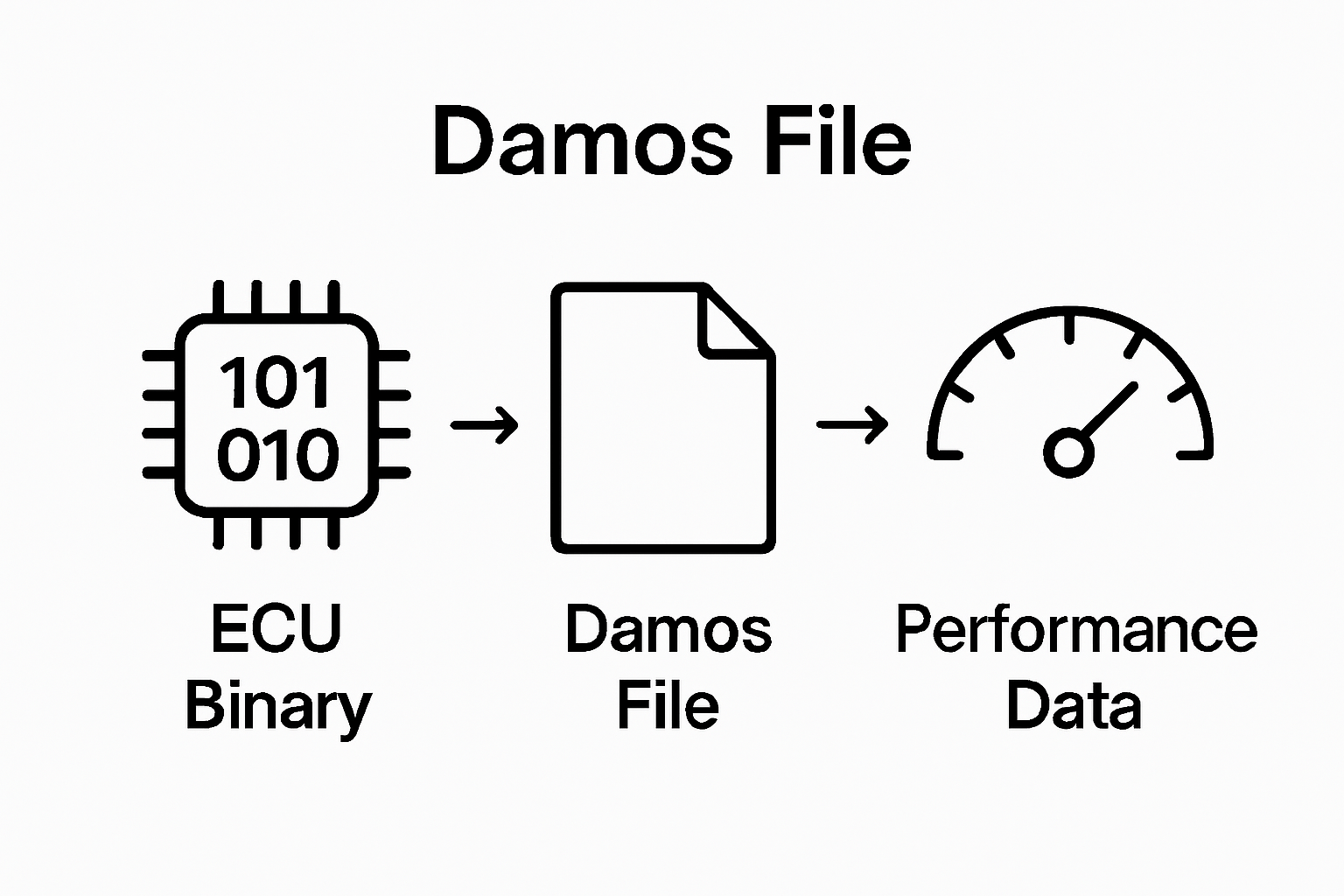
The data interpretation process involves:
- Parsing binary information through predefined translation rules
- Mapping memory locations to specific performance parameters
- Converting raw sensor data into standardized measurement units
- Identifying potential performance optimization opportunities
Professional tuners and automotive engineers rely on these files to decode the complex language of modern vehicle electronic systems. Explore advanced ECU tuning techniques to gain deeper insights into how these sophisticated data mapping processes transform raw electronic information into precise performance enhancements.
Applications of Damos Files in Performance Enhancement
Damos files serve as powerful tools in automotive performance engineering, enabling sophisticated modifications and optimizations across various vehicle systems. These specialized definition files provide unprecedented insights into engine control unit (ECU) configurations, allowing professional tuners to unlock hidden performance potential through precise, data-driven interventions.
Performance Calibration Strategies
Professional automotive engineers leverage Damos files to develop targeted performance enhancement strategies that go beyond traditional tuning approaches. By mapping intricate relationships between sensor inputs, mechanical parameters, and electronic control systems, these files enable nuanced adjustments that can significantly improve vehicle dynamics without compromising mechanical integrity.
Key performance calibration capabilities include:
- Optimizing fuel injection timing and duration
- Adjusting turbocharger boost pressure parameters
- Fine-tuning ignition timing across different engine loads
- Modifying air-fuel mixture ratios for improved combustion efficiency
Advanced Performance Optimization Techniques
According to automotive systems engineering research, Damos files facilitate complex performance modifications by providing granular control over electronic system behaviors. Professional tuners can implement sophisticated optimization techniques that adapt vehicle performance characteristics to specific driving conditions and performance requirements.
Performance enhancement methods utilizing Damos files encompass:
- Creating custom performance profiles for different driving environments
- Implementing adaptive learning algorithms for continuous optimization
Explore advanced ECU modification techniques to understand how these sophisticated definition files transform vehicle performance engineering. The strategic application of Damos files represents a cutting-edge approach to automotive performance enhancement, offering unprecedented precision and control in electronic system modifications.
Real-World Implications of Using Damos Files for Tuners
Damos files represent a transformative technology in automotive performance engineering, providing professional tuners with sophisticated tools to unlock complex vehicle performance potential. These specialized definition files bridge theoretical optimization concepts with practical, actionable modifications across diverse automotive platforms.
Professional Performance Modification Challenges
Professional automotive tuners encounter multiple complex challenges when attempting to modify vehicle performance. Damos files offer a systematic approach to addressing these technical barriers by providing precise, granular insights into electronic control unit (ECU) configurations and system behaviors.
Critical challenges addressed by Damos files include:
The table below outlines the main challenges professional tuners face during performance modification and how Damos files address each challenge, providing a clear side-by-side comparison for greater clarity.
| Tuning Challenge | How Damos Files Address the Challenge |
|---|---|
| Complex Manufacturer-Specific ECU Architectures | Provide detailed mapping and decoding for different ECU layouts |
| Safe Operational Parameter Boundaries | Enable precise parameter adjustments within safe limits |
| Reproducibility of Performance Enhancements | Deliver structured, systematic modification instructions |
| Long-Term Mechanical Risk Mitigation | Document safe modification limits, reducing chance of damage |
- Navigating complex manufacturer-specific ECU architectures
- Ensuring modifications remain within safe operational parameters
- Developing reproducible performance enhancement strategies
- Mitigating potential long-term mechanical risks during tuning
Risk Management and Technical Precision
According to automotive systems engineering research, Damos files enable professional tuners to implement modifications with unprecedented technical precision. These definition files serve as comprehensive reference documents that dramatically reduce the potential for mechanical damage or unintended performance consequences.
Key risk management considerations involve:
- Documenting precise modification parameters
- Establishing clear performance modification boundaries
- Creating verifiable optimization protocols
- Maintaining manufacturer warranty compliance
Explore comprehensive automotive tuning strategies to understand how professional tuners leverage these sophisticated definition files. The strategic application of Damos files represents a sophisticated approach to performance enhancement, offering automotive professionals a methodical framework for safe and effective vehicle modifications.

Unlock Data Precision with Verified Damos Files for Every Tuning Challenge
Are you struggling to decode ECU data or searching for the right Damos files to make precise and safe tuning adjustments? As highlighted in this article, the complexity of modern ECUs can make interpretation and calibration difficult without the right mapped data. Errors in file selection or faulty interpretation put both performance and reliability at risk. Using verified Damos files and streamlined search solutions is crucial for any tuner or enthusiast looking to confidently enhance performance, reduce risk, and save time.

Now is the ideal time to level up your tuning projects with resources trusted by professionals worldwide. At ECUFlashFiles.com, you get instant access to tested Damos files, original and performance ECU data, and a support team ready to help you find exactly what you need. Ready to overcome uncertainty and achieve pinpoint results? Visit ECUFlashFiles.com to search, download, and boost your next tuning session with confidence. If you want to learn more before taking the next step, check out our guide on comprehensive automotive tuning strategies for additional tips and insights.
Frequently Asked Questions
What is a Damos file and how is it used in ECU tuning?
A Damos file is a specialized definition file used in automotive engine control unit (ECU) tuning. It provides detailed metadata about memory locations, data structures, and configuration parameters within an ECU, enabling precise interpretation and modification of engine performance data.
Why are Damos files important for automotive engineers and tuners?
Damos files are crucial because they allow engineers and tuners to decode complex ECU configurations with high accuracy, facilitating targeted modifications that can enhance vehicle performance while ensuring safe operation.
What does the internal structure of a Damos file consist of?
The internal structure of a Damos file includes memory address references for engine parameters, detailed data type definitions, scaling and conversion algorithms, and metadata about sensor input ranges, all organized meticulously for accurate data interpretation.
How do Damos files aid in performance calibration and optimization?
Damos files enable advanced performance calibration by allowing tuners to optimize critical parameters like fuel injection timing, turbocharger boost pressure, and ignition timing, ensuring that modifications improve vehicle performance without compromising system integrity.
Recommended
- A Compact Guide to ECU Reading & Chiptuning Tool Fundamentals – Ecu flash files
- ECU Tuning for Beginners: Essential Guide for 2025 – Ecu flash files
- How to Read ECU Data: Step-by-Step Guide for Tuners – Ecu flash files
- ECU Tuned File | stage 1 | VW Transporter Bosch EDC17CP20 EDC17 CB.03.15.00 C34.00 1.0 03L906022CD