
Every modern car owes its smooth ride and power to the ECU and this tiny computer controls hundreds of functions behind the scenes. Most people never realize that some vehicles now rely on up to 100 separate ECUs working together. You might think accessing all that data requires a degree in rocket science. The surprise is anyone with the right approach and tools can actually read and decode ECU data like a pro.
Table of Contents
- Understanding ECU Data And Its Importance
- Tools And Software Needed To Read ECU Data
- Step-By-Step Process To Access ECU Data
- Common Data Parameters And Their Meanings
Quick Summary
| Takeaway | Explanation |
|---|---|
| ECUs are crucial for vehicle performance | Electronic Control Units manage multiple systems to optimize engine efficiency and safety. Understanding them is essential for tuners. |
| Use advanced diagnostic tools for analysis | Specialized hardware and software are necessary for accessing and interpreting ECU data accurately. Proper tools enhance diagnosis and performance insights. |
| Follow a systematic data access process | Establishing secure connections and following a structured method for data extraction ensures accurate and meaningful information retrieval from ECUs. |
| Master performance and diagnostic parameters | Knowing key metrics like engine speed and fuel injection timing helps professionals identify issues and optimize vehicle capabilities effectively. |
| Continual learning is vital in ECU tuning | The automotive industry evolves rapidly, requiring professionals to stay updated on new technologies and interpretation techniques to maintain effective tuning practices. |
Understanding ECU Data and Its Importance
Electronic Control Units (ECUs) represent the digital brain of modern vehicles, transforming automotive technology through precise electronic management. Understanding ECU data has become crucial for automotive professionals seeking to optimize vehicle performance and diagnostics.
The Critical Role of ECU in Modern Vehicles
ECUs monitor and control multiple vehicle systems simultaneously, functioning as sophisticated computational networks that process complex information in milliseconds. Research from the academic community highlights that these electronic systems manage time-sensitive communications critical to vehicle operation, encompassing everything from engine performance to safety features.
Modern vehicles contain multiple ECUs responsible for different subsystems. These microcomputers collect and analyze data from numerous sensors, making real-time decisions that impact engine efficiency, emissions control, and overall vehicle performance. According to automotive diagnostic experts, ECUs continuously monitor parameters like engine temperature, fuel injection, ignition timing, and air-fuel mixture to ensure optimal functionality.
Decoding the Importance of ECU Data Analysis
Professional tuners and automotive technicians recognize that reading ECU data provides invaluable insights into a vehicle’s health and performance potential. By understanding these electronic signals, professionals can diagnose issues, optimize engine characteristics, and unlock performance improvements.
The data transmitted through ECUs includes critical information such as:
- Sensor Readings: Real-time measurements of temperature, pressure, and other environmental factors
- Performance Metrics: Engine load, RPM, throttle position, and fuel consumption
- Error Codes: Diagnostic trouble codes indicating potential mechanical or electrical problems
Automotive technology resources emphasize that ECUs play a transformative role in modern vehicle safety and efficiency. They support advanced driver-assistance systems, improve fuel economy, and enable precise engine management.
Advanced ECU Data Interpretation Techniques
Successful ECU data reading requires specialized knowledge and tools. Professional tuners must understand the intricate communication protocols, data structures, and interpretation methods unique to different vehicle manufacturers. This process involves using advanced diagnostic tools, understanding manufacturer-specific data formats, and translating raw electronic signals into actionable performance insights.
To effectively read ECU data, professionals need comprehensive knowledge of automotive electronics, programming interfaces, and real-time data analysis techniques. Learn more about ECU tuning fundamentals to develop a deeper understanding of these complex systems.
By mastering ECU data interpretation, automotive professionals can unlock unprecedented levels of vehicle performance, diagnose complex issues more efficiently, and provide targeted optimization solutions that transform automotive engineering approaches.
Tools and Software Needed to Read ECU Data
Reading ECU data requires specialized tools and software that enable automotive professionals to access, interpret, and analyze complex electronic vehicle systems. The right equipment can transform raw electronic signals into actionable performance insights.
Professional Diagnostic Interfaces
Automotive professionals rely on multiple diagnostic interfaces to read ECU data effectively. Research from automotive technology experts highlights the importance of wireless and wired diagnostic systems that can capture and transmit vehicle parameters with precision.
Key diagnostic tools include:
Here’s a table summarizing the key diagnostic tools and software platforms used for reading ECU data, along with their main features and purposes. This helps readers quickly compare options discussed in the article.
| Tool/Software | Main Features/Protocols | Primary Purpose |
|---|---|---|
| OBD II Readers | Standard diagnostic interface, basic data retrieval | Basic diagnostics |
| Advanced Scan Tools | Support multiple manufacturers, detailed analysis | In-depth diagnostics |
| Professional Diagnostic Platforms | High-end, extensive data analysis capabilities | Comprehensive diagnostics and tuning |
| INCA (ETAS) | Supports CAN, ETK, Ethernet, FlexRay protocols | Measurement & calibration |
| CANoe (Vector Informatik) | Supports multiple vehicle bus systems, deep insights | ECU network development and analysis |
- OBD II Readers: Standard diagnostic interfaces that provide basic vehicle data
- Advanced Scan Tools: Comprehensive devices supporting multiple vehicle manufacturers
- Professional Diagnostic Platforms: High-end systems with extensive data analysis capabilities
The INCA software developed by ETAS represents a sophisticated measurement and calibration platform widely used in automotive engineering. This tool supports various ECU interfaces including CAN, ETK, Ethernet, and FlexRay communication protocols, enabling detailed data capture and analysis.
Software Platforms for ECU Data Analysis
Sophisticated software platforms are essential for interpreting ECU data. CANoe, developed by Vector Informatik, stands out as a comprehensive solution for ECU network development and analysis. These platforms support multiple vehicle bus systems and provide deep insights into electronic control unit performance.
Professional software platforms typically offer:
- Real-time data streaming
- Advanced diagnostic trouble code interpretation
- Performance mapping and analysis
- Customizable reporting features
Explore our comprehensive guide to chiptuning tools to understand the nuanced world of ECU data reading equipment.
Specialized Hardware Requirements
Successful ECU data reading demands specific hardware configurations. Professionals need high-speed computers with robust processing capabilities, specialized interface modules, and reliable communication adapters compatible with various vehicle manufacturers.
Critical hardware components include:
- High-performance laptop or desktop computer
- Universal ECU reading interfaces
- Stable power supply systems
- Secure data storage solutions
Investing in quality tools ensures accurate ECU data reading, prevents potential system errors, and provides reliable performance insights. Automotive professionals must continuously update their equipment to match evolving vehicle technologies and communication protocols.
By understanding and utilizing these advanced tools and software, tuners can unlock comprehensive vehicle performance data, diagnose complex issues, and develop targeted optimization strategies that push automotive technology forward.
Step-by-Step Process to Access ECU Data
Accessing ECU data requires a systematic approach that combines technical knowledge, precise equipment, and careful procedural execution. Professional tuners must follow a structured method to extract accurate and meaningful information from vehicle electronic control units.
Preliminary ECU Connection Setup
Before initiating data retrieval, professionals must establish a secure and compatible connection between diagnostic tools and the vehicle’s ECU system. Research from automotive engineering studies highlights the importance of using standardized protocols and understanding the specific communication interfaces of different vehicle manufacturers.
Key preparation steps include:
- Verifying vehicle compatibility with diagnostic tools
- Ensuring stable electrical connections
- Checking interface cable integrity
- Confirming diagnostic tool firmware is up to date
Data Extraction and Interpretation Techniques
Successful ECU data access involves multiple intricate stages. Learn more about ECU system fundamentals to understand the complexity of these electronic systems.
Professional data extraction typically follows these critical stages:
Below is a step-by-step process table outlining the key stages of accessing and analyzing ECU data, as described in the article. Use this as a procedural reference when working with ECUs.
| Step | Procedure | Purpose |
|---|---|---|
| 1 | Connect OBD II or diagnostic interface | Establish hardware connection |
| 2 | Initialize communication protocol | Enable data transfer with ECU |
| 3 | Select data parameters for retrieval | Choose relevant metrics to monitor |
| 4 | Configure data logging settings | Set up collection of needed information |
| 5 | Capture and record electronic signals | Gather ECU data for analysis |
| 6 | Analyze retrieved information | Interpret data to diagnose and optimize |
- Connect OBD II or specialized diagnostic interface
- Initialize communication protocol
- Select specific data parameters for retrieval
- Configure data logging settings
- Capture and record electronic signals
- Analyze retrieved information
Understanding the A2L (Asam MCD-2 MC) file format is crucial. This standardized format contains comprehensive details about measurement and calibration variables, enabling precise data interpretation across different vehicle platforms.
Advanced Data Verification and Analysis
After successfully accessing ECU data, automotive professionals must implement rigorous verification and analysis protocols. This stage involves cross-referencing retrieved information with manufacturer specifications, identifying potential anomalies, and interpreting complex electronic signals.
Critical analysis techniques include:
- Comparing current data against baseline performance metrics
- Identifying potential sensor discrepancies
- Detecting intermittent electronic signal variations
- Generating comprehensive diagnostic reports
Professional tuners must develop a systematic approach that combines technical expertise, sophisticated diagnostic tools, and meticulous data interpretation skills. The process demands continuous learning and adaptation to evolving automotive electronic technologies.
By mastering these step-by-step techniques, automotive professionals can unlock deep insights into vehicle performance, diagnose complex electronic system issues, and develop targeted optimization strategies that push the boundaries of automotive engineering.
Common Data Parameters and Their Meanings
Understanding ECU data parameters is crucial for automotive professionals seeking to optimize vehicle performance and diagnose complex mechanical issues. These electronic signals provide comprehensive insights into a vehicle’s operational characteristics, enabling precise tuning and maintenance strategies.
Core Performance Metrics
Research from the Federal Highway Administration highlights the essential ECU parameters that professionals must monitor. These critical metrics offer a comprehensive view of vehicle performance and operational health.
Key performance parameters include:

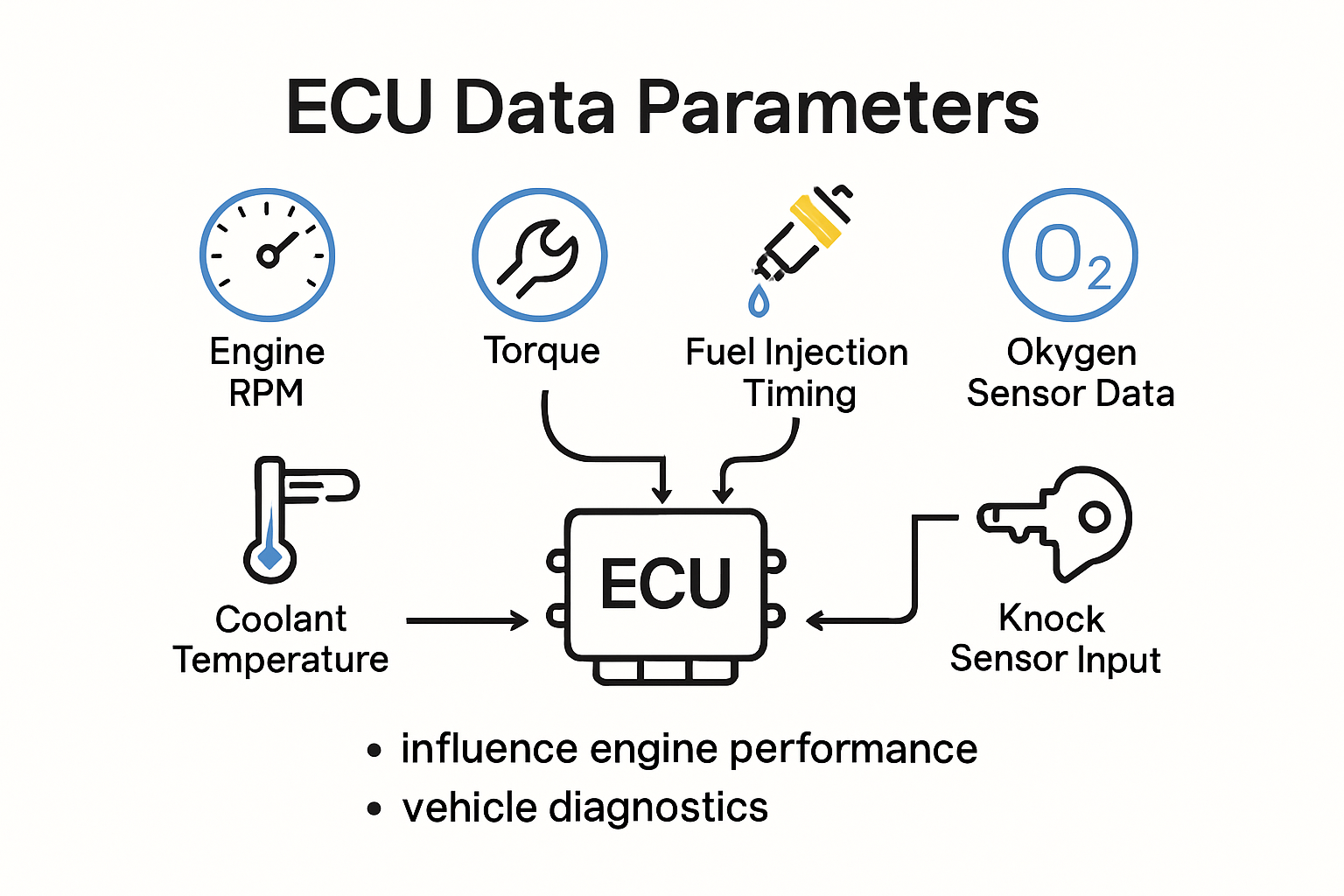
- Engine Speed (RPM): Indicates current engine rotation rate and performance
- Engine Torque: Measures rotational force generated by the engine
- Fuel Injection Timing: Tracks precise fuel delivery moments
- Air-Fuel Ratio: Monitors combustion mixture efficiency
European Union regulations specify critical parameters such as engine coolant temperature and torque output, emphasizing the importance of comprehensive data monitoring for vehicle optimization.
Diagnostic and Environmental Parameters
Beyond performance metrics, ECU data provides crucial diagnostic information that helps identify potential mechanical issues and environmental influences. Vehicle energy research demonstrates the significance of tracking comprehensive vehicle parameters for advanced diagnostic and optimization purposes.
Critical diagnostic parameters include:
- Oxygen Sensor Readings: Indicates combustion efficiency
- Coolant Temperature: Monitors engine thermal management
- Intake Air Temperature: Tracks environmental conditions affecting performance
- Knock Sensor Data: Detects potential engine detonation risks
Explore advanced ECU tuning techniques to understand how these parameters interact and influence overall vehicle performance.
Advanced Signal Interpretation Techniques
Interpreting ECU data requires more than simply reading numeric values. Professional tuners must understand the complex relationships between different parameters, recognizing how changes in one metric can cascade through the vehicle’s electronic systems.
Advanced interpretation techniques involve:
- Establishing baseline performance metrics
- Identifying anomalous signal patterns
- Correlating multiple parameter changes
- Understanding manufacturer-specific data encoding
Professional automotive technicians must develop a nuanced understanding of these electronic signals, transforming raw data into actionable performance insights. This process requires continuous learning, sophisticated diagnostic tools, and a deep comprehension of automotive electronic systems.
By mastering these data parameters and their intricate meanings, automotive professionals can unlock unprecedented levels of vehicle performance optimization, ensuring precise tuning and proactive maintenance strategies that push the boundaries of automotive engineering.
Frequently Asked Questions
What is ECU data and why is it important?
ECU data refers to the information managed by Electronic Control Units in vehicles. It is crucial for diagnosing vehicle performance, optimizing engine characteristics, and ensuring efficient operations.
What tools are needed to read ECU data?
To read ECU data, you need specialized diagnostic interfaces like OBD II readers, advanced scan tools, and professional diagnostic platforms, alongside robust software for data analysis and a compatible computer setup.
How do you establish a connection to the ECU?
To establish a connection to the ECU, verify vehicle compatibility with your diagnostic tool, ensure stable electrical connections, and initialize the appropriate communication protocol before data retrieval can commence.
What are some common data parameters in ECU data analysis?
Common data parameters include engine speed (RPM), engine torque, fuel injection timing, air-fuel ratio, oxygen sensor readings, and coolant temperature, each providing insights into vehicle performance and diagnostics.
Ready to Turn ECU Data Into Real Results?
You have just learned how important precise ECU data reading is for unlocking a car’s true performance and solving diagnostic challenges. But after following all the technical steps, you might still face one of the biggest hurdles: finding trusted, high-quality ECU files that actually deliver results. Many tuners struggle with unverified files, incomplete DAMOS data, or hard-to-find original calibrations. This can waste your time and risk the health of your projects. If you want tested, professional ECU solutions that match your specific car make, model, and tuning goals, you need a partner who understands the difference thorough tuning files can make.
Stop guessing with your next calibration. Visit ECUFlashFiles.com for instant access to a huge library of factory and performance ECU files, DAMOS calibration data, and expert support. Confidently remap or recover any ECU using proven files trusted by professionals worldwide. Ready to transform your workshop? Explore verified ECU files now and give your next tuning project the advantage it deserves.
Recommended
- ECU Tuning for Beginners: Essential Guide for 2025 – Ecu flash files
- How Does ECU Work? 2025 Guide for Car Performance – Ecu flash files
- A Compact Guide to ECU Reading & Chiptuning Tool Fundamentals – Ecu flash files
- ECU Tuned File | stage 1 | VW Transporter Bosch EDC17CP20 EDC17 CB.03.15.00 C34.00 1.0 03L906022CD