
Remapping can turn an ordinary car into a powerhouse and it is all done with a few lines of code. Most people expect you need new parts or expensive upgrades to squeeze out extra horsepower but the real magic comes from tweaking the vehicle’s software itself. In fact, remapping an ECU can increase both horsepower and fuel efficiency without touching a single bolt under the hood and this surprising shift can leave even seasoned drivers rethinking everything they thought they knew about performance upgrades.
Table of Contents
- What Is Remapping And How Does It Work?
- The Importance Of Understanding Remapping Risks
- Key Effects Of Remapping On Vehicle Performance
- The Role Of Engine Components In Remapping Outcomes
- Real-World Implications Of Remapping On Car Longevity
Quick Summary
| Takeaway | Explanation |
|---|---|
| Professional tuning is essential for remapping. | Expert knowledge is crucial to ensure engine reliability and avoid mechanical failure during ECU modifications. |
| Understand insurance implications before remapping. | Modifying the ECU can affect warranty coverage and insurance claims, so communicate with your provider beforehand. |
| Remapping enhances performance but introduces risks. | While it increases horsepower and efficiency, incorrect modifications can lead to engine wear and reliability issues. |
| Consider mechanical limits associated with remapping. | Each engine part has inherent constraints that affect performance improvements; tuning must align with these limits. |
| Regular maintenance post-remapping is vital. | Keeping up with maintenance helps sustain performance and minimizes potential mechanical degradation after modifications. |
What is Remapping and How Does It Work?
Remapping, also known as ECU tuning, represents a sophisticated process of modifying a vehicle’s Electronic Control Unit (ECU) software to optimize engine performance and efficiency. According to research published in the Journal of Physics Conference Series, this process can dramatically enhance vehicle capabilities by reprogramming critical engine parameters.
Understanding Electronic Control Units
At its core, an ECU functions as the vehicle’s central computer system. This sophisticated electronic brain manages multiple critical functions including:
- Fuel injection timing
- Ignition spark control
- Boost pressure regulation
- Throttle response management
- Emissions control systems
During remapping, automotive technicians access this system to adjust these parameters, effectively “teaching” the engine to perform differently without physically modifying hardware components.
The Remapping Process
Remapping involves carefully rewriting the manufacturer’s default software configuration with customized programming. Technicians use specialized diagnostic tools to connect directly to the vehicle’s OBD (On Board Diagnostics) port, downloading the existing ECU file and then modifying its internal mapping.
Key modifications typically focus on:
- Increasing horsepower and torque
- Improving fuel efficiency
- Enhancing throttle response
- Adjusting transmission shift points
While remapping offers significant performance potential, professionals recommend understanding the complete process before implementation. Each vehicle requires unique calibration, making expert intervention crucial to prevent potential mechanical complications.
The process demands precision. A single miscalculation could potentially compromise engine reliability, underscoring the importance of working with experienced automotive tuning specialists who understand intricate software and mechanical interactions.
The Importance of Understanding Remapping Risks
While ECU remapping offers exciting performance potential, understanding its inherent risks is crucial for responsible vehicle modification. According to research from Sumandeep University, vehicle modifications can significantly impact insurance coverage and overall vehicle reliability.
Potential Insurance and Warranty Implications
Remapping introduces several critical considerations that vehicle owners must carefully evaluate. Insurance providers often view ECU modifications as substantial changes that alter a vehicle’s original specifications. This perspective can lead to serious consequences:
- Potential invalidation of manufacturer warranties
- Increased insurance premiums
- Possible denial of claims related to engine damage
- Complications with comprehensive vehicle coverage
Professional automotive experts strongly recommend transparent communication with insurance providers before attempting any ECU modifications.
To clarify insurance and warranty issues related to ECU remapping, the following table summarizes the main impacts and considerations for car owners considering modifications.
| Issue | Potential Impact | Recommended Action |
|---|---|---|
| Manufacturer Warranty | May be invalidated if ECU is modified | Consult dealer or manufacturer before remapping |
| Insurance Premiums | Potentially increased due to alteration of vehicle | Notify insurance provider and review policy terms |
| Insurance Claim Denial | Possible denial of engine-related claims | Ensure modifications are disclosed to insurer |
| Coverage Complications | Difficulties securing comprehensive coverage | Request written confirmation from provider if unsure |
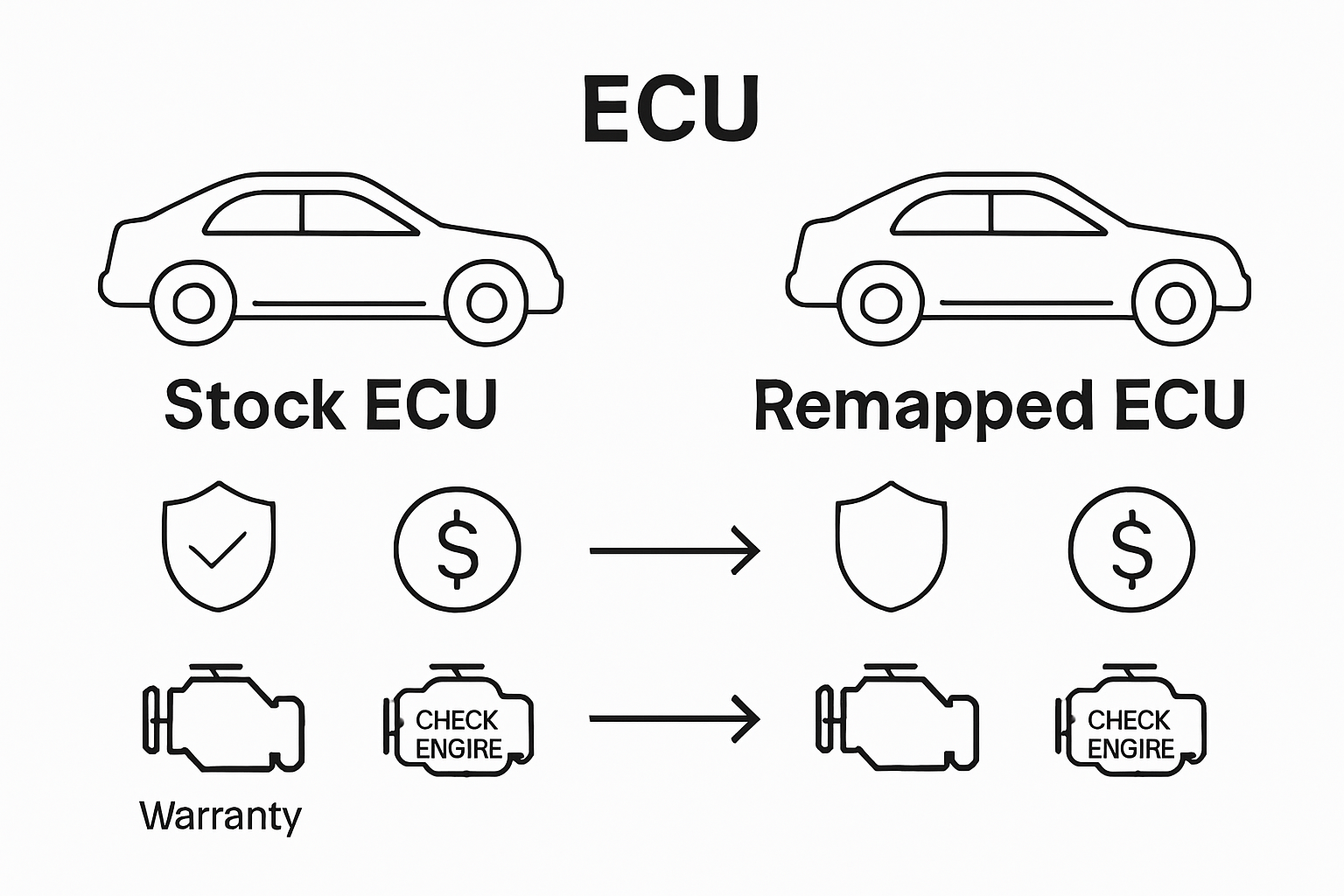 Exploring the full scope of remapping consequences can help prevent unexpected financial and legal complications.
Technical and Performance Risks
Beyond insurance concerns, remapping presents several technical risks that could compromise vehicle performance and longevity. Improper ECU modifications can potentially:
- Accelerate engine component wear
- Reduce overall engine reliability
- Compromise fuel efficiency
- Increase thermal stress on mechanical components
- Potentially void manufacturer performance guarantees
The precision required for successful remapping demands expert knowledge. A miscalculation in fuel mapping, boost pressure, or ignition timing could transform a performance enhancement into an expensive mechanical failure.
The following table breaks down several key risks associated with ECU remapping, providing a clear overview of technical and performance concerns that car owners should consider.
| Risk Factor | Description |
|---|---|
| Engine Component Wear | Accelerates wear on internal engine parts |
| Reduced Engine Reliability | Increases likelihood of malfunction or breakdown |
| Compromised Fuel Efficiency | May lead to higher fuel consumption if mapping is incorrect |
| Increased Thermal Stress | Raises operating temperatures and strains engine materials |
| Potential Warranty Voiding | Modifications may not be covered by manufacturer guarantees |
Vehicle owners must recognize that while remapping offers performance benefits, it simultaneously introduces complex technical challenges that require professional expertise and comprehensive understanding.
Key Effects of Remapping on Vehicle Performance
Remapping fundamentally transforms a vehicle’s performance characteristics by strategically reprogramming the Electronic Control Unit (ECU). According to guidelines from the Code of Federal Regulations, precise engine mapping is critical for maintaining optimal performance and compliance.
Performance Enhancement Mechanisms
Remapping operates through sophisticated software modifications that recalibrate multiple engine parameters. These adjustments enable vehicles to unlock additional performance potential without physical hardware modifications. Key performance enhancement areas include:
- Increased horsepower output
- Enhanced torque delivery
- Improved throttle response
- More efficient fuel consumption
- Optimized transmission shift points
Understanding the nuanced performance implications helps vehicle owners make informed decisions about potential modifications.
Dynamic Performance Impact
The performance transformation through remapping extends beyond simple numerical improvements. Automotive engineers carefully adjust intricate software parameters to create a more responsive and engaging driving experience. These modifications can significantly alter:
- Acceleration characteristics
- Engine responsiveness
- Power band distribution
- Overall driving dynamics
- Fuel efficiency optimization
While performance gains are attractive, vehicle owners must recognize that each modification represents a delicate balance between enhanced capabilities and potential mechanical stress. Professional tuning remains essential to ensure these software adjustments complement the vehicle’s existing mechanical architecture without compromising long-term reliability.
The Role of Engine Components in Remapping Outcomes
Engine components interact intricately during remapping, creating complex performance dynamics that extend far beyond simple software modifications. According to research published in PubMed, electronic component interactions can dramatically influence vehicle performance and emissions.
Critical Component Interactions
Remapping success depends on the harmonious interaction between electronic and mechanical systems. Key engine components that significantly impact remapping outcomes include:
- Fuel injection systems
- Turbocharger mechanisms
- Exhaust gas recirculation (EGR) valves
- Mass airflow sensors
- Oxygen sensors
- Electronic throttle control units
Understanding these intricate component relationships helps prevent potential performance disruptions during remapping processes.
Mechanical Stress and Performance Limitations
Each engine component possesses inherent mechanical limitations that can restrict remapping potential. While software modifications can optimize performance parameters, they cannot fundamentally overcome physical engineering constraints. Critical considerations include:
- Original manufacturing tolerances
- Material structural integrity
- Thermal management capabilities
- Mechanical wear and aging
- Original design performance envelopes
Professional tuners must carefully evaluate these mechanical constraints to ensure that remapping modifications align with the vehicle’s fundamental engineering design, preventing potential catastrophic component failures or accelerated mechanical degradation.
Here is a summary of key engine components that interact with software tuning and the physical limitations that may restrict remapping potential.
| Engine Component | Role in Remapping Outcome | Limitation or Risk |
|---|---|---|
| Fuel Injection System | Controls precise fuel delivery | Over-enrichment can cause carbon buildup |
| Turbocharger Mechanism | Manages boost pressure for power | Excess boost can damage turbo components |
| EGR Valve | Regulates emissions and combustion efficiency | Incorrect mapping may increase emissions |
| Oxygen/Mass Airflow Sensors | Monitors and controls air-fuel mixture | Sensor failure can disrupt performance |
| Electronic Throttle Control | Manages acceleration response | Poor calibration can cause throttle lag |
Real-World Implications of Remapping on Car Longevity
Remapping represents a nuanced intervention with profound consequences for vehicle performance and long-term reliability. According to research from Purdue University, advanced electronic systems play a critical role in monitoring engine health and maintaining optimal performance throughout a vehicle’s lifecycle.
Wear and Degradation Factors
Remapping introduces complex mechanical stressors that can accelerate vehicle component deterioration. Key longevity considerations include:
- Increased thermal stress on engine components
- Elevated mechanical wear rates
- Potential premature failure of critical systems
- Accelerated component fatigue
- Reduced margin of mechanical safety
Exploring comprehensive performance implications helps vehicle owners understand the intricate balance between performance enhancement and mechanical sustainability.
Long-Term Performance Sustainability
While remapping offers immediate performance gains, its sustained impact on vehicle longevity requires meticulous evaluation. Professional tuners must consider multiple interconnected factors:
- Original manufacturer design tolerances
- Component material durability
- Frequency and intensity of performance modifications
- Regular maintenance practices
- Driving conditions and environmental factors
Successful remapping demands a holistic approach that balances performance optimization with preserving the vehicle’s fundamental mechanical integrity. Vehicle owners must recognize that aggressive modifications can potentially compromise long-term reliability, necessitating a nuanced and measured approach to electronic performance tuning.

Protect Your Car with Verified ECU Remapping Solutions
Worried that ECU remapping could harm your car, void your warranty, or put your engine at unnecessary risk? The article highlighted how remapping comes with serious concerns about insurance, mechanical reliability, and long-term performance. Instead of risking your vehicle to unreliable files or accidental mistakes, why not safeguard your investment with professional support?

Turn worry into peace of mind. Choose ECUFlashFiles.com for tested and verified ECU files created by experts with over 20 years of experience. Whether you need original, tuned, or DAMOS files for safer remapping, our platform helps you find exact matches by make, model, and engine type. See how our secure file search and delivery system gives you both confidence and control. Visit our homepage right now to get started, and experience the difference reliable ECU file management makes.
Frequently Asked Questions
Can remapping damage my car?
Remapping can potentially damage your car if not done correctly. Improper ECU modifications can lead to accelerated engine wear, reduced reliability, and compromised fuel efficiency. It’s essential to work with experienced automotive specialists to minimize risks.
What are the risks associated with ECU remapping?
The risks include potential invalidation of manufacturer warranties, increased insurance premiums, and possible denial of claims related to engine damage. Additionally, improper mapping could lead to mechanical failures or accelerated component wear.
Does remapping affect my vehicle’s warranty or insurance?
Yes, remapping may void manufacturer warranties as it alters the vehicle’s original specifications. It’s crucial to communicate with your insurance provider before modifications, as it can impact your coverage and premiums.
How does remapping impact vehicle performance?
Remapping can enhance vehicle performance by increasing horsepower, improving torque delivery, and optimizing throttle response. However, these enhancements must be balanced with the vehicle’s original design constraints to avoid long-term reliability issues.