
A P0411 or P0491 code usually arrives without any driveability symptom. The engine runs fine, yet the warning lamp stays on and the “secondary air” readiness monitor never completes. To fix it first time, it helps to know what the secondary air injection system does in its short working life after each cold start, and how the engine control unit decides that it has failed.
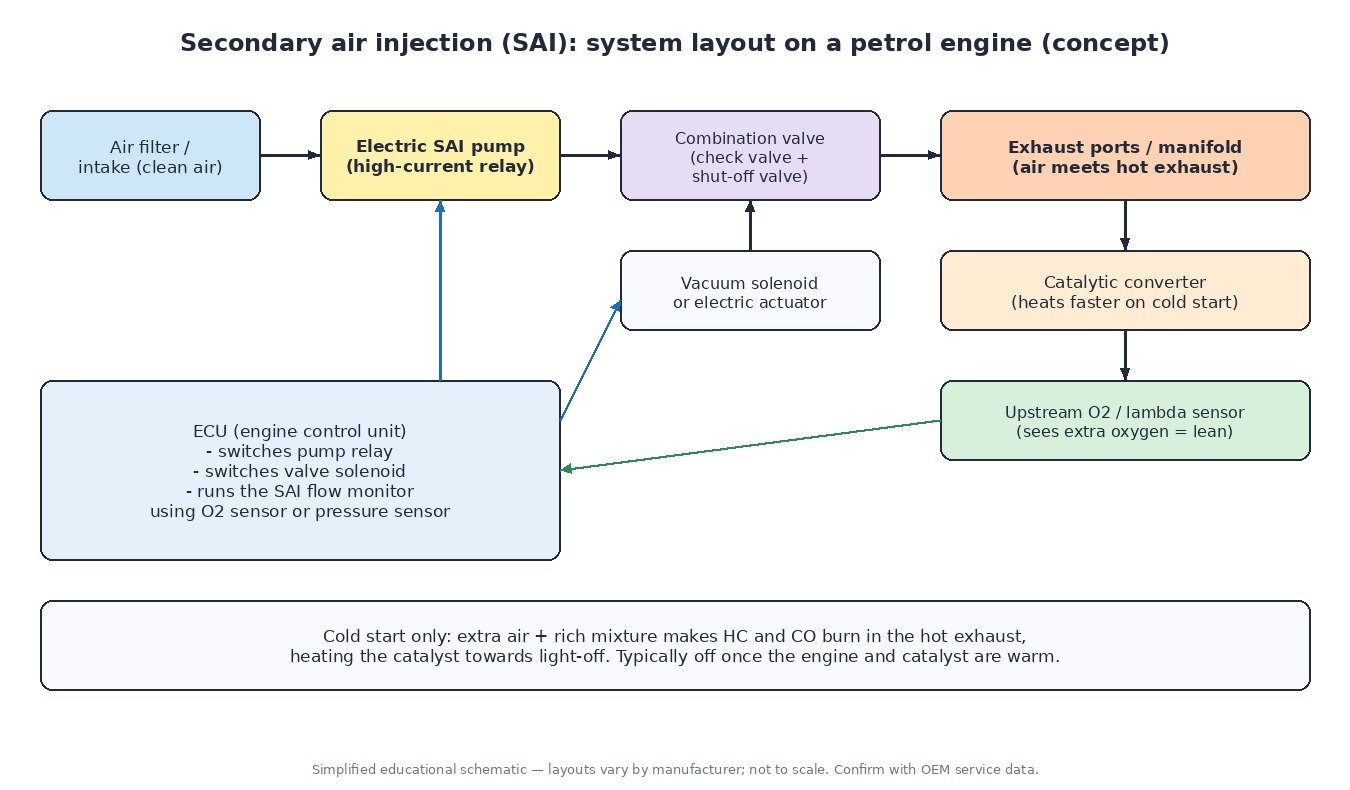
What secondary air injection does
For the first moments after a cold start a petrol engine runs slightly rich, and the catalytic converter is still below its working temperature. Secondary air injection (SAI, sometimes called AIR) blows filtered air into the exhaust ports or manifold. The extra oxygen burns off hydrocarbons and carbon monoxide in the hot exhaust, and the heat from that reaction brings the catalyst up to temperature sooner. Once the engine is warm the system is switched off and plays no further part in running the engine. For more on catalyst warm-up, see our P0420 catalyst diagnostics guide.
The parts you will be testing
- Electric air pump, fed through a fuse and relay controlled by the ECU.
- Combination valve: a shut-off valve with a built-in check valve that blocks exhaust backflow.
- Control solenoid: on most systems it switches vacuum to the combination valve; some valves are electric or pressure-opened.
- Hoses, pipes and head passages carrying air to each exhaust port.
- Sensors: the upstream oxygen sensor, plus a secondary air pressure sensor on some later designs.
How the ECU decides the system has failed
The ECU only runs secondary air inside a calibrated window: coolant and intake air within set temperatures, adequate battery voltage and, on some engines, a limit on altitude. During that run it checks whether air is actually reaching the exhaust.
On systems without a dedicated sensor, the ECU expects the upstream oxygen sensor to swing lean while the pump runs. A weak response sets an incorrect or insufficient flow code. Systems with a pressure sensor compare readings with the pump on and off and the valve open and closed, so they can separate a pump fault from a valve stuck open or stuck closed. Because the test depends on a cold start, a repair cannot be confirmed by a quick hot test drive.

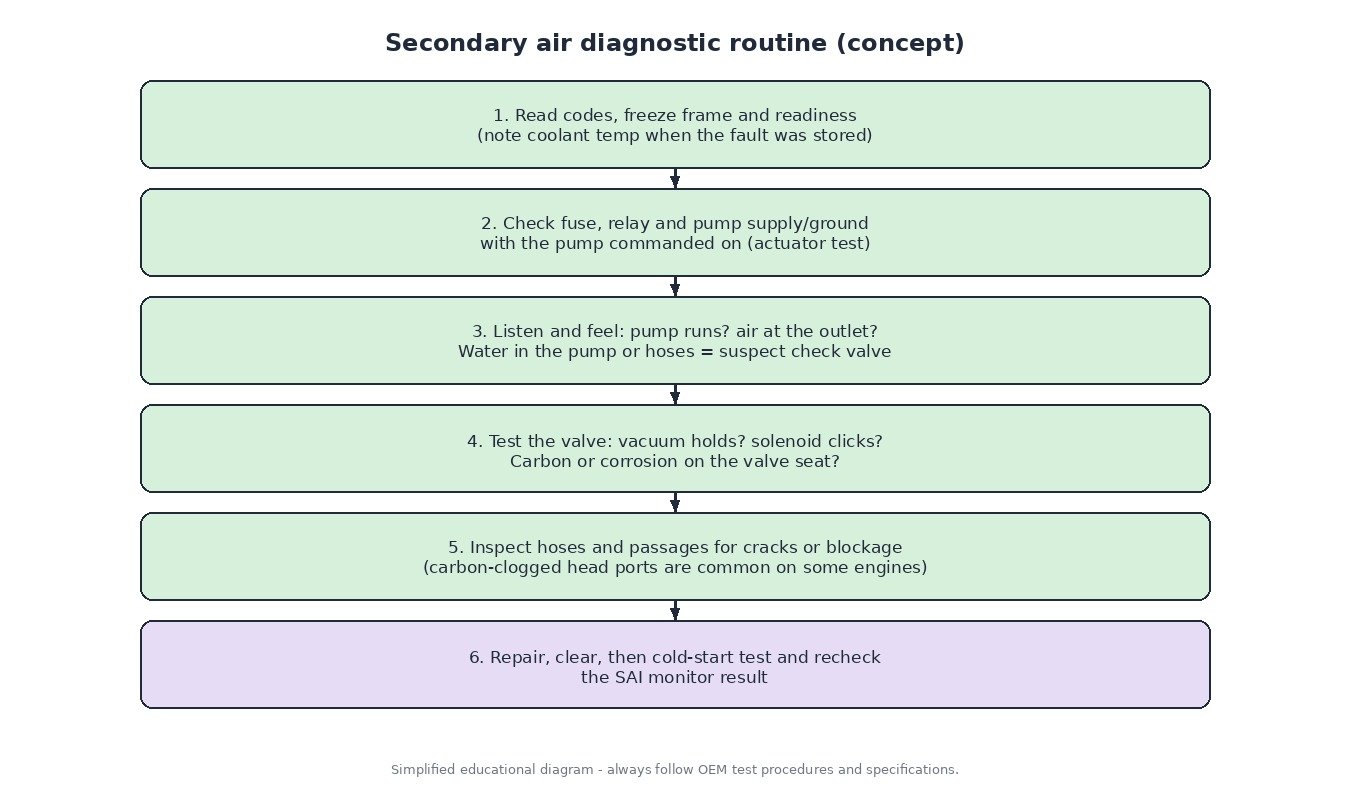
Step-by-step diagnosis
- Save the evidence. Read all codes, freeze frame and readiness before clearing. A fault logged at low coolant temperature confirms it was set during the SAI phase.
- Check the power side. Command the pump with an actuator test. Check the fuse and relay, and measure voltage at the pump connector while it is trying to run. A voltage drop under load points to a corroded connector or relay.
- Check the pump. It should run with a clear blowing noise. Disconnect the outlet hose and feel for flow. Water, rust or soot inside the hose means the check valve has been leaking exhaust back.
- Check the valve. With a hand vacuum pump, confirm the diaphragm holds vacuum and the valve opens. Confirm the solenoid switches vacuum when commanded. Valves seized with carbon are common.
- Check flow paths. If pump and valve both work but flow is still low, inspect the pipes and cylinder-head air channels for carbon blockage. On some engines this is the real cause.
- Prove the repair. Clear codes, leave the vehicle to cool fully, then cold start and let the monitor run. Recheck readiness and pending codes.
Symptoms worth knowing
- A loud whine or roar for a minute after cold start that suddenly gets quieter: normal pump operation.
- No pump noise at all on a cold start: fuse, relay, wiring or a seized pump.
- Lean codes at warm idle together with SAI codes: a combination valve that leaks air when it should be shut.
- Rattle or ticking near the valve: a damaged or carbon-loaded valve.
Differences across vehicle types
Cars and vans: widely used on petrol engines from the late 1990s and 2000s. Many newer engines heat the catalyst with ignition retard and injection strategies instead, so check whether the engine has SAI before ordering parts.
Pickups and light trucks: petrol versions often have it; heavy diesel trucks do not, since their aftertreatment uses DOC, DPF and SCR.
Tractors and machinery: almost all diesel, so SAI is not part of the system.
Motorcycles: many use a pump-less pulse air system with reed valves, often switched by an ECU-controlled solenoid on fuel-injected models. Leaking reeds or hoses can cause exhaust popping on overrun.
Before any ECU work
Always save a full original read so the ECU can be returned to its factory calibration. Secondary air is an emissions system: keep it fitted and working, and leave its control functions as the manufacturer intended. If SAI codes appear after programming, rule out the hardware first, then compare against the stock file.
Related fault codes (DTCs)
Generic OBD-II/EOBD codes (SAE J2012). Exact descriptions differ slightly by manufacturer; confirm with service data for the vehicle.
| Code | Meaning | Typical causes |
|---|---|---|
| P0410 | Secondary Air Injection System (malfunction) | General SAI fault: pump, valve, hoses, relay or wiring; read other stored SAI codes and freeze frame |
| P0411 | Secondary Air Injection System Incorrect Flow Detected | Weak or seized pump, stuck check/combination valve, cracked or disconnected hoses, carbon-blocked air passages |
| P0412 | Secondary Air Injection System Switching Valve A Circuit | Faulty vacuum/shut-off solenoid, damaged connector, open or shorted wiring, ECU driver fault |
| P0413 / P0414 | Secondary Air Injection System Switching Valve A Circuit Open / Shorted | Broken wire or connector, solenoid coil open or shorted, chafed harness |
| P0415 / P0416 / P0417 | Secondary Air Injection System Switching Valve B Circuit / Open / Shorted | Same as valve A, on systems with a second valve (for example, one per bank) |
| P0418 | Secondary Air Injection System Control “A” Circuit (pump relay A) | Failed pump relay, blown fuse, relay coil wiring fault, pump drawing excessive current |
| P0419 | Secondary Air Injection System Control “B” Circuit (pump relay B) | As P0418, on systems with a second pump or relay circuit |
| P0491 / P0492 | Secondary Air Injection System Insufficient Flow, Bank 1 / Bank 2 | Restricted hose or head passage on that bank, stuck valve, weak pump, exhaust leak, slow upstream O2 sensor |
| P2430 – P2433 | Secondary Air Injection System Air Flow/Pressure Sensor Circuit, Range/Performance, Low, High (Bank 1) | Faulty SAI pressure sensor, reference/ground wiring, blocked sensor port, or real flow problem seen as implausible pressure |
| P2440 / P2441 | Secondary Air Injection System Switching Valve Stuck Open / Stuck Closed, Bank 1 | Carbon, corrosion or moisture in the valve, failed diaphragm, vacuum supply leak; stuck open can let exhaust and water reach the pump |
| P2442 / P2443 | Secondary Air Injection System Switching Valve Stuck Open / Stuck Closed, Bank 2 | As P2440/P2441, on bank 2 |
| P2444 / P2445 | Secondary Air Injection System Pump Stuck On / Stuck Off, Bank 1 | Relay contacts welded or relay stuck (stuck on); seized pump, no power or ground, failed relay (stuck off) |
| P0171 / P0174 | System Too Lean, Bank 1 / Bank 2 | Not an SAI code itself, but a combination valve leaking air when it should be closed can add unmetered oxygen upstream of the O2 sensor |
Closing
Power, pump, valve, passages, then a real cold start: following that order fixes most secondary air faults without guesswork.
Need the original stock file for a specific ECU hardware and software number? Browse the ECUFlashFiles original file catalogue.