
A P0420 on the scan tool often ends with a new catalytic converter being ordered, and a few weeks later the same code comes back. In many cases the catalyst was a victim, not the cause. This guide looks at catalyst faults from the workshop side: how the ECU decides the converter is worn, what really kills catalysts and the checks to do before spending money on a replacement.
How the ECU judges the catalyst
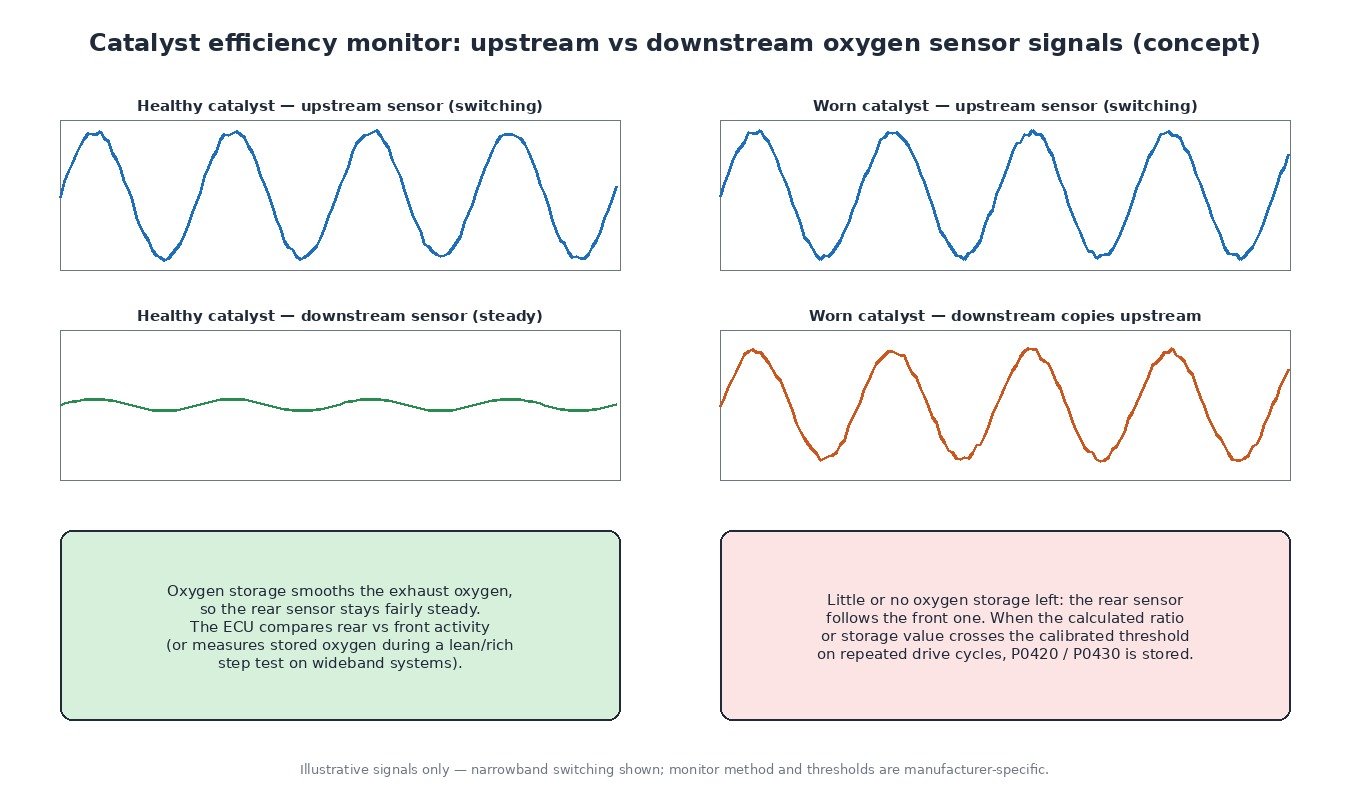
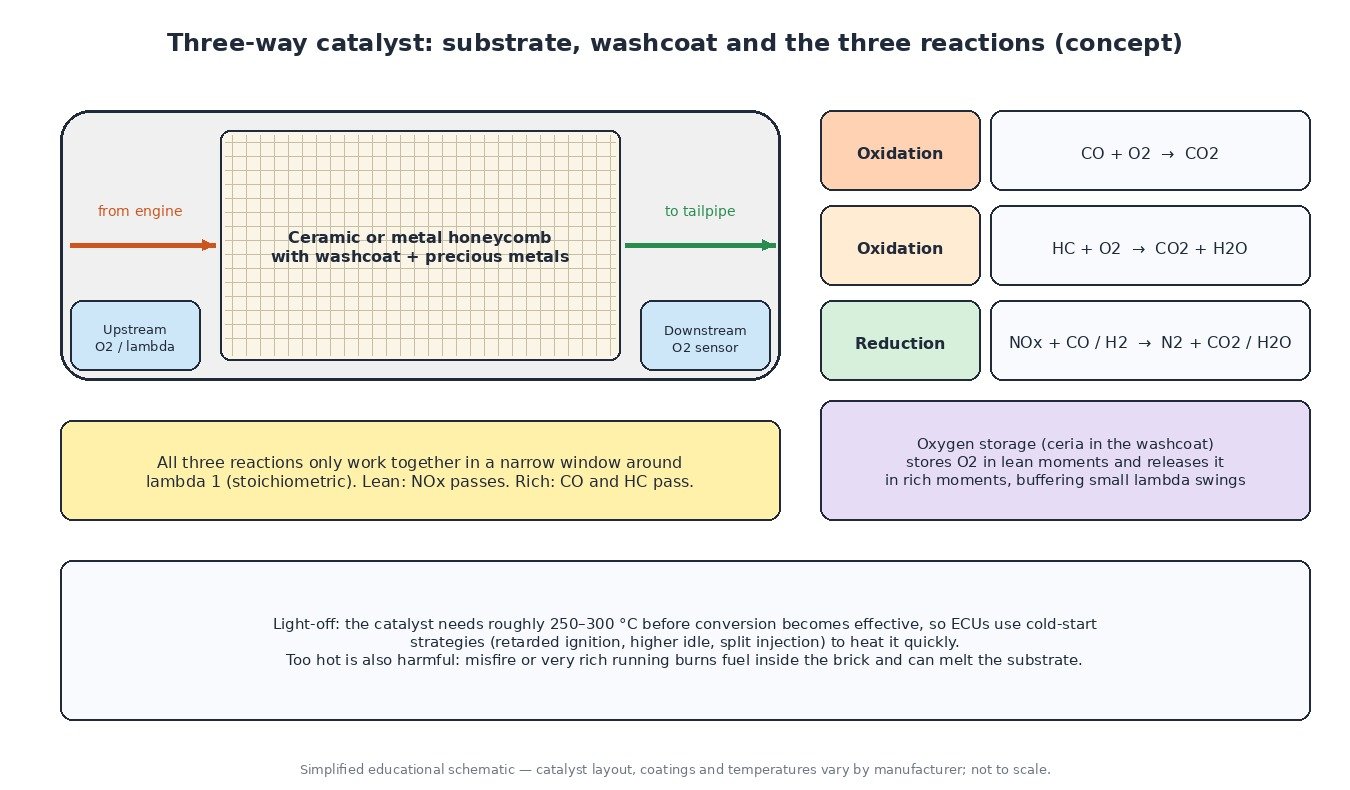
The ECU cannot measure CO, HC or NOx directly in most vehicles. Instead, it measures how well the catalyst stores oxygen. Inside the converter, the washcoat contains oxygen-storage materials that absorb oxygen when the mixture goes briefly lean and release it when the mixture goes briefly rich. With a healthy catalyst, the sensor after the converter therefore shows a fairly steady signal while the sensor before it moves up and down with the closed-loop fuelling.
As the catalyst ages, storage capacity drops and the rear signal starts to follow the front one. The ECU turns this into a number, either a comparison of the two signals’ activity on narrowband systems or a measured storage value after a commanded lean and rich step on wideband systems. If the number crosses the manufacturer’s threshold, usually on two drive cycles, P0420 (bank 1) or P0430 (bank 2) is stored.
The monitor only runs with a warm engine and stable cruise conditions, which is why the readiness status for the catalyst can take a while to complete after codes are cleared.
Why catalysts fail
- Misfire: unburnt fuel ignites inside the brick, overheats it and can melt the honeycomb. Even a short period of heavy misfire can do lasting damage.
- Rich running: leaking injectors, high fuel pressure or a faulty coolant temperature signal make the catalyst work hot and overloaded.
- Oil and coolant contamination: worn valve stem seals, piston rings, turbo seals or a head gasket leak coat the washcoat with ash and phosphorus or silicon compounds, which block the active surface.
- Mechanical damage: impact, thermal shock from water splash on a hot converter or a broken substrate rattling inside the housing.
- Age: precious metal and storage materials gradually lose activity over many kilometres or operating hours.
False P0420: when the catalyst is fine
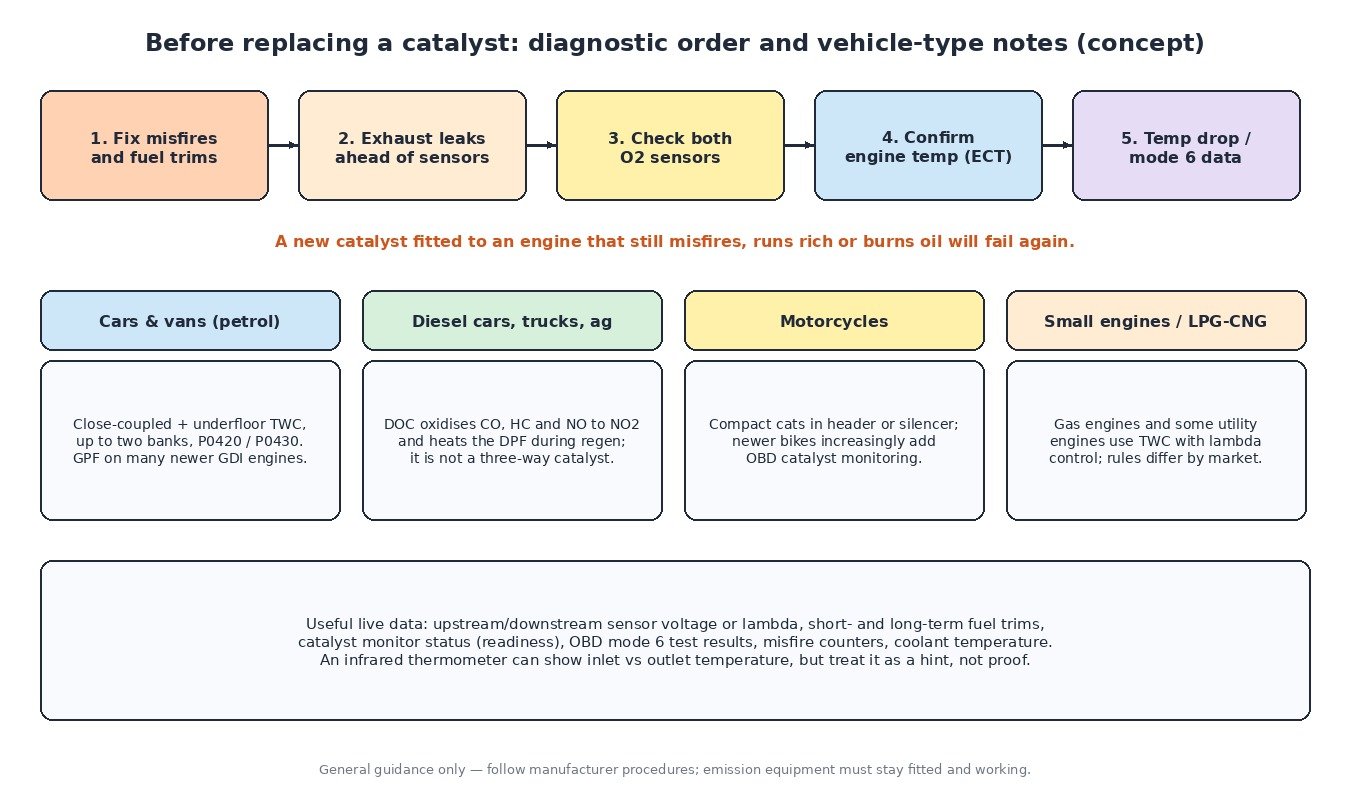
Before condemning the converter, rule out the things that fool the monitor:
- Exhaust leaks ahead of or near the rear sensor let air in, so the sensor sees extra oxygen and appears to switch.
- A slow or biased downstream sensor can give a misleading signal. Check it for response and heater operation.
- A wrong or low-quality aftermarket catalyst may have too little oxygen storage for the ECU’s threshold.
- An engine that never reaches temperature, for example because of a stuck-open thermostat, keeps the catalyst cool and can affect the monitor.
- Outdated software: some manufacturers have released ECU updates that revise catalyst monitoring. Check for a service campaign or technical bulletin.
Workshop diagnostic routine
- Read all codes and freeze frame. Fix misfire, fuel trim and sensor codes first.
- Check short and long-term fuel trims at idle and at around 2,500 rpm. Large corrections point to an engine problem upstream of the catalyst.
- Inspect and smoke test the exhaust for leaks from the manifold to the rear sensor.
- Log both oxygen sensors at a steady 2,500 rpm with a fully warm engine. A rear signal that mirrors the front points to low oxygen storage.
- Read OBD mode 6 test results for the catalyst monitor where available. They show the measured value against the limit, which tells you how close to the threshold the system is.
- Check for oil consumption, coolant loss and turbo oil leaks before fitting a new catalyst.
Diesels, trucks, tractors and bikes
Diesel cars, trucks and agricultural machines use a diesel oxidation catalyst (DOC) rather than a three-way catalyst. Its job is to oxidise CO and HC and to burn post-injected fuel that heats the particulate filter during regeneration. The ECU checks it with exhaust gas temperature sensors before and after the DOC: a DOC that does not produce the expected temperature rise during regeneration is flagged, often together with DPF regeneration problems. Faults are frequently caused by oil contamination or injector problems.
Fuel-injected motorcycles use compact catalysts in the header or silencer, and newer models increasingly have OBD catalyst monitoring. Misfire and rich running damage them in the same way as on cars.
After the repair
Clear codes, then drive the vehicle through the conditions the catalyst monitor needs and confirm the readiness status is complete. Keep the original ECU software as a reference: if a vehicle shows catalyst or emission faults after software work, restoring the matching original file is the starting point. The catalyst, DPF, EGR and AdBlue/SCR systems must remain fitted and working.
Related fault codes (DTCs)
Generic OBD-II codes (SAE J2012). Manufacturer wording varies.
| Code | Meaning | Typical causes |
|---|---|---|
| P0420 | Catalyst System Efficiency Below Threshold (Bank 1) | Aged or poisoned catalyst, exhaust leak ahead of the rear sensor, slow or biased downstream sensor, misfire or rich running history |
| P0421 | Warm Up Catalyst Efficiency Below Threshold (Bank 1) | Worn close-coupled catalyst, leak near the manifold, sensor fault |
| P0422 | Main Catalyst Efficiency Below Threshold (Bank 1) | Worn underfloor catalyst, exhaust leak, downstream sensor fault |
| P0423 | Heated Catalyst Efficiency Below Threshold (Bank 1) | Heated catalyst element or control fault, aged catalyst |
| P0424 | Heated Catalyst Temperature Below Threshold (Bank 1) | Catalyst heater circuit fault, catalyst not reaching temperature |
| P0425 | Catalyst Temperature Sensor (Bank 1) | Failed catalyst temperature sensor, wiring or connector fault |
| P0426 | Catalyst Temperature Sensor Range/Performance (Bank 1) | Implausible sensor reading, sensor drift, exhaust leak near the sensor |
| P0427 | Catalyst Temperature Sensor Circuit Low (Bank 1) | Short to ground, damaged sensor |
| P0428 | Catalyst Temperature Sensor Circuit High (Bank 1) | Open circuit, short to voltage, unplugged sensor |
| P0430 | Catalyst System Efficiency Below Threshold (Bank 2) | Same causes as P0420, on the bank 2 catalyst |
| P0431 | Warm Up Catalyst Efficiency Below Threshold (Bank 2) | Worn bank 2 close-coupled catalyst, leak, sensor fault |
| P0136 | O2 Sensor Circuit (Bank 1 Sensor 2) | Downstream sensor or wiring fault |
| P0137 | O2 Sensor Circuit Low Voltage (Bank 1 Sensor 2) | Exhaust leak pulling in air, short to ground, failed sensor |
| P0138 | O2 Sensor Circuit High Voltage (Bank 1 Sensor 2) | Short to voltage, sensor fault, very rich running |
| P0139 | O2 Sensor Circuit Slow Response (Bank 1 Sensor 2) | Aged or contaminated downstream sensor |
| P0141 | O2 Sensor Heater Circuit (Bank 1 Sensor 2) | Failed heater element, fuse, wiring or connector |
| P2096 | Post Catalyst Fuel Trim System Too Lean (Bank 1) | Exhaust leak, intake leak, low fuel pressure, downstream sensor bias |
| P2097 | Post Catalyst Fuel Trim System Too Rich (Bank 1) | Leaking injector, high fuel pressure, upstream sensor bias, purge fault |
| P2270 | O2 Sensor Signal Stuck Lean (Bank 1 Sensor 2) | Exhaust leak, failed sensor, wiring fault |
| P2271 | O2 Sensor Signal Stuck Rich (Bank 1 Sensor 2) | Rich running, sensor contamination, failed sensor |
| P0300 | Random/Multiple Cylinder Misfire Detected | Ignition, injection, compression or air leaks; unburnt fuel overheats and damages the catalyst |
| P0171 | System Too Lean (Bank 1) | Intake or vacuum leak, MAF contamination, low fuel pressure |
| P0172 | System Too Rich (Bank 1) | Leaking injectors, high fuel pressure, MAF or ECT fault |
| P0544 | Exhaust Gas Temperature Sensor Circuit (Bank 1 Sensor 1) | EGT sensor or wiring fault; affects catalyst and DPF temperature control on diesels |
Closing
Treat P0420 as a question about the whole engine, not only about the converter. Fix the cause first, then the catalyst lasts.
Need the original stock file for a specific ECU hardware and software number? Browse the ECUFlashFiles original file catalogue.