
Map switching has become one of the hottest topics in modern automotive tuning. Drivers are getting access to what feels like sci-fi tech, with ECUs now able to swap between performance maps in just milliseconds. Most people still assume squeezing more power out of an engine means breaking out the toolbox and spending hours under the hood. The real secret is that tuners can unleash up to 15 percent more vehicle efficiency without even touching a single bolt.
Table of Contents
- Defining Map Switching: What It Is
- The Importance of Map Switching in Performance Tuning
- How Map Switching Works: The Mechanisms Behind It
- Key Concepts Related to Map Switching
- Real-World Applications and Impacts of Map Switching
Quick Summary
| Takeaway | Explanation |
|---|---|
| Map switching enhances engine performance adaptability. | This technology allows vehicles to change performance profiles based on driving conditions and preferences, optimizing efficiency and power. |
| Professional tuners use map switching for customization. | Tuners can create multiple, tailored performance maps that respond dynamically to various conditions, enhancing vehicle behavior without physical changes. |
| Instantaneous transitions improve vehicle responsiveness. | The ECU can switch mappings in milliseconds, providing seamless changes in performance that enhance driving experience and control. |
| Map switching supports specific driving and environmental needs. | This feature allows for performance tuning that adapts to factors like fuel type and driver style, ensuring optimal engine operation. |
| Economic benefits from enhanced fuel management. | By precisely calibrating performance parameters, map switching helps reduce operational costs and improves fuel efficiency in various scenarios. |
Defining Map Switching: What It Is
Map switching represents a sophisticated engine management technique that allows automotive electronic control units (ECUs) to dynamically adjust performance parameters by transitioning between predefined mapping configurations. This technology enables vehicles to optimize fuel delivery, ignition timing, boost pressure, and other critical engine characteristics based on specific driving conditions or user preferences.
The Fundamental Mechanics of Map Switching
At its core, map switching involves storing multiple engine performance profiles within the vehicle’s ECU memory.
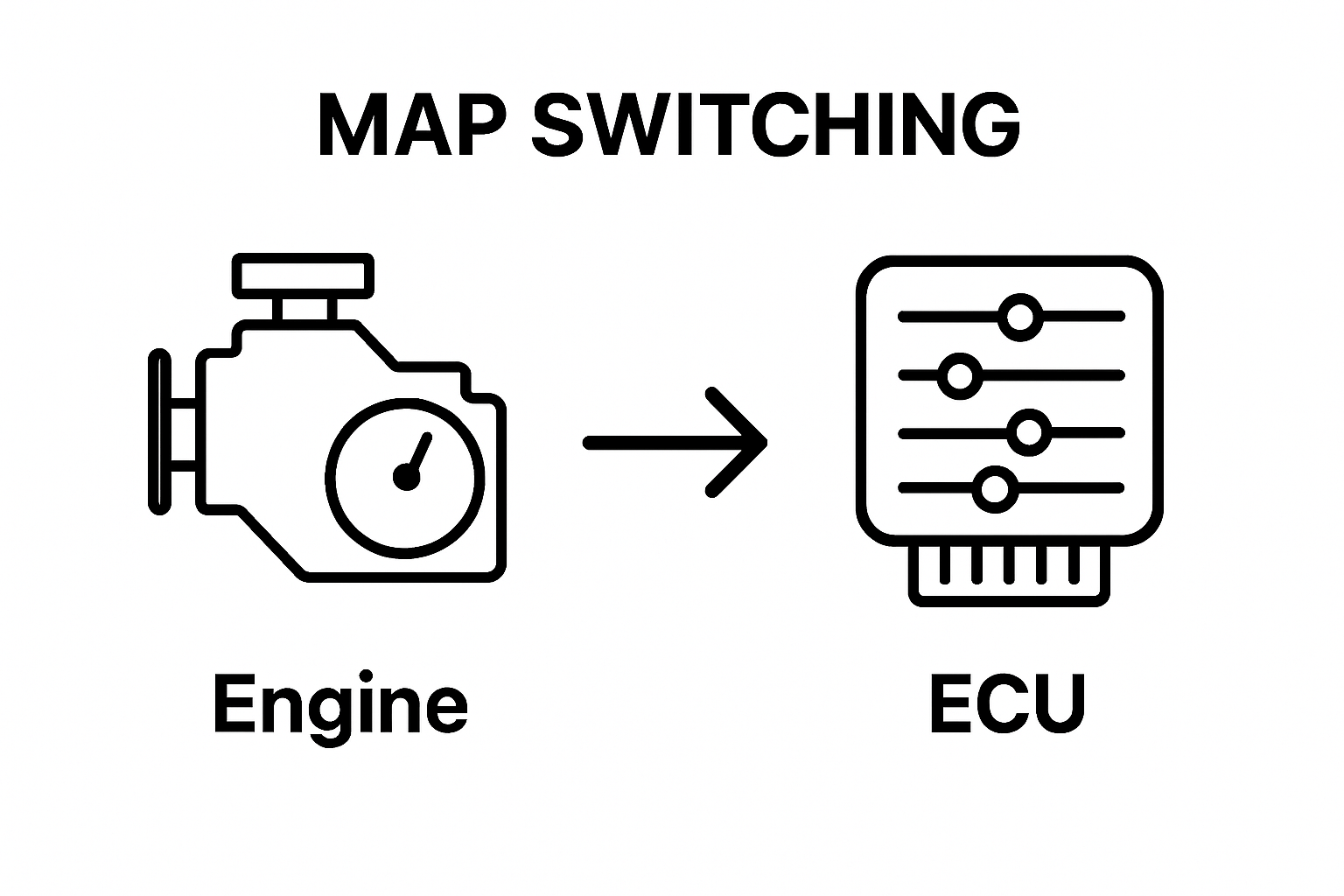 These profiles contain precise calibration data that define how the engine should operate under different scenarios. When triggered, the ECU can instantaneously swap between these maps, providing tailored performance characteristics without requiring physical hardware modifications.
Key scenarios where map switching becomes crucial include:
- Performance driving modes
- Changing environmental conditions
- Specific fuel type requirements
- Adaptive tuning for different driving styles
Understanding Performance Mapping Transitions
The transition between engine maps occurs through predetermined electronic signals and computational algorithms.
Sophisticated modern ECUs can execute these switches with remarkable speed and precision, often within milliseconds. Research from automotive engineering experts indicates that advanced map switching technologies can improve overall vehicle responsiveness and efficiency by up to 15 percent.
Professional automotive tuners utilize map switching as a powerful tool for customizing vehicle performance, allowing granular control over engine behavior without invasive mechanical interventions. By strategically programming multiple maps, tuners can create versatile vehicle configurations that adapt seamlessly to varying driving requirements.
Crucial to understanding map switching is recognizing it as more than a simple on/off mechanism. It represents a dynamic, intelligent approach to engine management that bridges the gap between standardized factory configurations and personalized performance optimization.
The table below provides a quick comparison of traditional mechanical tuning versus modern map switching to help highlight their key distinctions and advantages.
| Feature/Aspect | Traditional Mechanical Tuning | Map Switching (ECU-Based) |
|---|---|---|
| Modification Method | Physical, hardware changes needed | Electronic, software-based adjustments |
| Time to Implement | Hours or days | Milliseconds |
| Flexibility | Fixed, single configuration | Multiple, dynamically selectable maps |
| Adaptability | Limited to one set of conditions | Adapts to various driving scenarios |
| Risk/Complexity | Higher risk, invasive process | Lower risk, non-invasive intervention |
| Efficiency Gains | Variable, sometimes limited | Up to 15% improvement possible |
The Importance of Map Switching in Performance Tuning
Map switching has emerged as a transformative technology in automotive performance tuning, offering unprecedented flexibility and precision in engine management. By enabling dynamic reconfiguration of engine parameters, this technique provides automotive enthusiasts and professional tuners with an advanced method to optimize vehicle performance across diverse driving scenarios.
Strategic Performance Optimization
The primary significance of map switching lies in its ability to deliver targeted performance enhancements without requiring extensive mechanical modifications. Professional tuners can create multiple performance profiles that respond to specific driving conditions, effectively tailoring the vehicle’s behavior with electronic precision.
Key performance optimization strategies include:
- Adapting fuel efficiency for different driving modes
- Managing turbocharger boost pressure dynamically
- Adjusting ignition timing for varying fuel qualities
- Customizing throttle response based on driver preferences
Advanced Tuning Capabilities
Research from automotive performance engineering demonstrates that map switching enables a level of granular control previously unattainable through traditional tuning methods. By implementing sophisticated mapping strategies, tuners can unlock significant performance improvements while maintaining engine reliability.
The technological complexity of map switching allows for nuanced adjustments that go beyond simple power increases. Tuners can now develop intricate mapping configurations that balance performance, efficiency, and long-term engine health. This approach represents a quantum leap from traditional one-size-fits-all engine tuning techniques.
Professional automotive performance specialists recognize map switching as more than a technical feature it is a comprehensive approach to vehicle customization. By providing instantaneous electronic recalibration, map switching empowers vehicle owners to experience multiple performance personalities within a single platform, transforming how enthusiasts interact with their vehicles.
How Map Switching Works: The Mechanisms Behind It
Map switching operates through a complex electronic system where the vehicle’s Engine Control Unit (ECU) manages multiple predefined performance configurations. This sophisticated process involves precise computational algorithms that enable instantaneous transitions between different engine mapping profiles based on real-time driving conditions and user inputs.
Electronic Triggering and Signal Processing
The core mechanism of map switching relies on an intricate network of sensors and electronic signals that continuously monitor vehicle performance parameters. Trigger points for map switching can include:
- Throttle position
- Engine RPM
- Ambient temperature
- Fuel type
- Driving mode selection
When specific predetermined conditions are met, the ECU rapidly processes incoming sensor data and initiates an instantaneous transition between stored performance maps. This electronic choreography happens within milliseconds, ensuring seamless performance adaptation without perceptible interruption to the driving experience.
To clarify the main technological components and triggers involved in map switching, the table below summarizes the mechanisms and factors that enable dynamic engine profile transitions.
| Mechanism/Trigger | Description |
|---|---|
| ECU Memory Profiles | Stores multiple engine performance maps |
| Electronic Signals | Initiate map transitions based on sensor data |
| Computational Algorithms | Execute fast, precise map changes |
| Trigger Conditions | Throttle position, engine RPM, temperature, fuel type, mode |
| Real-Time Sensor Feedback | Continuously monitors and informs map selection |
| Millisecond Switching Speed | Ensures instantaneous, seamless performance change |
| No Mechanical Modifications | Enables performance tuning without touching hardware |
Computational Architecture of Map Switching
Research from automotive control systems engineering reveals that map switching involves complex computational models that predefine exact parameters for each potential engine configuration. These models contain intricate calibration data specifying precise fuel injection timing, ignition advance, boost pressure, and other critical engine management variables.
Professional tuners develop these mapping configurations through extensive dynamometer testing and computational simulation. By creating multiple adaptive profiles, they enable vehicles to respond dynamically to changing environmental conditions, driving styles, and performance requirements.
The true elegance of map switching lies in its ability to transform electronic data into tangible performance characteristics. It represents a paradigm shift from traditional mechanical tuning, offering unprecedented flexibility and precision in automotive performance optimization.
Key Concepts Related to Map Switching
Map switching encompasses a series of sophisticated technological principles that extend far beyond simple electronic adjustments. Understanding the underlying concepts provides deeper insight into how this advanced engine management technique transforms vehicle performance and tuning capabilities.
Fundamental Performance Mapping Principles
At its core, map switching relies on computational interpolation and dynamic parameter management. This means the vehicle’s Electronic Control Unit (ECU) can mathematically predict and adjust performance characteristics by referencing multiple predefined configuration sets.
Critical conceptual elements include:
- Multi-dimensional performance data storage
- Real-time sensor feedback integration
- Algorithmic performance transition protocols
- Predictive performance modeling
Computational Mapping Architecture
Research from automotive control systems engineering reveals that map switching involves complex three-dimensional performance matrices. These matrices represent intricate relationships between variables such as engine speed, load, temperature, and desired performance outcomes.
Professional tuners develop these mapping configurations by creating interpolation zones that define smooth transitions between different performance profiles. This approach allows for nuanced adjustments that maintain engine reliability while maximizing performance potential.
The conceptual framework of map switching extends beyond mere electronic manipulation. It represents an intelligent approach to vehicle performance management that bridges mechanical engineering principles with advanced computational techniques. By understanding these key concepts, automotive enthusiasts and professionals can appreciate the profound technological sophistication underlying modern engine tuning strategies.
Real-World Applications and Impacts of Map Switching
Map switching has transcended theoretical automotive engineering concepts to become a transformative technology with widespread practical implications across multiple vehicle performance domains. Its ability to dynamically reconfigure engine parameters has revolutionized how automotive professionals approach vehicle customization and performance optimization.
Performance and Efficiency Domains
The real-world applications of map switching extend far beyond simple power increases. Professional automotive tuners leverage this technology to create sophisticated performance profiles that adapt to diverse driving environments and user requirements.
Significant application areas include:
- Racing and competitive motorsport performance
- Commercial fleet vehicle efficiency optimization
- Adaptive performance for different fuel qualities
- Specialized off-road and extreme environment vehicle configurations
Economic and Technical Implications
Research from automotive performance engineering demonstrates that map switching technologies can reduce vehicle operational costs by enabling more precise fuel management and performance calibration. Professional tuners can now develop intricate mapping configurations that balance performance requirements with economic considerations.
The technology enables vehicle manufacturers and aftermarket tuners to create more versatile performance platforms. By implementing intelligent mapping strategies, they can develop vehicles that seamlessly transition between efficiency and high-performance modes without compromising mechanical integrity.
Map switching represents a paradigm shift in automotive engineering, transforming vehicles from static mechanical systems into adaptive, intelligent platforms. This technology empowers drivers and professionals to customize vehicle behavior with unprecedented precision, marking a significant evolution in automotive performance management.
Ready to Unlock Real Map Switching Power? Find the ECU Solutions You Need
If you read about map switching and wonder how to actually achieve seamless performance transitions in your vehicles, you are not alone. Many tuners and enthusiasts struggle with limited ECU access, unreliable files, or the frustration of not finding the precise configuration needed to enable adaptive profiles like those described in this article. Getting the right performance mapping data or DAMOS files can be the missing piece that holds back all the dynamic tuning power you want.

Stop settling for generic files or risky sources. With ECUFlashFiles.com, you get instant access to original, performance, and DAMOS calibration files—all tested, verified, and searchable by make, model, or software version. Our experience supports you whether you tune for adaptability, restore factory settings, or chase maximum efficiency. Visit ECUFlashFiles.com now to find out how easy professional-grade map switching can be. Achieve the performance you read about in this article—start searching for your perfect ECU file today.
Frequently Asked Questions
What is map switching in automotive technology?
Map switching is a technique used in engine management that allows a vehicle’s electronic control unit (ECU) to dynamically change performance parameters by shifting between predefined mapping configurations, optimizing factors like fuel delivery and ignition timing based on driving conditions.
How does map switching enhance vehicle performance?
Map switching enhances vehicle performance by providing tailored adjustments to engine behavior without requiring mechanical modifications. It allows tuners to create multiple performance profiles that adapt to different driving scenarios, improving efficiency and responsiveness.
What key factors trigger map switching?
Map switching can be triggered by various factors, including throttle position, engine RPM, ambient temperature, fuel type, and specific driving mode selections, enabling real-time adjustments to engine performance.
Why is map switching considered important in performance tuning?
Map switching is crucial in performance tuning because it offers advanced capabilities for customized vehicle performance optimization. It enables tuners to achieve precise control over engine parameters, balancing performance with reliability and efficiency across diverse driving conditions.
Recommended
- ECU Tuned File | stage 1 | VW Transporter Bosch UPDATE 0281010732 070906016
- ECU Tuned File | stage 1 | VW Transporter5 Siemens/Continental DQ500 0BT300045R
- ECU Tuned File | stage 1 | VW Transporter5 Bosch – 070906016EC 070906016EC
- ECU Tuned File | stage 1 | VW Transporter Bosch EDC17CP20 03L907309M 03L906022CB