
A warning lamp with P2004 or P2015, a flat spot below 2,000 rpm and a rough idle: on many diesel and petrol direct-injection engines, that combination points to the intake manifold flaps. Swirl flaps, tumble flaps and intake runner valves are ECU-controlled parts that wear quietly for years before they cause trouble. This guide focuses on the workshop side: what the flaps do, how the ECU checks them and a logical routine for finding the real fault.

What intake flaps do, in short
At low engine speed, intake air moves slowly and mixes poorly with fuel. Flaps in the manifold change the path of the air so it enters the cylinder with organised motion:
- Swirl flaps, common on four-valve diesels, close one of the two inlet ports of each cylinder. The air enters through the other port and spins around the bore.
- Tumble flaps, common on petrol direct-injection engines, blank part of the port so the air rolls end-over-end inside the cylinder.
- Runner or tuning valves switch between a long and short intake path to use pressure-wave resonance, improving torque at low rpm and breathing at high rpm.
At high load and rpm the flaps open so they do not restrict airflow. In between, electric systems can hold intermediate positions.
How the ECU monitors flap position
The engine control unit chooses a target position from maps based mainly on rpm and load, with corrections for temperatures, barometric pressure and special modes such as DPF regeneration or catalyst heating. It then checks that the flap really got there.
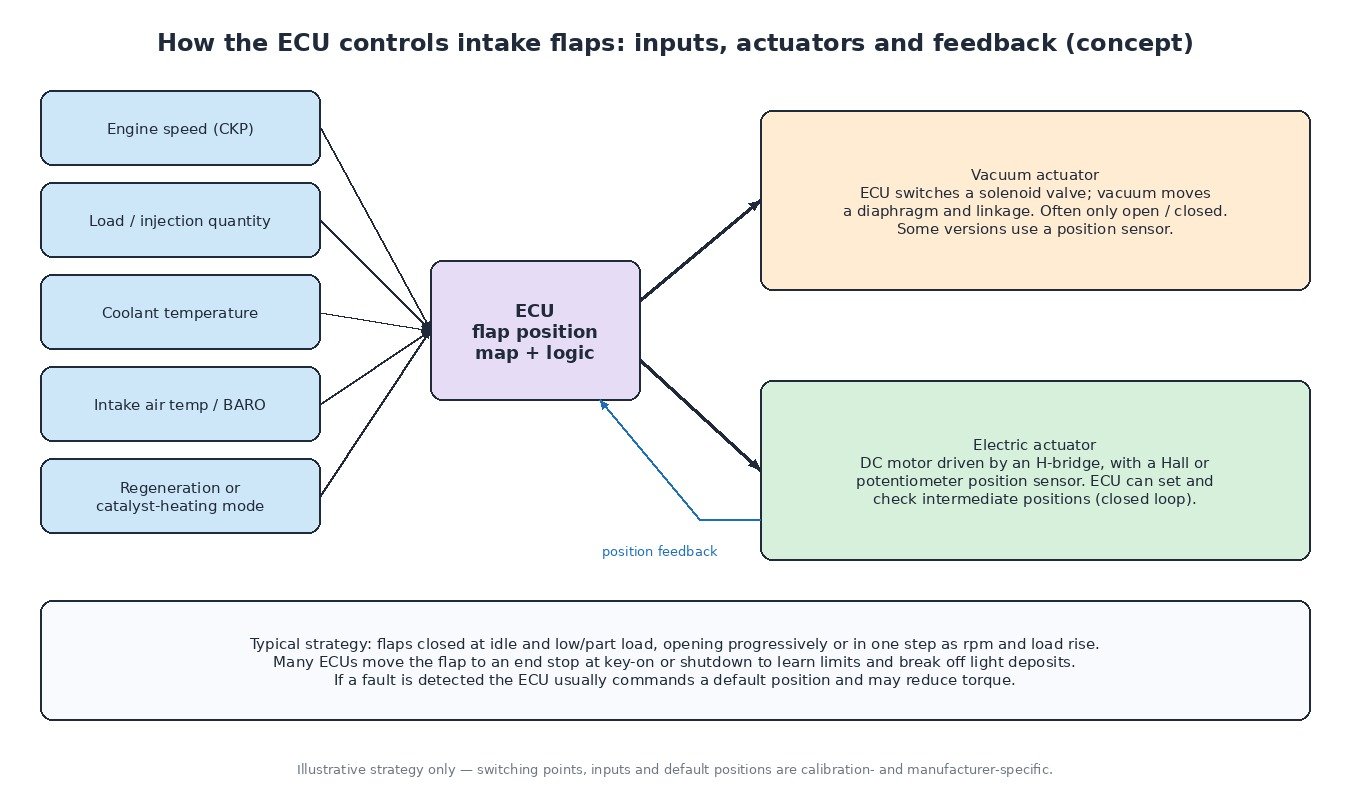
With an electric actuator, the ECU drives a DC motor and reads a position sensor, so it can detect a flap that is slow, stuck or outside its learnt end stops. That is where range/performance and stuck open or stuck closed codes come from. With a vacuum actuator, the ECU controls a solenoid valve; without a position sensor it can only monitor the solenoid circuit electrically, so a seized flap may show no code at all and only cause drivability complaints.
Many electric systems sweep the flap at key-on or after shutdown. If you hear a short buzz from the manifold when switching the ignition on or off, that is often the flap actuator performing this check.
A practical diagnostic routine
- Read all codes and freeze frame data. Note whether the fault is a circuit code (wiring, actuator, sensor) or a plausibility code (flap not following the command).
- Compare commanded and actual position in live data. Change engine speed and load and see whether the actual value follows smoothly or lags, hesitates or sticks at one position.
- Run an actuator test with the diagnostic tool, if supported, and watch the linkage. A motor that moves while the flap shaft does not points to a broken lever or clip.
- Check supply side. For vacuum systems, test vacuum at the actuator and check hoses and the solenoid valve. For electric systems, check power, ground, the sensor reference voltage and the connector for corrosion.
- Inspect the manifold. Remove the actuator and feel for resistance or play in the flap shaft. Heavy carbon deposits from EGR and crankcase vapours are a frequent cause of sticking. On high-mileage engines with older flap designs, check for loose flaps or fixings, because parts that come loose can damage valves and pistons.
After a repair, clear the codes, let the ECU relearn the end stops if the procedure requires it and confirm the readiness and live data during a road test.

By vehicle type
Cars and vans account for most flap faults, with swirl flap systems on many common-rail diesels and tumble flaps on many petrol direct-injection engines. Trucks and tractors rarely have separate swirl flaps because the ports themselves are shaped to create swirl; on these machines, an intake throttle valve and the EGR system are the usual intake actuators to check. Motorcycles with variable-length intake funnels use an ECU-driven actuator as well, and a stuck funnel mechanism mainly shows up as a change in power delivery.
Why the original software matters
Flap control is part of the calibration: switching points, default positions and fault reactions are all stored in the ECU software and tied to the emission strategy. When an ECU has been replaced, reflashed or modified and flap faults or odd behaviour appear, restoring the correct original file for the exact hardware and software number gives you a known reference. Fix the mechanical fault first and keep flap control working as the manufacturer intended.
Related fault codes (DTCs)
Generic OBD-II codes (SAE J2012). Manufacturer-specific codes and wording also exist, so check the OEM description for the vehicle.
| Code | Meaning | Typical causes |
|---|---|---|
| P2004 | Intake Manifold Runner Control Stuck Open (Bank 1) | Flap seized open by carbon, broken linkage, no vacuum to the actuator, actuator failure |
| P2005 | Intake Manifold Runner Control Stuck Open (Bank 2) | Same causes as P2004, on the bank 2 flaps |
| P2006 | Intake Manifold Runner Control Stuck Closed (Bank 1) | Flap seized closed, sticking spindle, actuator stuck, vacuum held by a faulty solenoid valve |
| P2007 | Intake Manifold Runner Control Stuck Closed (Bank 2) | Same causes as P2006, on the bank 2 flaps |
| P2008 | Intake Manifold Runner Control Circuit/Open (Bank 1) | Open circuit in the actuator or solenoid wiring, unplugged connector, failed coil or motor |
| P2009 | Intake Manifold Runner Control Circuit Low (Bank 1) | Short to ground in the control circuit, damaged actuator |
| P2010 | Intake Manifold Runner Control Circuit High (Bank 1) | Short to voltage, internal actuator fault |
| P2014 | Intake Manifold Runner Position Sensor/Switch Circuit (Bank 1) | Position sensor or wiring fault, missing reference voltage or ground |
| P2015 | Intake Manifold Runner Position Sensor/Switch Circuit Range/Performance (Bank 1) | Flap not reaching the commanded position, worn linkage, carbon deposits, sensor out of range |
| P2016 | Intake Manifold Runner Position Sensor/Switch Circuit Low (Bank 1) | Short to ground, open reference supply, failed sensor |
| P2017 | Intake Manifold Runner Position Sensor/Switch Circuit High (Bank 1) | Open signal or ground circuit, short to voltage, failed sensor |
| P0660 | Intake Manifold Tuning Valve Control Circuit/Open (Bank 1) | Tuning (runner length) valve actuator or wiring open circuit |
| P0661 | Intake Manifold Tuning Valve Control Circuit Low (Bank 1) | Short to ground in the tuning valve circuit |
| P0662 | Intake Manifold Tuning Valve Control Circuit High (Bank 1) | Short to voltage, failed tuning valve actuator |
| P0300 | Random/Multiple Cylinder Misfire Detected | Many causes; check for loose flap parts or a damaged inlet valve if flaps have failed mechanically |
Closing
Most intake flap faults come down to deposits, wear or a simple electrical issue. Comparing commanded with actual position quickly narrows down which one you are dealing with.
Need the original stock file for a specific ECU hardware and software number? Browse the ECUFlashFiles original file catalogue.