
A diesel that cranks but will not start, goes into limp mode on a long hill or throws P0087 after a remap usually has the same thing in common: the ECU cannot hold the rail pressure it wants. This workshop guide walks through rail pressure control on common rail diesels, the parts involved, how the ECU regulates pressure, and a practical diagnostic order for cars, vans, trucks and tractors.
Two fuel circuits, one target
Think of a common rail system as two separate circuits joined by the high-pressure pump.
- Supply side: tank, lift pump (electric, gear-type on the pump, or both), fuel filter and water separator, plus the return lines.
- High-pressure side: the engine-driven high-pressure pump, the rail, the high-pressure pipes and the injectors.
The rail is an accumulator. It holds fuel at the pressure the ECU has chosen, independent of crank speed, so injectors can deliver several precise injections per cycle at high pressure even at idle. That separation between pressure generation and injection timing is the key difference from older pump-line-nozzle and rotary pump systems.
Meet the parts
Rail pressure sensor
A diaphragm with strain gauges sits at the tip of the sensor. Pressure bends the diaphragm, the gauge resistance changes, and built-in electronics turn that into a voltage. It is normally a three-wire sensor with a 5 V supply, ground and signal. The signal is designed to stay inside a window below the supply voltage and above ground, so the ECU can tell a real pressure reading from a short or an open circuit.
Metering valve on the pump inlet
Different makers call it MPROP, ZME, IMV or SCV, but the job is the same: it throttles how much fuel reaches the pumping elements. The ECU sends a current-controlled PWM signal. More opening means more fuel delivered to the rail and higher pressure. Less opening means lower pressure.
Pressure control valve on the high-pressure side
Often called DRV or PCV and mounted on the rail or pump, this valve dumps high-pressure fuel to the return. It reacts much faster than the inlet valve, so it handles quick pressure drops on overrun and fine control at idle, and some systems use it to heat fuel when cold.
Pressure limiting valve
A purely mechanical safety valve that opens when pressure goes above the system limit. Some versions then hold a reduced emergency pressure so the vehicle can limp home. A leaking limiter is an easily missed cause of low pressure.

How the ECU regulates pressure
The calibration contains a rail pressure setpoint map, usually based on engine speed and injected fuel quantity, with corrections for temperatures, atmospheric pressure and special modes such as cold start or DPF regeneration. The ECU compares the setpoint with the sensor value and runs a closed-loop controller on the metering valve, the pressure control valve, or both.
In dual-actuator systems the strategy switches between the two valves depending on the operating point. Single-actuator systems use only the inlet metering valve and rely on injector leakage to bring pressure down. The ECU also watches for plausibility: if the actuator command and the measured pressure do not match its model, it stores a deviation fault and may limit power.
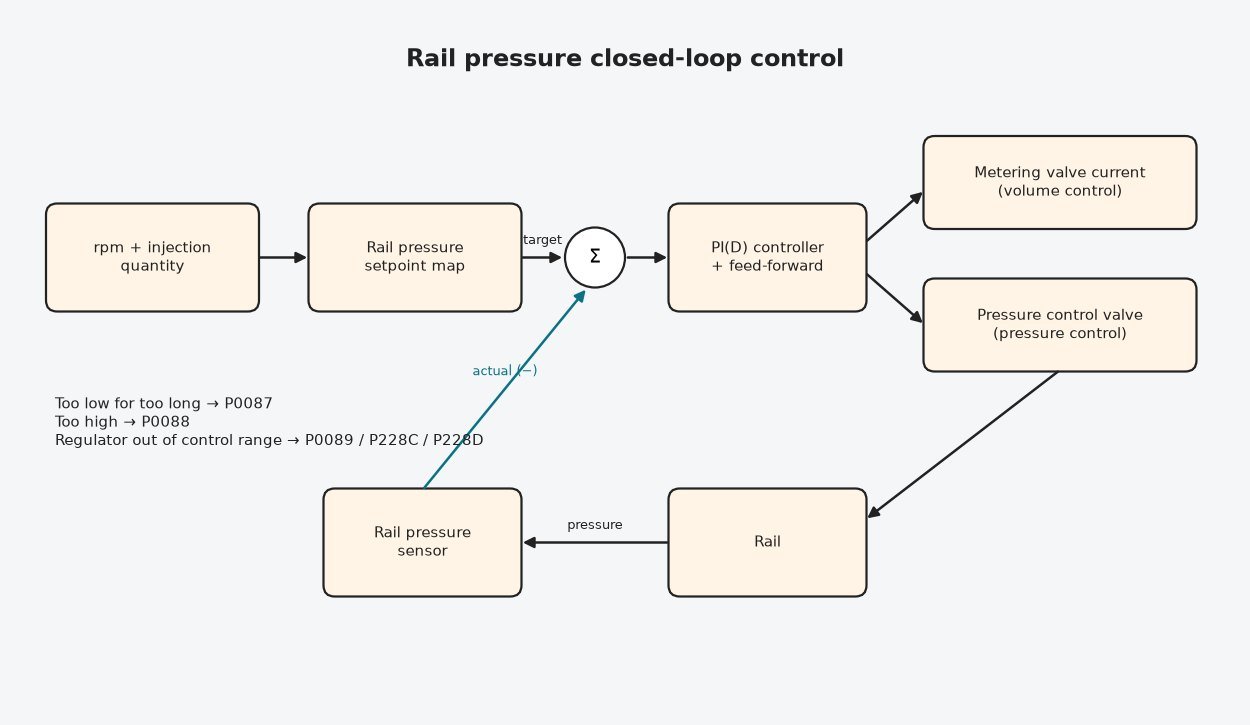
Reading the fault codes
- P0087: rail or system pressure too low.
- P0088: rail or system pressure too high.
- P0093: large fuel system leak detected.
- P0190 to P0193: rail pressure sensor circuit, range or performance, low and high input.
The code tells you which direction the problem goes, not which part has failed. Live data does the rest.
Related fault codes (DTCs)
Generic OBD-II (SAE J2012) codes related to common rail pressure control, the high-pressure pump metering valve and the rail pressure sensor. "Regulator 1" can mean the metering valve or the pressure control valve depending on the system, so check the manufacturer's definition.
| Code | Meaning | Typical causes |
|---|---|---|
| P0001 | Fuel Volume Regulator Control Circuit/Open | Open circuit to the HP pump inlet metering valve (MPROP/IMV/SCV), unplugged connector, failed valve |
| P0002 | Fuel Volume Regulator Control Circuit Range/Performance | Metering valve sticking (contaminated fuel, wear), high-resistance wiring |
| P0003 | Fuel Volume Regulator Control Circuit Low | Control circuit shorted to ground, failed metering valve |
| P0004 | Fuel Volume Regulator Control Circuit High | Control circuit shorted to voltage, failed metering valve |
| P0087 | Fuel Rail/System Pressure – Too Low | Clogged fuel filter, weak lift pump, air in fuel, sticking metering valve, high injector back-leakage, leaking pressure control valve, worn HP pump |
| P0088 | Fuel Rail/System Pressure – Too High | Pressure control valve stuck closed, metering valve stuck open, faulty rail pressure sensor, blocked return |
| P0089 | Fuel Pressure Regulator 1 Performance | Regulator (pressure control or metering valve) not achieving commanded pressure, contamination, wiring |
| P0090 | Fuel Pressure Regulator 1 Control Circuit | Open/short in the regulator circuit, failed regulator |
| P0091 | Fuel Pressure Regulator 1 Control Circuit Low | Regulator circuit shorted to ground, failed regulator |
| P0092 | Fuel Pressure Regulator 1 Control Circuit High | Regulator circuit shorted to voltage, failed regulator |
| P0093 | Fuel System Leak Detected – Large Leak | External high-pressure leak (pipe, union, rail), injector stuck open, pressure limiting valve opening |
| P0094 | Fuel System Leak Detected – Small Leak | Small external leak, excessive injector return flow, leaking pressure control/limiting valve |
| P0190 | Fuel Rail Pressure Sensor "A" Circuit | Rail pressure sensor or wiring fault, 5 V reference problem |
| P0191 | Fuel Rail Pressure Sensor "A" Circuit Range/Performance | Sensor drift or implausible reading (offset with engine off), connector corrosion |
| P0192 | Fuel Rail Pressure Sensor "A" Circuit Low | Signal open or shorted to ground, failed sensor |
| P0193 | Fuel Rail Pressure Sensor "A" Circuit High | Signal shorted to voltage, open ground, failed sensor |
| P0194 | Fuel Rail Pressure Sensor "A" Circuit Intermittent/Erratic | Loose connector, chafed wiring, failing sensor |
| P0251 | Injection Pump Fuel Metering Control "A" Malfunction (Cam/Rotor/Injector) | Fuel metering actuator or its circuit on the injection pump |
| P0252 | Injection Pump Fuel Metering Control "A" Range/Performance | Metering actuator not reaching commanded position: sticking, contamination, wiring |
| P0627 | Fuel Pump "A" Control Circuit/Open | Open circuit to the (electric) fuel pump control, relay or pump module fault |
| P0628 | Fuel Pump "A" Control Circuit Low | Pump control circuit shorted to ground, failed pump or relay |
| P0629 | Fuel Pump "A" Control Circuit High | Pump control circuit shorted to voltage, failed pump control module |
| P228C | Fuel Pressure Regulator 1 Exceeded Control Limits – Pressure Too Low | Pressure stays below target with regulator at its limit: supply restriction, worn HP pump, injector back-leak, leaking regulator |
| P228D | Fuel Pressure Regulator 1 Exceeded Control Limits – Pressure Too High | Pressure stays above target: regulator sticking, blocked return, faulty rail pressure sensor |
A practical diagnostic order
- Log setpoint, actual pressure and actuator command. Record cranking, idle, a snap throttle and a loaded run. Low pressure only at high load points to supply or pump capacity. Low pressure at idle or during cranking points to leakage.
- Check the supply side. Filter condition, air bubbles in clear test lines, lift pump delivery, collapsed hoses and, in cold weather, waxed fuel. Starving the pump causes many P0087 faults.
- Measure injector back-leak. One injector with high return flow can drag the whole rail down. A back-leak test or a pressure hold test with the injectors isolated separates injectors from the pump.
- Inspect the limiter and pressure control valve. A valve that does not seal will bleed pressure to the return.
- Confirm the sensor. A drifting sensor makes the ECU regulate to a wrong value. Compare against a known-good sensor or a gauge on a test bench.
- Check for debris. If the pump has worn internally, metal particles can reach the rail and injectors. Clean or replace downstream components, or the new pump may fail too.
On a crank-no-start, remember that the ECU will not open the injectors until rail pressure reaches its minimum release threshold. Watching actual rail pressure while cranking is often the fastest way to see whether the problem is fuel or something else.

Heavy-duty and agricultural engines
Tractors, combines, loaders and many trucks use the same Bosch, Denso or Delphi common rail principles on a larger scale, while some heavy-duty engines use unit injectors or unit pumps instead of a shared rail. Long hours at high load make fuel cleanliness and water separation especially important, and a weak supply side often shows up first as a pressure deviation during sustained heavy work.
Rail pressure and tuning
Every diesel calibration touches the rail pressure maps directly or indirectly. More injected fuel needs more pump delivery, so a good file is matched to what the pump can supply. Pushing the setpoint above the hardware’s design range loads the pump and injectors and shortens their life. After any remap, log setpoint against actual pressure at full load and check that the metering valve still has room left. If it is at its limit, the calibration is asking too much of that fuel system.
Summary
The pump builds pressure, the rail stores it, one sensor measures it and the ECU controls it through the metering and pressure control valves. Start every rail pressure diagnosis with setpoint, actual and actuator command, then work from the tank to the injectors.
Looking for an original or tuned file for your diesel ECU? Find your ECU file on ECUFlashFiles.