
When a scan tool shows P2200, P229E or P20EE, the temptation is to replace the NOx sensor and hope. On SCR-equipped diesels that rarely fixes the root cause. This technician guide walks through AdBlue/DEF dosing, how upstream and downstream NOx sensors feed the ECU, how efficiency is judged, and a diagnostic order that checks leaks, fluid quality and heaters before you buy parts—covering light vehicles, trucks and machines, with a short note on why most petrol bikes never see SCR.
NOx aftertreatment on modern diesels
High combustion temperatures produce nitrogen oxides. Lean diesel combustion makes NOx especially hard to treat with a three-way catalyst alone, so legislators pushed manufacturers toward dedicated NOx aftertreatment. Selective Catalytic Reduction injects a urea solution (DEF / AdBlue) into the exhaust; heat turns it into ammonia, and the SCR brick reduces NOx to nitrogen and water.
Treat SCR as a complete emissions system. Calibration and workshop work should keep dosing and NOx monitoring in place. Presenting AdBlue, DPF or EGR as delete options is neither professional nor legal for road use, and it fights the inducement strategies built into today’s ECUs.
From urea tank to ammonia
DEF is stored in a dedicated tank with level and quality sensing and, in cold markets, tank and line heaters. A pump feeds a dosing module; an injector sprays the fluid into the exhaust; a mixer spreads it before the SCR substrate. Ammonia formation and NOx reduction only proceed properly inside the catalyst’s temperature window—so EGT and SCR temperature signals matter as much as the NOx readings themselves.
Do not quote “typical” concentration figures from memory in a report. Follow the OEM quality check (refractometer or equivalent where specified) and the refill/activation routine after a low-level event.
Where the NOx sensors sit
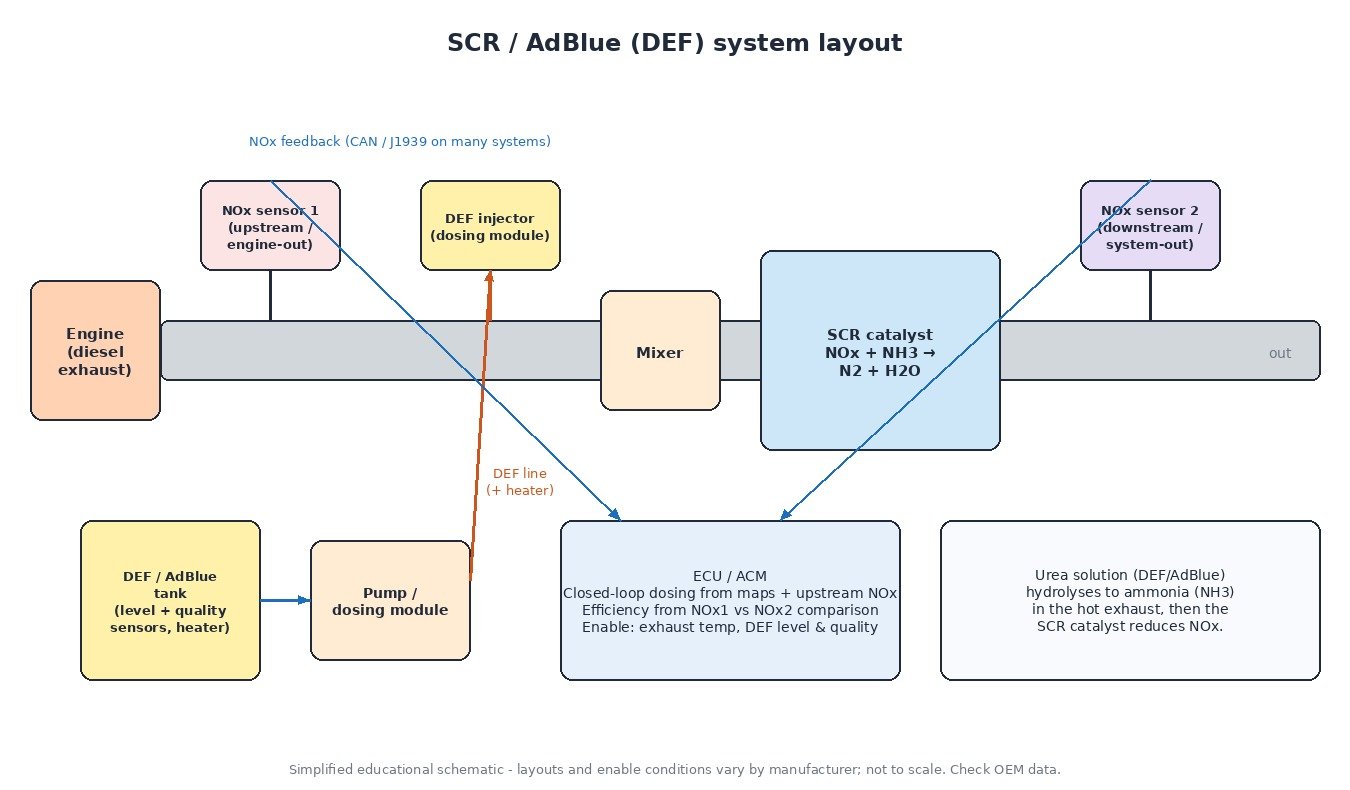
Two NOx sensors bookend the SCR:
- Upstream (engine-out) — measures NOx leaving the engine/turbine/DOC path before or at SCR inlet; used heavily for feedforward dosing.
- Downstream (system-out) — measures residual NOx after the catalyst; used to judge conversion efficiency.
Service information decides which DTC “Sensor 1” and “Sensor 2” map to which physical probe. Part numbers differ; mixing them up creates range/performance and communication faults that look like hardware failure.
Smart NOx sensors and the data path
A NOx probe is not a simple zirconia voltage sensor. It runs an internal heater, needs warm-up, and often reports over CAN (passenger cars) or J1939 (many commercial vehicles). Until heater status and temperature thresholds are satisfied, the ECU will not trust the value for closed-loop control. Heater open/low/high and heater-sense codes (P2205–P2209 and the sensor-2 equivalents) therefore block valid diagnostics until they are fixed.
Closed-loop control and P20EE
Dosing starts from maps (rpm, load, temperatures) and upstream NOx, then is trimmed so that downstream NOx stays within the calibrated band. Efficiency monitoring is essentially: under enable conditions, is the drop from NOx1 to NOx2 large enough?
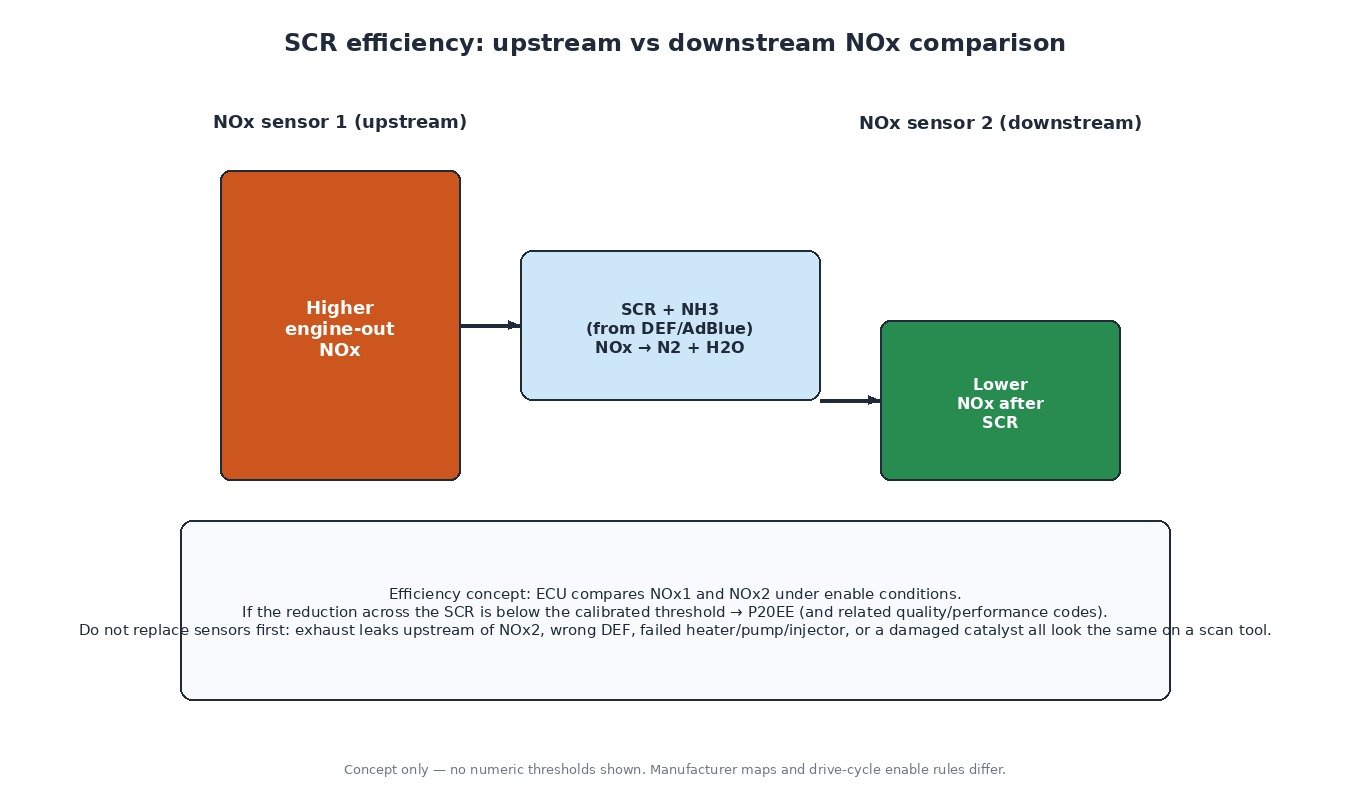
If not, P20EE (SCR NOx catalyst efficiency below threshold) sets. The same symptoms can also raise reductant quality or system performance codes. Causes range from exhaust leaks and bad DEF to a failed injector, blocked mixer, aged catalyst or lying sensors—hence the need for a structured check, not a parts lottery.
Workshop diagnostic order
- Freeze frame and readiness. Note temperatures, DEF level/quality flags and whether dosing was active when the code set.
- Exhaust integrity. Smoke or soap the joints from turbo to tail; a post-SCR leak is a classic false efficiency failure.
- Fluid first. Confirm genuine DEF, no diesel/coolant contamination, and correct fill recognition after a P203F low-level event.
- Electrical and network. Power, ground, heater circuits and CAN integrity (U029D / U029E lost communication with NOx A/B) before condemning the probe.
- Live data at temperature. With both sensors warm, compare NOx1 and NOx2 while dosing. Flat or stuck values implicate the sensor path; a small real delta with correct delivery implicates catalyst or dosing quantity.
- Injector and pump. Circuit codes such as P2047, plus hydraulic tests from the OEM routine, separate electrical faults from a weak spray pattern.
Application notes
Cars and vans package SCR tightly, often in a combined aftertreatment can. Trucks and tractors use larger tanks, heavier heating and staged driver inducement when DEF is empty or out of spec. Petrol bikes almost never run SCR; they rely on lambda-controlled three-way catalysts. The diagnostic logic—temperature enable, fluid quality, leak checks, sensor plausibility—still transfers whenever you meet an SCR system.
Related fault codes (DTCs)
Generic SAE J2012 codes. Bank/sensor labels and monitor enable rules are manufacturer-specific; verify against the wiring diagram and OBD description.
| Code | Meaning | Typical causes |
|---|---|---|
| P2200 | NOx Sensor Circuit Bank 1 Sensor 1 | Open or shorted circuit, damaged connector, failed sensor |
| P2201 | NOx Sensor Circuit Range/Performance Bank 1 Sensor 1 | Implausible NOx value, leak, fouling, incorrect replacement sensor |
| P2202 | NOx Sensor Circuit Low Bank 1 Sensor 1 | Signal short to ground, wiring damage, internal fault |
| P2203 | NOx Sensor Circuit High Bank 1 Sensor 1 | Signal short to voltage, open ground reference, internal fault |
| P2204 | NOx Sensor Circuit Intermittent Bank 1 Sensor 1 | Intermittent contact, harness chafe, water in connector |
| P2205 | NOx Sensor Heater Control Circuit/Open Bank 1 Sensor 1 | Open heater supply/control, fuse, failed heater |
| P2206 / P2207 | NOx Sensor Heater Control Circuit Low / High Bank 1 Sensor 1 | Heater driver shorted low / high |
| P2208 / P2209 | NOx Sensor Heater Sense Circuit / Range Bank 1 Sensor 1 | Heater current feedback out of range, sense-wire fault |
| P229E | NOx Sensor Circuit Bank 1 Sensor 2 | Circuit fault on the second NOx sensor (often downstream) |
| P229F | NOx Sensor Circuit Range/Performance Bank 1 Sensor 2 | Implausible post-SCR reading, leak, wrong sensor |
| P22A0 / P22A1 | NOx Sensor Circuit Low / High Bank 1 Sensor 2 | Low / high signal faults on sensor 2 |
| P20EE | SCR NOx Catalyst Efficiency Below Threshold Bank 1 | Leak, bad DEF, dosing problem, SCR damage, false NOx data |
| P203F | Reductant Level Too Low | DEF tank low — refill and complete OEM recognition routine |
| P207F | Reductant Quality Performance | Incorrect DEF, quality sensor issue, excess engine-out NOx |
| P2047 | Reductant Injector Circuit/Open Bank 1 Unit 1 | Open injector wiring, failed dosing valve, poor connector |
| U029D / U029E | Lost Communication With NOx Sensor A / B | CAN/harness fault, missing sensor power/ground, dead module |
Tuning implications
A proper Stage 1 or Stage 2 file increases cylinder pressure and can raise engine-out NOx. Keep SCR dosing, NOx sensors and efficiency monitors enabled so the aftertreatment can still do its job. If P20EE or NOx circuit codes appear after a flash, fix mechanical and fluid issues before changing the map again. Deleting SCR/NOx monitoring is not a tuning strategy—it is a compliance and reliability problem.
Looking for a file that respects SCR and NOx monitoring? Browse tuning files at ECUFlashFiles.