
The engine pulls hard and then suddenly goes flat, the rpm will not climb past a certain point, or a tractor loses power on a hot afternoon. Is that a fault, a protective derate or simply a limiter doing its job? This guide approaches ECU limiters from the diagnostic side: what limp mode and derate look like, how to tell a normal limit from a real fault, and which data to log before replacing parts.
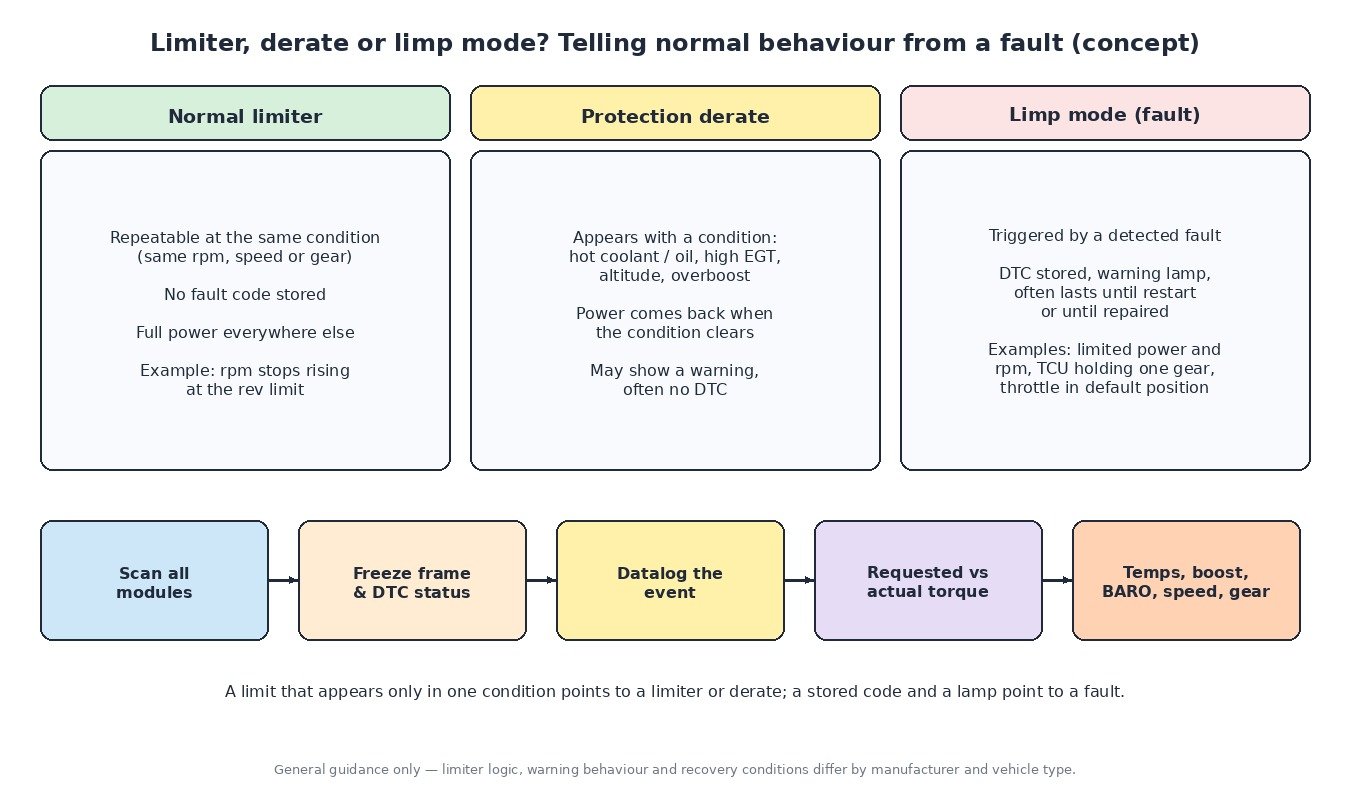
Three different things that feel the same
- Normal limiter: the ECU caps engine speed, road speed or torque at a calibrated value. It happens repeatably at the same condition, stores no fault code, and the vehicle drives normally everywhere else.
- Protection derate: torque or boost is reduced because a temperature, pressure or altitude condition calls for it. Power returns once the condition clears. A warning may appear, but often no code is stored.
- Limp mode (limp home): a detected fault forces a fallback strategy. Typical signs are a warning lamp, a stored DTC, reduced power and engine speed, an automatic gearbox held in one gear, or an electronic throttle resting in its default position. It often lasts until restart or repair.
The limiters you will meet
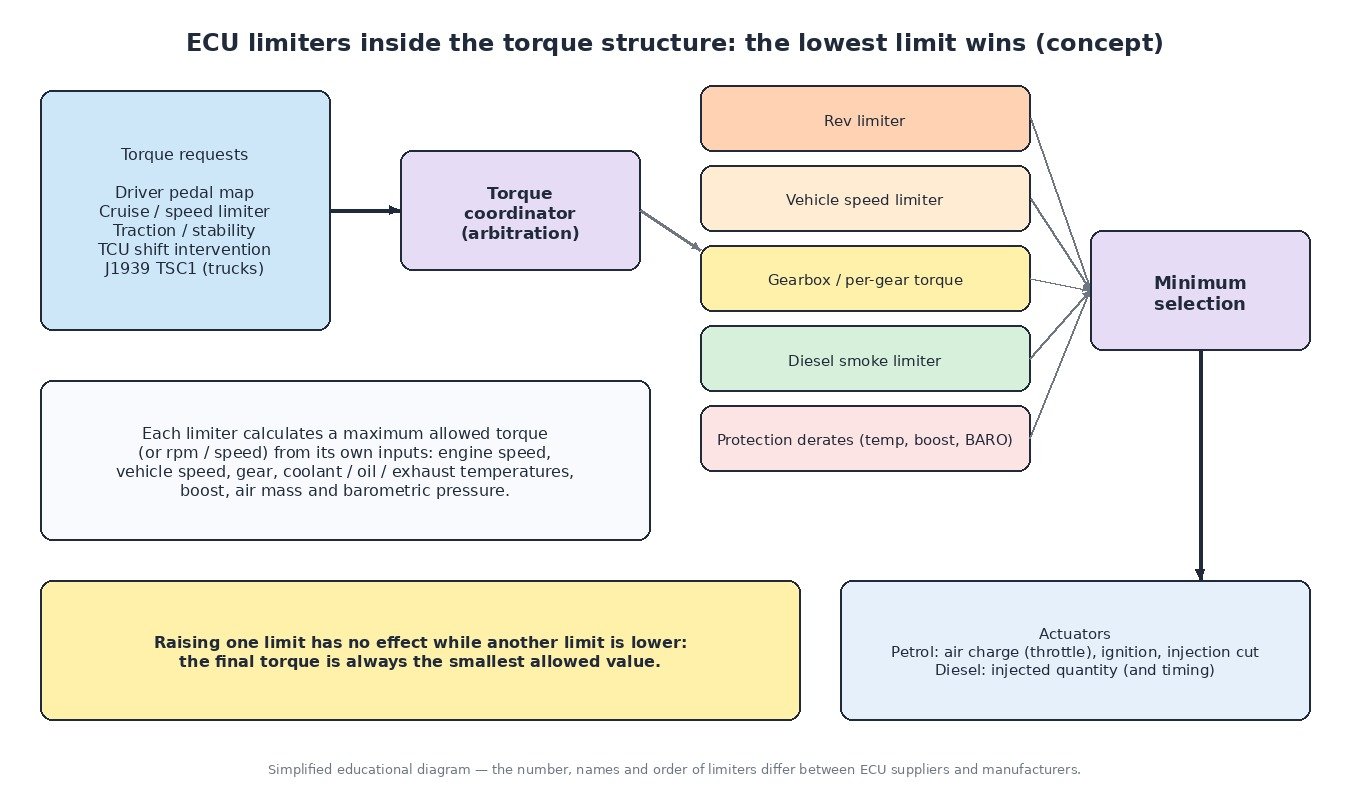
In a torque-based ECU, every limiter calculates a maximum allowed torque and the coordinator applies the lowest one. Knowing which limiters exist helps you recognise them in a log:
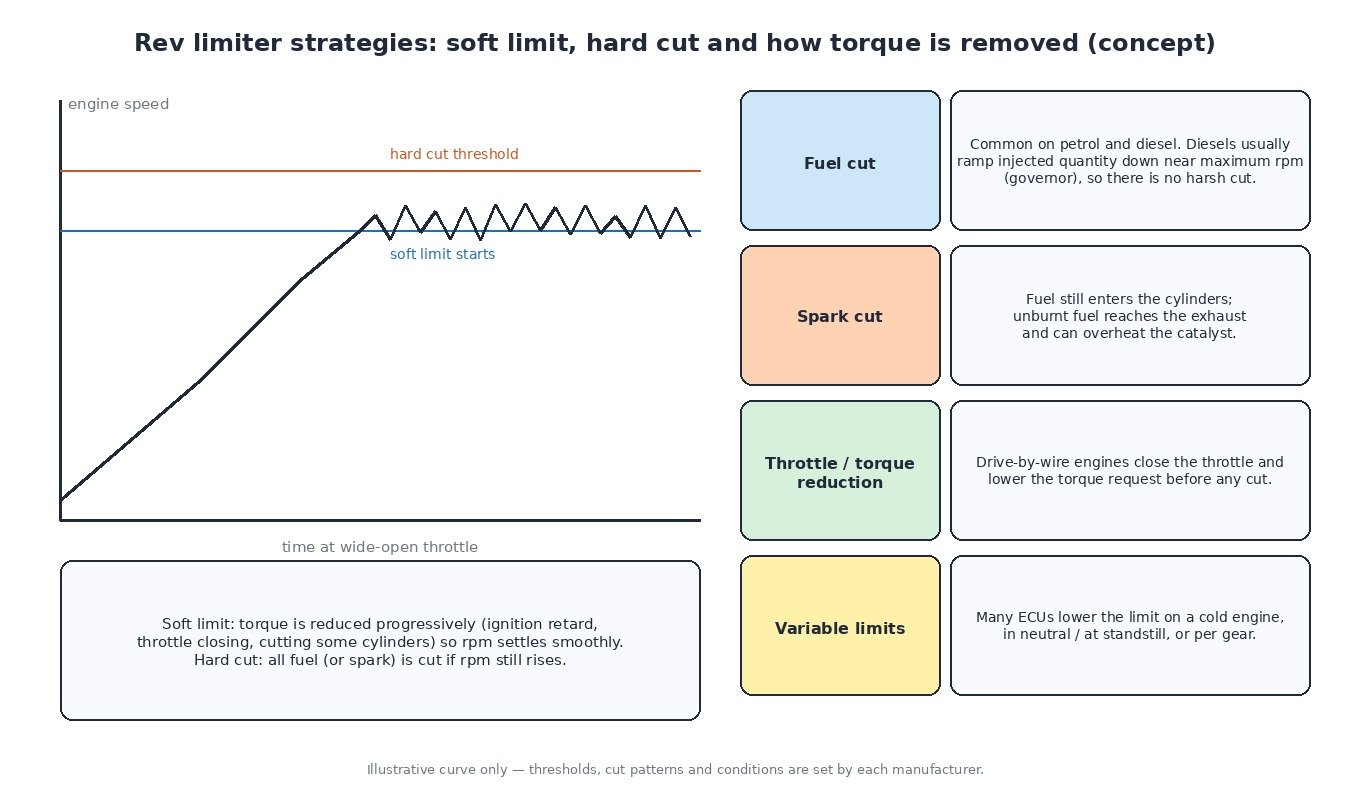
- Rev limiter: a soft stage removes torque through ignition retard, throttle closing or cylinder cut-out, then a hard fuel cut follows if rpm keeps rising. Spark cut is less common because unburnt fuel can overheat the catalyst. Diesels ramp quantity down through the governor. Many ECUs lower the limit on a cold engine, in neutral or per gear, so a lower cut-off when cold is normal.
- Vehicle speed limiter: based on the wheel speed or gearbox output signal. A faulty speed sensor or ABS module can make cruise control, the adjustable speed limiter and even shift logic misbehave.
- Torque limits: per-gear limits protect the clutch and gearbox, and the TCU requests torque reductions during shifts. Losing TCU communication often triggers a reduced torque limit.
- Smoke limiter (diesel): caps fuel based on air mass or boost and intake temperature. An air leak or a faulty air-mass reading makes this limiter cut power without any fuel system fault.
- Protection limits: coolant, oil, transmission and exhaust gas temperature, maximum boost or overboost, and barometric pressure for altitude derate.
Vehicle-type examples
A car that refuses to rev past a modest rpm with the engine light on is usually in limp mode, often after a pedal or throttle sensor correlation fault. A truck held at a fixed road speed is normally on its road speed governor; on J1939 networks the transmission, retarder or ABS can also request torque or speed limits through the TSC1 message, so check those modules too. Speed limitation devices required on heavy vehicles by Directive 92/6/EEC are a legal requirement and must remain active. An agricultural tractor losing power under heavy PTO work may be derating on coolant or charge-air temperature, or on low reductant level, rather than suffering an engine fault. A motorcycle that cuts power on a wet road may simply be in a rain ride mode or under traction control intervention.
A practical diagnostic routine
- Scan all modules, not just the engine ECU, and note whether codes are active or stored.
- Read the freeze frame to see rpm, load, speed and temperatures at the moment of the event.
- Reproduce the symptom while datalogging: engine speed, vehicle speed, gear, requested versus actual torque, boost actual versus specified, air mass, coolant, oil and intake temperatures, and barometric pressure.
- Where the scan tool shows torque intervention or limiter status, note which source is active.
- A limit that appears at one exact condition without a code points to a limiter; one that follows a temperature or pressure points to a derate; a stored code points to a fault.
Calibration notes
Limiters belong to the torque model, so changing one limit rarely acts alone, and every value reflects a component’s capability. A correct, matching original file is the reference when diagnosing unexpected limits after software work, because it restores the manufacturer’s limiter set. Legal and emission-related limits, including DPF, EGR and AdBlue/SCR strategies, must remain intact.
Related fault codes (DTCs)
Generic OBD-II codes (SAE J2012). Wording varies by manufacturer, and normal limiter activity stores no code.
| Code | Meaning | Typical causes |
|---|---|---|
| P0219 | Engine Overspeed Condition | Missed downshift, engine driven over limit downhill, speed signal fault |
| P0500 | Vehicle Speed Sensor “A” | Failed speed or wheel speed sensor, wiring, missing CAN speed signal |
| P0501 | Vehicle Speed Sensor “A” Range/Performance | Implausible signal, wrong tyre size coding, damaged tone ring |
| P0502 | Vehicle Speed Sensor “A” Circuit Low | Short to ground, open circuit, failed sensor |
| P0503 | Vehicle Speed Sensor “A” Intermittent/Erratic/High | Loose connector, chafed wiring, debris on the sensor |
| P0504 | Brake Switch “A”/”B” Correlation | Misadjusted or failed brake switch, fuse or wiring fault |
| P0571 | Brake Switch “A” Circuit | Brake switch or circuit fault; cruise and speed limiter often disabled |
| P0217 | Engine Coolant Over Temperature Condition | Low coolant, thermostat, pump or fan failure, blocked radiator |
| P0218 | Transmission Fluid Over Temperature Condition | Heavy load or towing, low or old fluid, blocked cooler, slipping clutches |
| P0524 | Engine Oil Pressure Too Low | Low oil level, worn pump or bearings, faulty sensor |
| P0234 | Turbocharger/Supercharger “A” Overboost Condition | Sticking wastegate or VGT, actuator or sensor fault |
| P0299 | Turbocharger/Supercharger “A” Underboost Condition | Boost leak, split hose, actuator fault, worn turbo |
| P2227 | Barometric Pressure Sensor “A” Circuit Range/Performance | Faulty BARO sensor, plausibility error against MAP sensor |
| P2135 | Throttle/Pedal Position Sensor/Switch “A”/”B” Voltage Correlation | Worn throttle sensor track, wiring or connector fault |
| P2138 | Throttle/Pedal Position Sensor/Switch “D”/”E” Voltage Correlation | Worn pedal sensor, wiring, supply or ground fault |
| P0606 | Control Module Processor | Internal ECU fault, supply problems, corrupted software |
| P0700 | Transmission Control System (MIL Request) | TCU has stored a fault; read the TCU for details |
| U0101 | Lost Communication With TCM | CAN wiring fault, TCU power or ground loss, failed TCU |
Closing
Before chasing a power loss, decide whether you are looking at a limiter, a derate or limp mode. A good datalog usually answers that in a single drive.
Need the original stock file for a specific ECU hardware and software number? Browse the ECUFlashFiles original file catalogue.