
Tuning your car’s brain is not just for racing enthusiasts anymore. More than 90 percent of new vehicles rely on regular ECU software updates to improve fuel efficiency, power, and security. Most drivers think these updates are only about patching bugs or fixing glitchy electronics, but the real impact goes way beyond that. A single software update can unlock hidden performance potential and transform the way your car drives.
Table of Contents
- Understanding Ecu Software Updates And Benefits
- Preparing Your Vehicle Before The Update
- Step-By-Step Ecu Software Update Guide
- Troubleshooting And Safety Tips For Ecu Updates
Quick Summary
| Takeaway | Explanation |
|---|---|
| Regularly update ECU software | Keeping ECU software updated improves vehicle performance and efficiency. |
| Prepare thoroughly before updates | Conduct diagnostics and ensure compatibility to prevent complications during updates. |
| Follow a step-by-step update process | Use a structured method for executing updates to minimize risks and ensure success. |
| Monitor and test post-update | Validate the software installation with detailed diagnostics to confirm vehicle functionality. |
| Be aware of potential complications | Recognize issues like software incompatibility or data corruption to handle problems effectively. |
Understanding ECU Software Updates and Benefits
Engine Control Unit (ECU) software updates represent a critical aspect of modern vehicle performance optimization. These digital enhancements go far beyond simple software patches, serving as sophisticated tools that can transform a vehicle’s operational capabilities. Understanding the nuanced world of ECU software updates requires a comprehensive look at their technological significance and potential performance impacts.
The Core Purpose of ECU Software Updates
At its fundamental level, an ECU software update is designed to recalibrate the electronic systems controlling your vehicle’s engine performance. According to research from ScalOTA, modern automotive software update architectures are developing increasingly sophisticated protocols that ensure secure and efficient data transmission. These updates can address multiple critical areas including fuel efficiency, engine responsiveness, emission control, and overall vehicle performance.
Professional automotive engineers recognize that ECU software updates are not merely about adding new features but about refining existing systems. They represent precision interventions that can optimize engine parameters with remarkable accuracy. For instance, an update might adjust fuel injection timing, modify throttle response, or recalibrate transmission shift points to achieve better overall performance.
Security and Performance Optimization
Security remains a paramount concern in ECU software updates. Advanced research on embedded systems firmware updates highlights the critical importance of implementing robust, cryptographically secure update mechanisms. These protocols ensure that any software modifications are authenticated, preventing potential unauthorized interventions that could compromise vehicle safety.
The benefits of professional ECU software updates extend beyond immediate performance gains. They represent a strategic approach to vehicle maintenance, allowing manufacturers and owners to address potential software vulnerabilities, improve system efficiency, and adapt to evolving technological standards. Modern vehicles are essentially complex computer systems on wheels, and their software requires continuous refinement.
Interested automotive enthusiasts can learn more about the intricate mechanics of ECU systems to gain deeper insights into these technological marvels. Understanding the underlying principles helps car owners make informed decisions about potential software updates and their specific vehicle requirements.
For professional tuners and automotive enthusiasts, ECU software updates offer a nuanced approach to vehicle optimization. They provide a pathway to unlock latent performance potential, fine-tune engine characteristics, and adapt vehicles to specific driving conditions or performance requirements. Whether you’re seeking marginal improvements or substantial performance transformations, ECU software updates represent a precise, data-driven approach to automotive enhancement.
Ultimately, ECU software updates embody the intersection of automotive engineering and digital technology. They demonstrate how sophisticated electronic systems can be dynamically improved, offering vehicle owners an opportunity to enhance their driving experience through intelligent, targeted software interventions.
Preparing Your Vehicle Before the Update
Before initiating an ECU software update, comprehensive preparation is crucial to ensure a smooth and successful process. Professional automotive technicians emphasize that proper vehicle preparation can significantly reduce the risk of potential complications during the software update procedure.
Diagnostic System and Compatibility Check
The first critical step involves conducting a thorough diagnostic assessment of your vehicle’s existing electronic systems. According to research on automotive software updates, establishing a reliable network infrastructure and verifying software compatibility are essential preliminary tasks. This diagnostic check should include:
- Battery Voltage Verification: Ensuring the vehicle battery maintains a stable voltage above 12.5 volts throughout the update process
- System Compatibility Assessment: Checking the current ECU firmware version and its compatibility with the proposed update
- Communication Port Inspection: Confirming the vehicle’s diagnostic port and communication interfaces are functioning correctly
Explore essential ECU tuning preparation techniques to gain deeper insights into the preliminary steps required for a successful software update.
Power and Environment Considerations
The National Academies Press highlights the critical importance of managing power systems during ECU software updates. Professional technicians recommend:
- Connecting the vehicle to a stable power supply or using a battery maintenance device
- Performing updates in a controlled environment with stable temperature and minimal electrical interference
- Disconnecting non-essential electrical systems to prevent potential power fluctuations
Environmental factors play a significant role in the update process. Temperature extremes can potentially impact the software transfer and installation, making an indoor, climate-controlled environment ideal for performing ECU updates.
Security and Authentication Protocols
Security remains paramount during ECU software updates. Advanced research emphasizes the necessity of robust authentication mechanisms. Professionals recommend:
- Verifying the authenticity of the software update source
- Ensuring cryptographic signatures are intact and match manufacturer specifications
- Using specialized diagnostic tools that support secure communication protocols
Before initiating any update, confirm that you have:
- Original manufacturer update files
- Appropriate diagnostic equipment
- Backup of existing ECU configuration
- Stable power source
- Clean, controlled environment
Additionally, some vehicles may require specific preparation steps based on their make, model, and existing electronic architecture. Consulting the vehicle’s specific technical documentation or a professional automotive technician can provide model-specific guidance.
To help you prepare your vehicle for a safe and effective ECU software update, here is a checklist summarizing the key steps and conditions to verify before beginning the process:
| Preparation Item | Description | Status (Yes/No) |
|---|---|---|
| Battery Voltage Verified | Ensure voltage above 12.5V during update | |
| System Compatibility Checked | Confirm current firmware is compatible with new software | |
| Communication Ports Functioning | Diagnostic port and interfaces are operational | |
| Stable Power Source Available | Vehicle connected to stable supply or battery maintainer | |
| Clean, Controlled Environment Prepared | Indoor, climate-controlled area free from electrical interference | |
| Update Files from Authentic Source | Manufacturer-approved and verified update files available | |
| Diagnostic Equipment Ready | Tools support secure and encrypted protocols | |
| ECU Configuration Backup Completed | Existing ECU settings backed up |
Ultimately, proper preparation transforms the ECU update from a potentially risky procedure into a precise, controlled optimization of your vehicle’s electronic systems. Taking time to methodically prepare ensures the best possible outcome for your vehicle’s performance and electronic integrity.
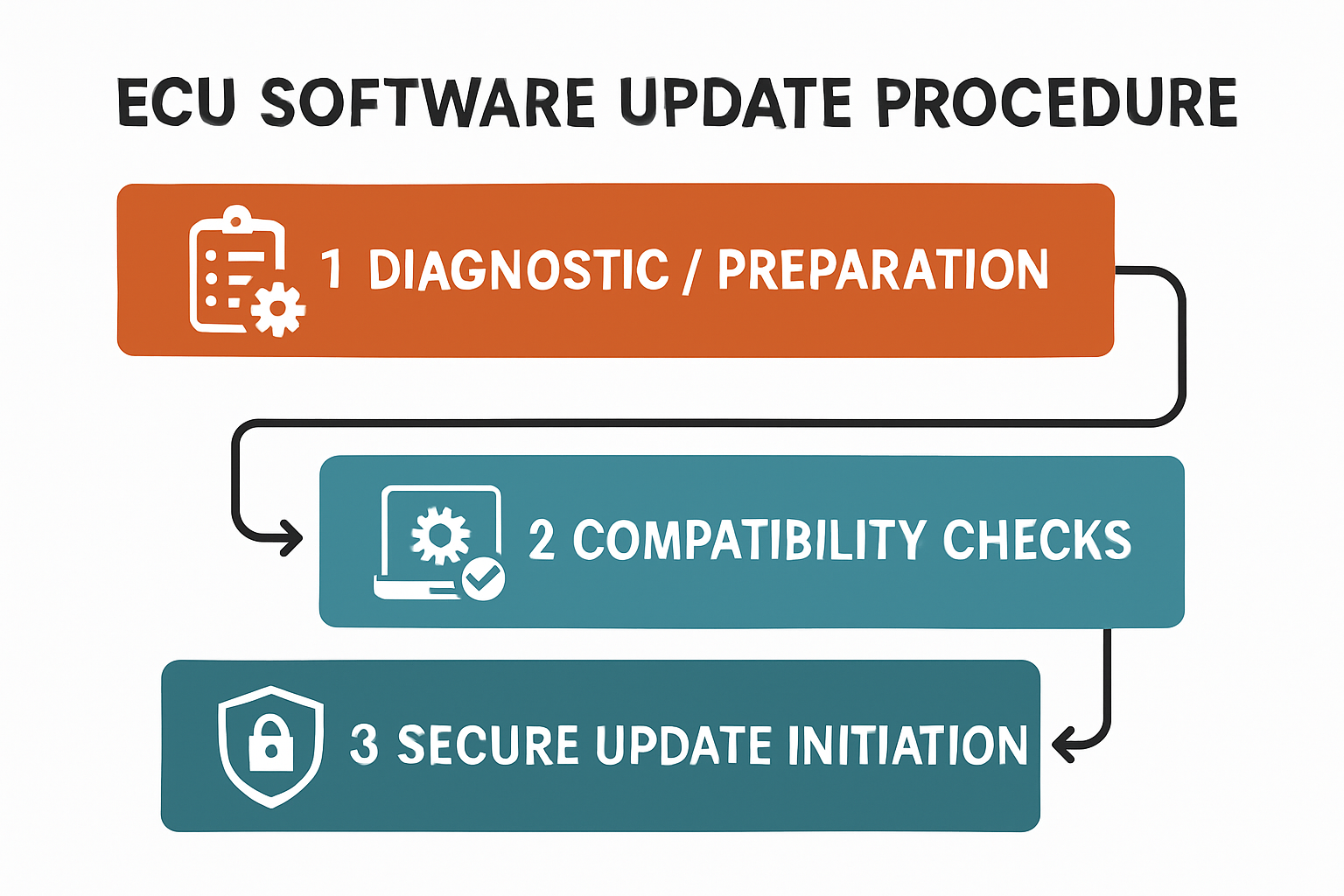
Step-by-Step ECU Software Update Guide
Updating ECU software requires a methodical approach that combines technical precision and careful execution. Professional automotive technicians emphasize the importance of following a structured process to ensure successful software implementation and minimize potential risks.
Diagnostic and Preparation Phase
Before initiating the update, professional technicians recommend a comprehensive diagnostic assessment. According to research from the National Academies Press, using standardized diagnostic protocols like Unified Diagnostic Services (UDS) and ISO 15765 is crucial for delivering accurate software updates. This phase involves:
- Connecting professional diagnostic equipment
- Reading current ECU firmware version
- Verifying vehicle compatibility with the new software
- Downloading manufacturer-approved update files
Explore the fundamentals of ECU tuning techniques to gain deeper insights into preparation strategies.
Software Update Execution
Secure software update processes highlight critical steps for successful ECU software installation. The execution phase requires careful attention to multiple technical considerations:
- Initiating a secure programming session
- Performing security access authentication
- Downloading new software data in controlled segments
- Verifying data integrity through digital signatures
- Confirming checksums to ensure accurate transmission
Professional technicians recommend using specialized diagnostic tools that support end-to-end encrypted communication protocols. These tools help prevent potential unauthorized interventions and maintain the security of the update process.
Post-Update Validation and Testing
After completing the software update, comprehensive validation becomes essential. This final phase involves:
- Running comprehensive system diagnostics
- Checking for any error codes or anomalies
- Performing baseline performance tests
- Monitoring vehicle behavior during initial drive cycles
- Verifying that all electronic systems function correctly

Potential risks during ECU updates include:
- Incomplete software transfer
- Compatibility issues with existing vehicle systems
- Potential electrical system disruptions
- Data corruption during transmission
To mitigate these risks, always:
- Use manufacturer-approved update files
- Work in a controlled, stable environment
- Maintain a stable power supply
- Have a professional backup of original configuration
- Consult vehicle-specific technical documentation
While many automotive enthusiasts can perform ECU updates, complex vehicles might require professional intervention. The intricate nature of modern automotive electronics demands precision and specialized knowledge.
Ultimately, a successful ECU software update represents a strategic optimization of your vehicle’s electronic systems. By following a structured, methodical approach and prioritizing security and compatibility, you can unlock enhanced performance and efficiency in your vehicle’s electronic architecture.
Troubleshooting and Safety Tips for ECU Updates
ECU software updates can present complex challenges that require meticulous attention to detail and comprehensive understanding of automotive electronic systems. Professional technicians emphasize the critical importance of adopting a systematic approach to mitigate potential risks and ensure successful software modifications.
Common ECU Update Complications
Explore advanced ECU tuning techniques to understand the nuanced challenges associated with software updates. According to research on ECU safety protocols, several common complications can arise during the update process:
- Incompatible Software Versions: Mismatched firmware can cause system instability
- Communication Protocol Errors: Interruptions in data transmission may lead to partial updates
- Authentication Failures: Security mechanisms might block update processes
- Hardware Compatibility Issues: Some ECUs may reject software not specifically designed for their configuration
Professional technicians recommend maintaining detailed documentation of each update attempt, including specific error codes, vehicle specifications, and software versions encountered during the process.
Security and Authentication Strategies
Automotive ECU architecture research highlights critical security considerations for successful updates. Recommended strategies include:
- Implementing gateway ECU authentication protocols
- Using cryptographically secure software transfer methods
- Verifying digital signatures before installation
- Creating comprehensive backup files of original configurations
- Utilizing A/B flash memory swap techniques to minimize update risks
Before initiating any update, professionals advise:
- Confirming exact vehicle make, model, and year
- Verifying software compatibility with specific ECU hardware
- Ensuring stable power supply during entire update process
- Disconnecting non-essential electrical systems
- Having professional diagnostic equipment available
Recovery and Rollback Procedures
Despite careful preparation, update complications can occur. Effective recovery procedures are essential:
- Maintain a complete backup of original ECU configuration
- Use specialized diagnostic tools capable of reverting changes
- Understand the specific rollback procedures for your vehicle’s make and model
- Have alternative communication interfaces ready in case primary methods fail
- Recognize warning signs of incomplete or corrupted updates
Potential warning signs of problematic updates include:
- Unexpected warning lights on dashboard
- Irregular engine performance
- Sudden changes in fuel efficiency
- Unresponsive electronic systems
- Intermittent communication errors
While many automotive enthusiasts attempt ECU updates independently, complex modern vehicles often require professional intervention. The increasing sophistication of automotive electronic systems demands specialized knowledge and precise execution.
Ultimately, successful ECU software updates represent a delicate balance between technical expertise, careful preparation, and robust security protocols. By adopting a methodical approach and prioritizing comprehensive safety measures, automotive professionals can effectively optimize vehicle performance while minimizing potential risks.
Frequently Asked Questions
What is ECU software and why is it important for car performance?
ECU software controls the electronic systems of a vehicle’s engine. Regular updates are essential for optimizing performance, improving fuel efficiency, and enhancing vehicle security.
How can I prepare my vehicle for an ECU software update?
Before an update, conduct a diagnostic check, verify battery voltage, assess system compatibility, and ensure a stable power supply. It’s also crucial to work in a controlled environment to avoid complications during the update.
What are the potential risks of not updating ECU software?
Failing to update ECU software can lead to decreased performance, increased emissions, fuel inefficiency, and vulnerabilities to security threats. Over time, these issues can affect vehicle reliability and safety.
How do I know if an ECU update has been successful after installation?
After the update, run comprehensive diagnostics, check for error codes, and perform baseline performance tests. Monitor the vehicle’s behavior during initial drives to ensure all electronic systems are functioning correctly.
Unlock Powerful Results With Trusted ECU File Solutions
Updating ECU software can unleash your vehicle’s hidden potential, but the process comes with real challenges. Missing the right file or making one small mistake can result in system errors, lost performance, or even the risk of a failed update. If you want reliable enhancements and true peace of mind, you need ECU files that are fully verified and tailored exactly to your make, model, and hardware. Millions of drivers and professional tuners just like you have struggled with compatibility problems, lost backups, and time-consuming file searches.

Get instant access to original and performance-optimized ECU files at ECUFlashFiles.com, the specialist platform trusted by experts for over 20 years. Here you will find secure downloads, precise DAMOS calibration data, and rapid support for any situation from tuning to recovery. Ready to skip the guesswork and enjoy the benefits of proven ECU software updates? Visit https://ecuflashfiles.com right now and see how easy it is to take control of your car’s performance or restore factory settings today.
Recommended
- ECU Tuning for Beginners: Essential Guide for 2025 – Ecu flash files
- How Does ECU Work? 2025 Guide for Car Performance – Ecu flash files
- A Compact Guide to ECU Reading & Chiptuning Tool Fundamentals – Ecu flash files
- ECU Tuned File | stage 1 | VW Transporter Bosch EDC17CP20 EDC17 CB.03.15.00 C34.00 1.0 03L906022CD