
Low rail pressure, a lean code or a sudden loss of power at full throttle often gets blamed on the high-pressure pump or the injectors. Very often the real cause sits further back: a tired lift pump, a blocked filter, a voltage drop or air in a diesel suction line. This guide explains how the fuel supply between tank and engine is built, how the ECU watches it, and how to find a supply fault quickly.
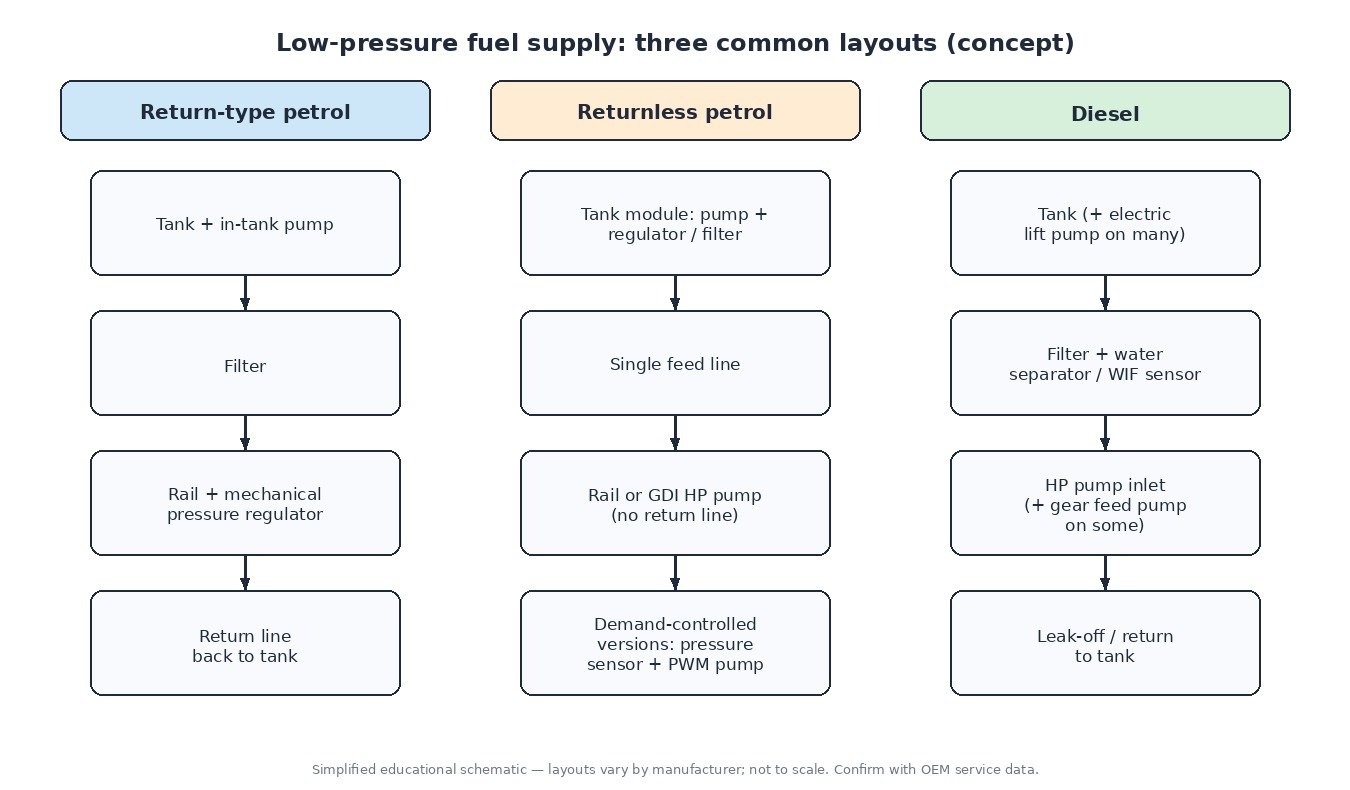
Low-pressure supply in one paragraph
The fuel supply system takes fuel from the tank, cleans it, removes water on diesels, and delivers it at a steady, moderate pressure. On port-injected petrol engines that pressure feeds the injectors directly. On direct injection petrol and common-rail diesel engines it feeds the high-pressure pump, which can only build rail pressure if its inlet gets enough fuel.
The three main layouts
Return-type petrol
An in-tank pump runs at full speed, a mechanical regulator on the rail sets the pressure, and surplus fuel flows back to the tank. Simple, but the pump always works at full output.
Returnless and demand-controlled petrol
The regulator moves into the tank module and only one line runs forward. On demand-controlled systems the pump speed varies: the ECU, or a separate fuel pump control module, sends a PWM signal and reads a low-pressure sensor to hold a target that changes with operating conditions.
Diesel
Fuel may be pushed by an electric lift pump, pulled by a mechanical gear feed pump on the high-pressure pump, or both. The filter usually includes a water separator and often a water-in-fuel (WIF) sensor. Injector and pump leak-off fuel returns to the tank.
What the ECU monitors
On a demand-controlled system the ECU compares the target pressure with the actual reading and adjusts pump duty. That gives it three useful signals: the pressure itself, the duty needed to reach it, and how fast pressure recovers when demand rises.

When duty runs near maximum and pressure still falls short, the ECU can set a flow or performance code. Without a low-pressure sensor, problems usually show up indirectly as lean fuel trims on petrol engines or as rail pressure deviations on diesels.
Step-by-step supply diagnosis
- Read all modules. Note fuel pump, pressure, lean and fuel level codes together; they often tell one story.
- Log under real load. Record target and actual pressure, pump duty and rail pressure on a road test or dyno pull. Many supply faults are invisible at idle.
- Confirm with a gauge. A mechanical gauge separates a real pressure problem from a sensor or wiring fault.
- Test the electrical supply. Measure voltage at the pump connector with the pump running, and voltage drop on feed and ground. Check relays, fuses and the pump control module.
- Check flow, not only pressure. A pump can reach pressure with no flow and still fail under load. Measure delivery volume against the manufacturer’s specification where one exists.
- Inspect filters and strainers. Replace overdue filters and check the tank strainer, especially after running on contaminated fuel.
- Diesel: hunt for air and water. Use a clear line on the suction side to spot bubbles, check seals and connectors, and drain the separator.
Cars, trucks, tractors and bikes

Cars and vans mostly use in-tank modules, with demand control common on newer petrol engines. Trucks and buses rely on large filter and separator assemblies and often an engine-driven feed pump, so priming and bleeding procedures matter. Tractors and other agricultural machines work in dusty, wet conditions where water-in-fuel warnings and filter intervals deserve extra attention. Motorbikes pack pump, regulator and strainer into a small module that runs hot, and running the tank close to empty shortens pump life.
Before any remap
A calibration that adds fuel assumes the supply system can deliver it. Log low pressure and pump duty at full load on the stock file first. If the margin is already thin, repair or upgrade the supply before changing the calibration, and keep fuel pressure monitoring and lean protection working.
Related fault codes (DTCs)
Generic OBD-II codes (SAE J2012) commonly linked to fuel supply faults. Wording and coverage vary by manufacturer, and OEM-specific codes may also be stored, so always read every module.
| Code | Meaning | Typical causes |
|---|---|---|
| P0087 | Fuel Rail/System Pressure – Too Low | Weak or failing lift pump, clogged filter or tank strainer, air leak on a diesel suction line, low supply voltage to the pump; on direct injection also high-pressure side faults |
| P0088 | Fuel Rail/System Pressure – Too High | Stuck regulator, kinked or blocked return line, pressure sensor fault |
| P0089 | Fuel Pressure Regulator 1 Performance | Regulator sticking or slow to respond, contamination, wiring fault |
| P0090 | Fuel Pressure Regulator 1 Control Circuit | Open or shorted regulator circuit, connector corrosion |
| P0148 | Fuel Delivery Error | Delivery cannot meet demand: pump, filter, restriction or supply voltage problem |
| P0171 / P0174 | System Too Lean (Bank 1 / Bank 2) | Low fuel pressure or flow under load, alongside the usual vacuum leak and air metering causes |
| P0180–P0183 | Fuel Temperature Sensor “A” Circuit / Range/Performance / Low / High | Sensor or wiring fault, connector damage, plausibility mismatch with other temperatures after a cold soak |
| P0190–P0193 | Fuel Rail Pressure Sensor “A” Circuit / Range/Performance / Low / High | Sensor, 5 V reference or ground fault, wiring damage; check the actual pressure with a gauge before replacing parts |
| P0230 | Fuel Pump Primary Circuit | Pump relay or its control circuit, fuse, wiring or ECU output fault |
| P0231 / P0232 | Fuel Pump Secondary Circuit Low / High | Open or shorted feed to the pump, bad ground, failed pump motor, relay contacts |
| P0460–P0463 | Fuel Level Sensor “A” Circuit / Range/Performance / Low / High | Sender in the tank module, float or wiring fault; can matter when the ECU limits functions at low fuel |
| P0627–P0629 | Fuel Pump “A” Control Circuit/Open / Low / High | Control line between ECU and pump control module open or shorted, module fault |
| P2264 | Water in Fuel Sensor Circuit | WIF sensor or wiring fault on the filter housing |
| P2269 | Water in Fuel Condition | Water collected in the filter or separator; drain it and check the fuel source |
| P2635 | Fuel Pump “A” Low Flow/Performance | Worn pump, restricted strainer or filter, voltage drop in the pump supply, wrong pump fitted |
Closing
Most supply faults come down to pressure, flow, voltage, filtration, air or water. Measure each one under load and you’ll rarely replace the wrong part.
Looking for an original stock ECU file for your vehicle? Browse the ECUFlashFiles catalogue.