
Judder on take-off, a flashing gear indicator, or a car that suddenly drives only in 1st and 3rd. Dual-clutch gearboxes (DCT, often called DSG, PDK or Powershift by different makers) have their own typical faults, and nearly all of them make sense once you know how the TCU controls two clutches. This guide covers the layout, the control strategy and a practical diagnostic approach, with the most useful fault codes at the end.
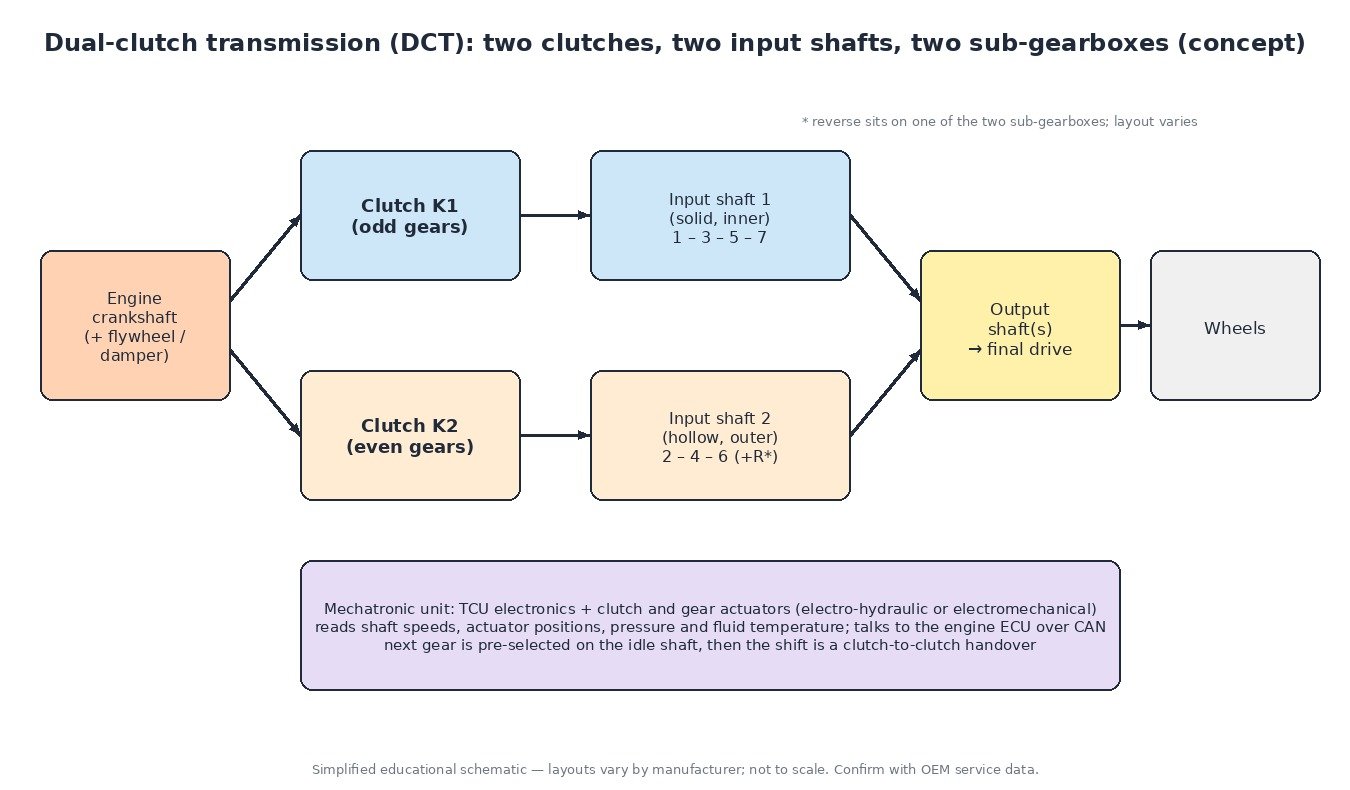
The layout in one minute
Think of a DCT as two manual sub-gearboxes behind one engine. Clutch 1 feeds a solid inner input shaft carrying the odd gears. Clutch 2 feeds a hollow outer shaft carrying the even gears, and reverse is assigned to one of the two halves. While one half carries torque, the TCU pre-selects the likely next gear on the other half. A shift is then a handover: one clutch opens while the other closes, so drive is never fully interrupted.
Dry versus wet: what fails differently
- Dry-clutch units are found on lower-torque applications. Their clutches are sensitive to heat from slipping in traffic, on hills and during repeated launches, and to oil contamination. Take-off judder and clutch-wear codes are typical.
- Wet-clutch units run multi-plate clutches in fluid for higher torque and better heat capacity. Here fluid condition, filter, pump and pressure faults matter more, and service intervals are important.
Inside the mechatronic unit
The TCU usually sits in a mechatronic unit together with the actuators. Designs differ, but you’ll typically find pressure-control solenoids, a valve body or electromechanical actuators, a pump (some dry units use an electric pump and pressure accumulator), clutch and gear actuators, speed sensors for both input shafts and the output, gear-actuator travel sensors, pressure sensors and a fluid temperature sensor. Many of these sensors are on internal circuits, so a “sensor” code can still mean replacing or repairing the mechatronic unit.

How the TCU controls the clutches
Every shift needs an accurate clutch torque model. The TCU learns each clutch’s kiss point (touch point), the position or pressure where it starts transmitting torque, and how torque grows beyond it. During an upshift it overlaps the two clutches in the torque phase, then brings engine speed down in the speed phase, often asking the engine ECU over CAN for a short torque reduction. It also runs a clutch temperature model. When clutches get hot it may shift earlier, reduce creep, cut torque or warn the driver.
A practical diagnostic routine
- Scan the TCU itself. P0700 in the engine ECU only flags that the TCU has stored a fault. Note manufacturer-specific codes and freeze-frame data such as fluid temperature, speed and gear.
- Check power and communication. Test battery health, TCU supply and grounds, and connectors. Low voltage and CAN faults (U0100, U0101) produce misleading gearbox complaints.
- Check fluid on wet-clutch units: level at the correct temperature and procedure, condition, and service history.
- Read live data on a road test: clutch slip per clutch, clutch temperature, adapted kiss points, actuator travel and shift times. A fault confined to one sub-gearbox points to that clutch, its actuator or its gear actuators.
- Recognise sub-gearbox shutdown. When one half is faulty, many DCTs lock it out and drive on the other half’s gears only. That tells you which side to investigate.
- Adapt after every repair. After clutch, mechatronic or software work, run the basic setting / clutch adaptation with a suitable tool and meet its conditions (fluid temperature range, idle, brake applied, stable voltage).
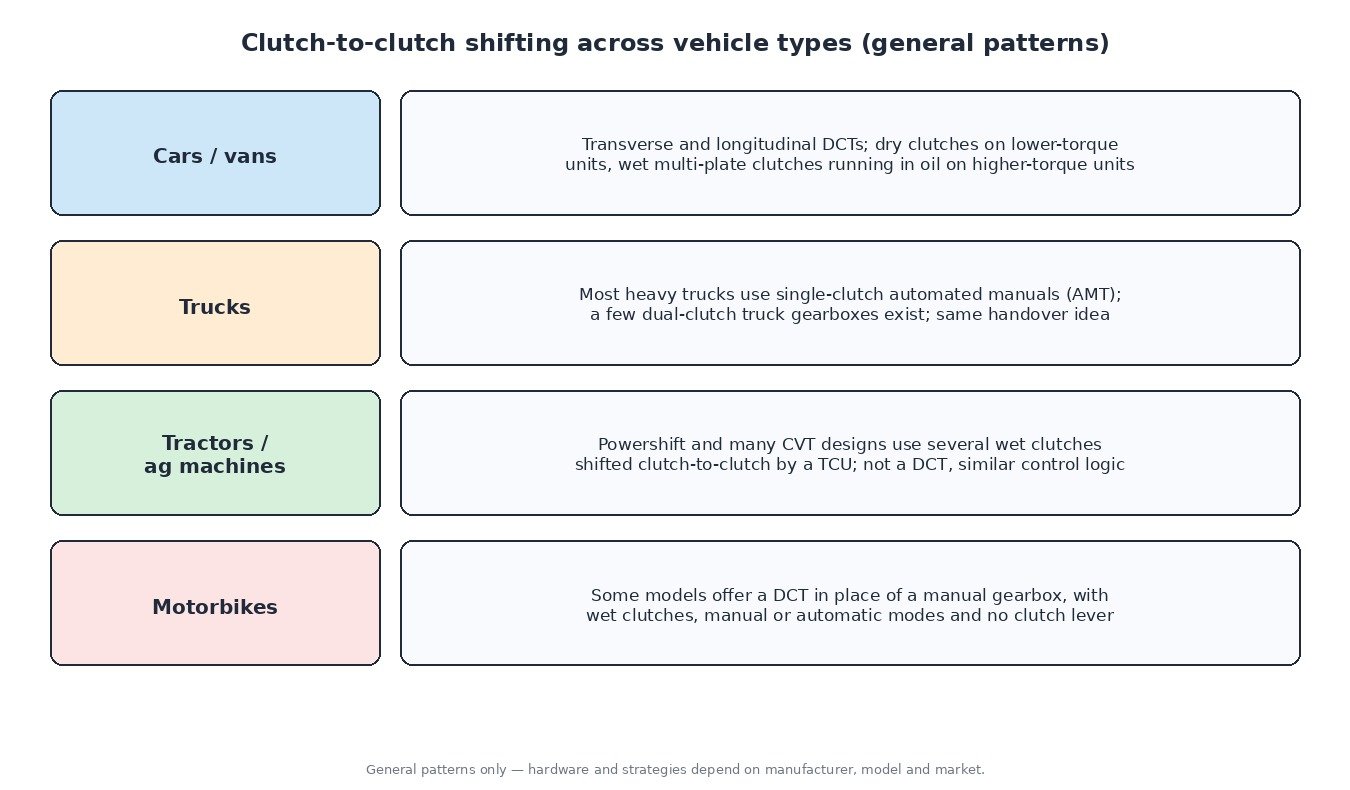
Beyond cars
Most heavy trucks use single-clutch automated manuals, though some dual-clutch truck gearboxes exist. Tractor powershift and many CVT transmissions shift several wet clutches clutch-to-clutch under TCU control. They aren’t DCTs, but pressure ramps, overlap and adaptation work the same way, so the same diagnostic thinking applies. Some motorbikes use a DCT in place of a manual gearbox. Their clutch-position and speed-sensor codes follow the same logic.
Remapped engine, standard gearbox?
A DCT is calibrated for a maximum input torque. After an engine-only remap the TCU may cap torque, or the clutches may slip and log slip or ratio codes. Clutch temperatures can also rise faster. That’s why serious DCT projects also review TCU calibration (torque limits, clutch pressure, shift and launch behaviour) within the hardware’s real limits. Always check clutch wear and adaptation values first, and save an original TCU backup before writing anything.
Related fault codes (DTCs)
Generic OBD-II codes (SAE J2012) often seen on DCTs. Manufacturers also store their own clutch and mechatronic codes; read them with an OEM-level tool.
| Code | Meaning | Typical causes |
|---|---|---|
| P0700 | Transmission Control System (MIL Request) | TCU has stored a fault; read the TCU for the real code |
| P0715 / P0716 / P0717 | Input/Turbine Speed Sensor “A” Circuit / Range/Performance / No Signal | Input shaft speed sensor or wiring fault, often inside the mechatronic unit; debris on the sensor |
| P0720 | Output Speed Sensor Circuit | Output speed sensor or wiring fault, damaged reluctor or target wheel |
| P0730 | Incorrect Gear Ratio | Clutch slip, gear actuator or shift fork fault, speed sensor error |
| P0731–P0735 / P0729 | Gear 1–5 Incorrect Ratio / Gear 6 Incorrect Ratio | Slipping clutch on that gear’s sub-gearbox, gear not fully engaged, worn synchroniser or selector |
| P0736 | Reverse Incorrect Ratio | Reverse gear engagement or clutch fault on the sub-gearbox carrying reverse |
| P0710–P0713 | Transmission Fluid Temperature Sensor “A” Circuit / Range/Performance / Low / High | Sensor or internal wiring fault, connector corrosion |
| P0218 | Transmission Fluid Over Temperature Condition | Long creeping or launching, towing, low fluid on wet units, cooler faults |
| P0805–P0808 | Clutch Position Sensor Circuit / Range/Performance / Low / High | Clutch travel sensor or wiring fault, actuator wear |
| P0810 | Clutch Position Control Error | Clutch actuator misses its target: pressure, actuator or adaptation fault |
| P0811 | Excessive Clutch “A” Slippage | Worn clutch, outdated kiss point, oil on a dry clutch, engine torque above clutch capacity |
| P0900–P0903 | Clutch Actuator Circuit/Open / Range/Performance / Low / High | Actuator, solenoid or valve wiring fault, mechatronic electrical fault |
| P0841 | Transmission Fluid Pressure Sensor/Switch “A” Circuit Range/Performance | Pressure sensor fault, hydraulic leak, pump or accumulator problem |
| P0868 | Transmission Fluid Pressure Low | Low fluid, pump wear, internal leakage, blocked filter |
| P0882 | TCM Power Input Signal Low | Weak battery, poor TCU supply or ground, corroded connector |
| P0562 | System Voltage Low | Battery or charging fault upsetting the actuators |
| P0613 | TCM Processor | Internal TCU fault, heat or water ingress, interrupted programming |
| U0100 | Lost Communication With ECM/PCM “A” | CAN wiring fault or engine ECU not responding; TCU loses torque data |
| U0101 | Lost Communication With TCM | TCU supply, ground, CAN wiring or internal TCU fault |
Closing
Most DCT problems come down to power supply, fluid, clutch condition or adaptation. Read the TCU, compare the odd and even sides, and adapt after every repair.
Looking for an original TCU or ECU file, or an engineered calibration? Browse the ECUFlashFiles shop.