
Rough idle, smoke, a knock on one cylinder or a balance code: many diesel complaints trace back to the injectors. To diagnose them properly, it helps to know how a solenoid or piezo injector actually opens, what the ECU expects from it, and which data shows that one injector has drifted. This guide walks through diesel injector operation, injector classification codes, cylinder balance and back-leak testing, and the generic fault codes technicians meet on cars, vans, trucks and tractors, plus a short note on petrol bikes.
Injection events in a modern diesel
Common-rail systems separate pressure generation from injection. The high-pressure pump keeps the rail at a target pressure, and the ECU opens each injector electrically at exactly the right crank angle. Instead of one long squirt, the ECU usually splits fuel into pilot injections for quieter combustion, a main injection for torque and, when needed, post injections for emissions control or particulate filter regeneration. Each event has its own quantity and timing.
Inside a solenoid injector
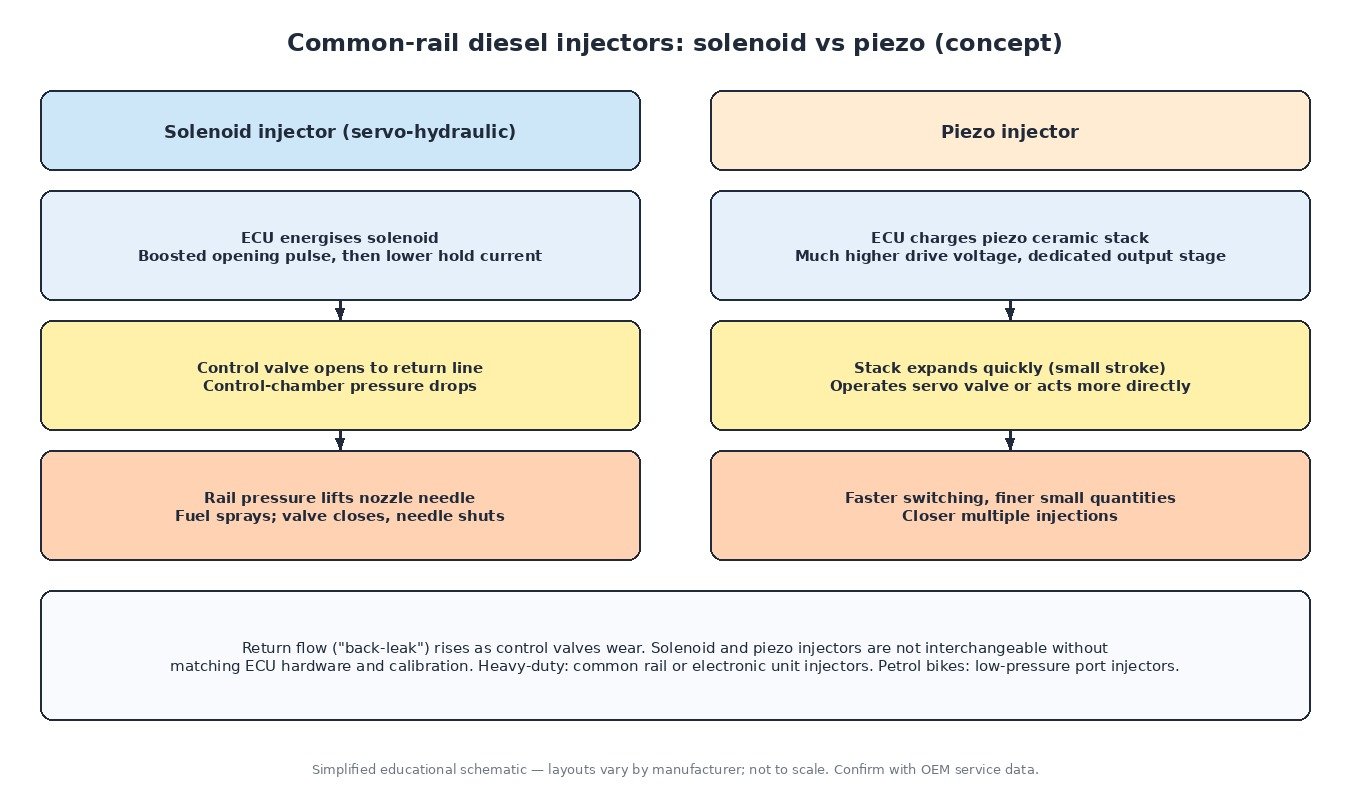
The nozzle needle is held shut by fuel pressure in a control chamber above it. Energising the solenoid opens a tiny valve that bleeds this chamber to the return line. With the pressure above the needle reduced, rail pressure acting on the needle lifts it and fuel sprays into the cylinder. Switching the solenoid off closes the bleed valve, pressure rebuilds and the needle closes. The bled fuel is the injector’s return flow, or back-leak, and it rises as the control valve wears.
The ECU drives the solenoid in phases: a strong opening pulse to move the armature quickly, then a lower holding current. A scope on the injector circuit shows this profile, and a missing or distorted pattern helps separate wiring problems from hydraulic ones.
How piezo injectors differ
Piezo injectors replace the solenoid with a stack of piezoceramic layers that expands when charged with a high voltage. The stack moves only slightly but responds very quickly, which allows shorter gaps between injections and better control of very small quantities. Most piezo designs still use a servo valve to move the needle, while some act on it more directly. Because the drive electronics and calibration are completely different, piezo and solenoid injectors are never interchangeable without matching ECU hardware and software.
How the ECU sets injection time
The ECU first works out how much fuel it wants, based on its torque model and limiters such as the smoke limit and component protection. It then turns that quantity into an energising time using the injector characteristic map, with rail pressure as a key input. Higher rail pressure delivers the same quantity in less time. This is why rail pressure faults and injector faults often show similar symptoms.
Classification codes and why coding matters
Every injector is flow-tested at the factory and marked with a classification code that describes how it deviates from nominal, such as a Bosch IMA code, a Delphi C2I or C3I code, or a Denso QR code. After replacing an injector, the new code must be programmed into the ECU with a diagnostic tool. Without it, the ECU applies the wrong correction and that cylinder runs rich or lean.
Balance values and back-leak testing
At idle, the ECU watches how much the crankshaft accelerates after each cylinder fires. If one cylinder contributes less, the smooth-running control adds fuel to it and takes fuel from the others. These correction values are visible in live data on most platforms, and one cylinder sitting well apart from the rest is a strong clue. Some systems also learn small-quantity corrections during overrun. A back-leak test, measuring return flow from each injector, confirms which injector is leaking internally.

Across vehicle types
Passenger cars and vans use solenoid or piezo common rail. Trucks and agricultural engines use common rail or, on some heavy-duty engines, electronic unit injectors that combine a cam-driven pump plunger with solenoid control valves. Petrol motorcycles typically use low-pressure port injectors, and petrol direct-injection engines use high-pressure solenoid or piezo injectors. The diagnostic logic of checking circuit, balance and leakage stays the same.
Related fault codes (DTCs)
Generic SAE J2012 meanings. Thresholds and test strategies are manufacturer-specific, so always confirm with service data.
| Code | Meaning | Typical causes |
|---|---|---|
| P0200 | Injector Circuit/Open | Common supply or ground fault, failed ECU output stage, harness damage |
| P0201–P0204 | Injector Circuit/Open – Cylinders 1 to 4 | Open injector winding or piezo stack, corroded connector, broken wire |
| P0205–P0208 | Injector Circuit/Open – Cylinders 5 to 8 | Same faults on six- and eight-cylinder truck, ag and car engines |
| P0261 | Cylinder 1 Injector Circuit Low | Signal shorted to ground, low injector resistance |
| P0262 | Cylinder 1 Injector Circuit High | Short to supply, high-resistance connection |
| P0263 | Cylinder 1 Contribution/Balance | Worn, sticking or leaking injector, missing coding, low compression |
| P0264 / P0265 | Cylinder 2 Injector Circuit Low / High | Short to ground or supply on cylinder 2 circuit |
| P0266 | Cylinder 2 Contribution/Balance | Injector wear or coding error on cylinder 2, mechanical fault |
| P0267 / P0268 | Cylinder 3 Injector Circuit Low / High | Short to ground or supply on cylinder 3 circuit |
| P0269 | Cylinder 3 Contribution/Balance | Injector wear or coding error on cylinder 3, mechanical fault |
| P0270 / P0271 | Cylinder 4 Injector Circuit Low / High | Short to ground or supply on cylinder 4 circuit |
| P0272 | Cylinder 4 Contribution/Balance | Injector wear or coding error on cylinder 4, mechanical fault |
| P062D | Fuel Injector Driver Circuit Performance Bank 1 | Shorted injector loading the driver, wiring fault, ECU output stage |
| P062E | Fuel Injector Driver Circuit Performance Bank 2 | Same as above for bank 2 |
| P2147 / P2148 | Fuel Injector Group “A” Supply Voltage Circuit Low / High | Supply line shorted to ground or to voltage, faulty injector in group A |
| P2150 / P2151 | Fuel Injector Group “B” Supply Voltage Circuit Low / High | Supply line shorted to ground or to voltage, faulty injector in group B |
| P0093 | Fuel System Large Leak Detected | Injector stuck open or excessive return leakage, external leak |
A practical diagnostic path
- Separate electrical faults (circuit and supply codes) from functional ones (balance, rail pressure, large leak).
- Inspect connectors and harness, measure injector resistance and compare it with the other cylinders.
- Check live balance corrections at warm idle and note the cylinder that stands out.
- Perform a return-flow test and, if needed, a compression or relative-compression test.
- Replace or recondition only the injectors that fail testing, then program classification codes and reset adaptations.
What it means for tuning
Good calibrations change torque requests, limiters, rail pressure and timing together, while keeping injection within the injector’s safe operating range. Running much longer injection times moves combustion late and raises exhaust temperatures. Upgraded or different injectors need their own characteristic data in the file. Before any remap, check balance values, because a worn injector will only get worse under more load.
Looking for original files and engineered diesel calibrations? Browse the ECUFlashFiles shop.