
Checksum correction might sound like just another step in ECU tuning, but the impact is anything but minor. Miss a single calculation and the entire engine can refuse to start or even throw unexpected errors into critical safety systems. Some tuning experts estimate that over 90 percent of ECU failures traced back to software mods are caused by invalid or forgotten checksums. This flips the script entirely, making checksum correction the true gatekeeper between smooth performance upgrades and costly troubleshooting nightmares.
Table of Contents
- Understanding Checksum Correction In ECU Tuning
- Why ECU Checksum Correction Is Essential
- Top Tools And Methods For Correcting Checksums
- Common Issues And Pro Tips For Safe Editing
Quick Summary
| Takeaway | Explanation |
|---|---|
| Checksum correction ensures system reliability | Correct checksums validate ECU modifications, preventing failures and performance issues. |
| Use advanced tools for checksum correction | Automated software can detect and correct checksums accurately, improving efficiency. |
| Failure to correct checksums can lead to errors | Incorrect checksums may cause ECU rejections or unpredictable vehicle behavior. |
| Prioritize data integrity in modifications | Ensuring data integrity protects against risks that may affect safety and performance. |
| Implement systematic verification processes | Regular verification of checksum corrections minimizes potential corruption and errors during ECU tuning. |
Understanding Checksum Correction in ECU Tuning
Checksum correction represents a critical technical process in automotive ECU tuning that ensures the integrity and functionality of modified engine control unit software. When automotive tuners make calibration changes, they must recalculate the checksum to prevent potential system failures and maintain precise engine performance.
The Fundamental Mechanics of Checksum Validation
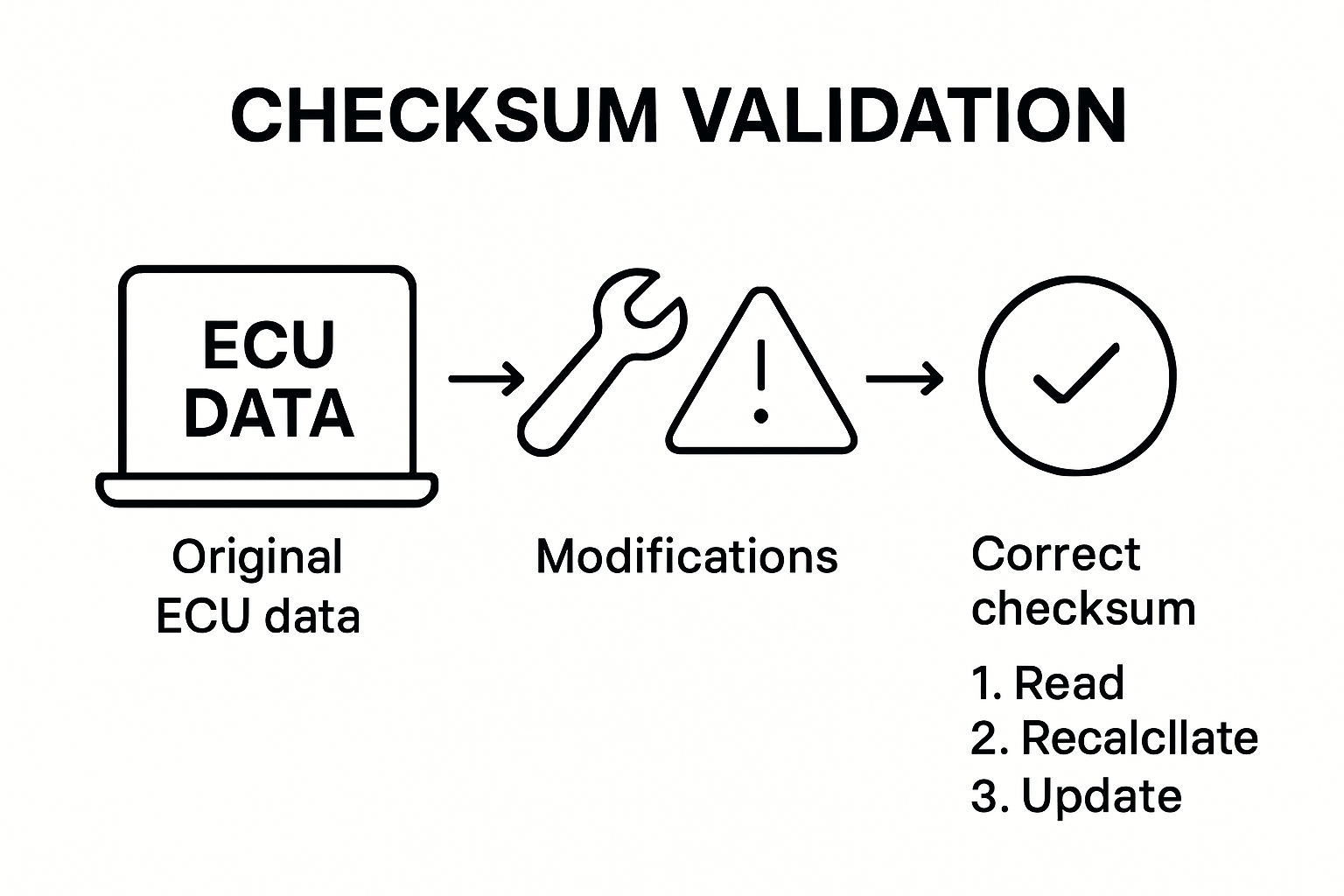
At its core, a checksum acts as a digital verification mechanism within ECU software. According to High Performance Academy, the checksum is a mathematical calculation that validates the integrity of data stored within the ECU’s memory. When tuners modify parameters like fuel injection timing, boost pressure, or ignition advance, these changes directly impact the original checksum value.
The validation process involves complex algorithmic computations that compare the original data signature against the modified version. If the checksum does not match the ECU’s original reference point, the engine control unit may reject the modifications, potentially preventing the vehicle from starting or causing significant performance disruptions.
Advanced Checksum Correction Techniques
Professional tuners employ sophisticated techniques to manage checksum corrections effectively. Microtronik discusses advanced auto checksum capabilities that can automatically recalculate and validate modified ECU files. These methods involve precise mathematical recalculations that preserve the original data structure while accommodating performance enhancements.
The process requires deep understanding of specific ECU architectures, as different vehicle manufacturers implement unique checksum algorithms. Some modern tuning tools offer automated correction features, but experienced tuners still rely on manual verification to ensure absolute precision.
For automotive enthusiasts looking to expand their understanding of ECU fundamentals, our comprehensive guide on ECU operations provides additional insights into the intricate world of engine control systems.
Checksum correction is not merely a technical requirement but a critical safeguard that protects both the vehicle’s performance and the integrity of its electronic systems. Tuners who master this skill can confidently modify engine parameters while maintaining system reliability and preventing potential computational errors that could compromise vehicle functionality.
Why ECU Checksum Correction Is Essential
ECU checksum correction plays a pivotal role in maintaining the reliability and performance of modern automotive electronic systems. By ensuring data integrity and preventing potential system failures, checksum correction becomes an indispensable process for automotive tuners and performance enthusiasts.
Data Integrity and System Protection
In the complex world of automotive electronics, data integrity is paramount. According to research from Engineering LibreTexts, checksums serve as a critical mechanism for verifying the authenticity and completeness of transmitted or stored data. When modifications are made to ECU software, the original checksum becomes invalid, potentially exposing the system to significant risks.
The consequences of neglecting checksum correction can be severe. An incorrect or unverified checksum might cause the ECU to reject modifications entirely, prevent vehicle startup, or worse, introduce unpredictable performance issues that could compromise vehicle safety and mechanical integrity.
Preventing Computational Errors and Performance Disruptions
Researchers exploring in-vehicle network systems highlight that Electronic Control Units are fundamental electronic components responsible for critical time-bounded communications within a vehicle. Checksum correction ensures that these intricate electronic communication pathways remain uninterrupted and function precisely as intended.
As GeeksforGeeks explains in their detailed analysis of checksum algorithms, the verification process involves comparing the calculated checksum against a known reference point. This mathematical validation acts as a robust safeguard against data corruption, unauthorized modifications, and potential system vulnerabilities.
For automotive enthusiasts eager to understand more about the intricacies of ECU systems, our comprehensive ECU operations guide offers deeper insights into these complex electronic ecosystems.
Checksum correction transcends mere technical compliance. It represents a critical quality control mechanism that protects the sophisticated electronic architecture of modern vehicles. Tuners and automotive professionals who prioritize precise checksum validation demonstrate a commitment to maintaining the highest standards of performance, reliability, and safety in vehicle modification processes.
Top Tools and Methods for Correcting Checksums
Navigating the complex landscape of checksum correction requires sophisticated tools and advanced methodological approaches. Professional automotive tuners rely on a range of specialized software and techniques to ensure precise ECU modification and data integrity.
Automated Checksum Correction Software
Modern ECU tuning demands advanced software solutions capable of rapidly and accurately correcting checksums. Researchers from ACM Digital Library have developed innovative program synthesis approaches that can automatically detect and reverse-engineer checksum algorithms from binary data samples. These sophisticated tools enable tuners to reconstruct and validate checksum algorithms with unprecedented precision.
Key features of professional checksum correction tools typically include:
- Automatic algorithm detection
- Multi-protocol support
- Real-time error validation
- Comprehensive ECU compatibility
Here’s a comparison table summarizing key features of professional checksum correction tools as discussed in the article. This table helps tuners quickly evaluate what capabilities to look for when selecting a checksum correction solution.
| Feature | Description |
|---|---|
| Automatic algorithm detection | Identifies correct checksum algorithm for each ECU |
| Multi-protocol support | Supports a variety of vehicle protocols and manufacturers |
| Real-time error validation | Detects and alerts on errors during checksum correction |
| Comprehensive ECU compatibility | Works across different ECU models and brands |
| Precise recalculation algorithms | Recomputes checksums accurately after any modification |
Advanced Computational Validation Techniques
Research published in the Royal Society Transactions highlights cutting-edge methodologies for detecting and correcting computational errors. These techniques extend beyond traditional checksum approaches, implementing robust error detection and correction routines that ensure computational integrity across complex electronic systems.
Professional tuners increasingly leverage these advanced validation techniques to:
- Minimize potential system failures
- Enhance modification reliability
- Provide comprehensive error tracking
- Maintain precise electronic system performance
Integrated Error Detection Strategies
Automotive manufacturing research emphasizes the critical importance of implementing comprehensive fault detection solutions. While traditional checksum correction focuses on mathematical validation, modern approaches integrate multiple error detection strategies to provide holistic system protection.
For automotive enthusiasts seeking deeper insights into ECU technologies, our comprehensive ECU operations guide offers an extensive exploration of these advanced diagnostic techniques.
The evolution of checksum correction tools reflects the increasing complexity of automotive electronic systems. As vehicles become more technologically sophisticated, the demand for precise, reliable, and adaptive checksum validation methods continues to grow. Professional tuners must remain at the forefront of these technological advancements, utilizing the most advanced tools and techniques to ensure optimal vehicle performance and system reliability.
Common Issues and Pro Tips for Safe Editing
ECU checksum editing involves complex technical challenges that can potentially compromise vehicle performance if not approached with precision and expertise. Professional tuners must navigate a landscape of potential pitfalls while maintaining the highest standards of electronic system integrity.
Diagnostic Error Code Management
Research investigating EEPROM checksum errors reveals critical insights into the most common diagnostic challenges faced during ECU modifications. The B1658 error code, for instance, indicates potential EEPROM checksum complications that can affect multiple vehicle systems including airbag control modules, anti-lock braking systems, and engine control units.
Key diagnostic considerations include:
- Identifying voltage spike impacts
- Detecting electromagnetic interference
- Recognizing physical ECU damage
- Understanding software reprogramming risks
Preventing Critical Checksum Modification Errors
Advanced diagnostics research highlights the B2207 error code as a significant indicator of potential data corruption within ECU ROM systems. Professional tuners must implement comprehensive strategies to mitigate risks associated with checksum editing.
Prevention strategies include:
- Maintaining stable power supply conditions
- Using high-quality diagnostic tools
- Implementing systematic verification processes
- Protecting ECU from electromagnetic interference
Advanced Error Mitigation Techniques
Specialized automotive research emphasizes the importance of understanding ROM checksum error mechanisms. The B1013 error code demonstrates the complexity of potential data corruption scenarios that can emerge during ECU modifications.
For automotive enthusiasts seeking a comprehensive foundation in tuning techniques, our beginner’s guide to ECU tuning provides essential insights into safe modification practices.
Successful checksum correction demands more than technical knowledge. It requires a holistic approach that combines precise technical skills, advanced diagnostic capabilities, and a deep understanding of automotive electronic systems. Professional tuners must continuously adapt to evolving technological landscapes, prioritizing system reliability and performance integrity above all else.

Frequently Asked Questions
What is checksum correction in ECU tuning?
Checksum correction in ECU tuning is the process of recalculating a checksum value after making modifications to the engine control unit (ECU) software. This ensures data integrity and prevents issues such as engine refusal to start or performance disruptions.
Why is checksum correction essential for tuners?
Checksum correction is essential because it maintains the reliability and functionality of ECU modifications. Failing to correct checksums can lead to invalid adjustments, causing the ECU to reject modifications or trigger safety errors.
What tools are used for automated checksum correction?
Automated checksum correction tools are specialized software programs that detect and correct checksum values automatically. These tools often feature automatic algorithm detection, multi-protocol support, and real-time error validation to enhance the accuracy of ECU modifications.
How can tuners prevent checksum modification errors?
Tuners can prevent checksum modification errors by ensuring a stable power supply during ECU programming, using high-quality diagnostic tools, and implementing systematic verification processes to validate checksum corrections.
Stop Costly ECU Mistakes: Get Verified Files and Professional Support
Worried about ECU errors and unreliable tuning results due to checksum issues? As highlighted in this guide, even a single miscalculation can leave your project stalled, cause data corruption, or trigger system rejections. Protect your reputation and your clients’ vehicles by working only with trusted, tested ECU file solutions designed to meet the strictest checksum requirements.

Join ECUFlashFiles.com today and instantly access a wide range of original, tuned, and DAMOS calibration files, all verified for integrity and safe integration. Restore lost data, safely remap ECUs, or recover from common checksum errors with the backing of over 20 years of industry expertise. Need guidance? Explore our clear explanations and dedicated support, or dive into our Beginner’s Guide to ECU Tuning to boost your confidence. Take control of your tuning projects now and secure accuracy in every update—visit ECUFlashFiles.com to experience the difference.
Recommended
- ECU Tuning for Beginners: Essential Guide for 2025 – Ecu flash files
- How Does ECU Work? 2025 Guide for Car Performance – Ecu flash files
- A Compact Guide to ECU Reading & Chiptuning Tool Fundamentals – Ecu flash files
- ECU Tuned File | stage 1 | VW Transporter Bosch EDC17CP20 EDC17 CB.03.15.00 C34.00 1.0 03L906022CD