
Car tuning fans are facing new rules in 2025 that change the game for custom rides and modified engines. Some shops are worried, and for good reason. The fines for non-compliance can now top $50,000 per violation, which is more than double previous years. This is not just about louder exhausts anymore. The biggest surprise is that even small tweaks now require full documentation and professional certification just to stay street-legal.
Table of Contents
- Key Changes In Car Modification Laws
- How New Laws Impact Tuners And Shops
- Complying With Emissions And Safety Standards
- Tips For Navigating Local And Federal Regulations
Quick Summary
| Takeaway | Explanation |
|---|---|
| Stricter emissions standards now apply. | The EPA has implemented new emissions regulations that modifications must comply with, impacting aftermarket parts. |
| Documentation is crucial for modifications. | Extensive records and certifications are required to demonstrate compliance with emissions and safety regulations. |
| Safety systems must remain intact. | Any modifications cannot compromise the vehicle’s original safety technologies or electronic systems. |
| Technological advancements are essential. | Tuners need advanced diagnostic tools and knowledge to adapt to the modern vehicle’s technological complexities. |
| Build relationships with regulatory bodies. | Engaging with agencies and associations can provide guidance and insights into compliance and industry changes. |
Key Changes in Car Modification Laws
The automotive modification landscape is experiencing unprecedented transformations in 2025, driven by stricter environmental regulations, technological advancements, and enhanced safety standards. Car enthusiasts and professional tuners must navigate a complex new regulatory environment that fundamentally reshapes how vehicles can be legally modified.
Emissions and Environmental Compliance
The Environmental Protection Agency (EPA) has introduced more stringent emissions standards that directly impact vehicle modifications. According to the EPA’s new regulations, light-duty and medium-duty vehicles must now meet dramatically reduced pollution thresholds starting with model year 2027. These standards represent a significant challenge for performance enthusiasts who traditionally modify exhaust systems and engine components.
Key implications for modifications include:
- Emissions Control: Any aftermarket part must demonstrate equivalent or lower emissions compared to original manufacturer specifications.
- Certification Requirements: Modifications now require explicit documentation proving compliance with federal emissions standards.
- Potential Penalties: Unauthorized modifications can result in substantial fines and potential vehicle registration restrictions.
The U.S. Department of Energy’s Alternative Fuels Data Center emphasizes that all vehicle and engine conversions must strictly adhere to standards set by multiple regulatory agencies, including the EPA, NHTSA, and state-level organizations like CARB. The Clean Air Act explicitly prohibits tampering with emissions control devices, making comprehensive documentation and professional certification more critical than ever.
Technological and Safety Regulations
Beyond emissions, technological advancements are driving unprecedented changes in modification regulations. Modern vehicles increasingly rely on complex electronic systems that interact with safety and performance features. This technological complexity means that modifications now require sophisticated understanding of integrated vehicle systems.
Professional tuners must now:
- Maintain Electronic Integrity: Ensure modifications do not compromise vehicle’s onboard diagnostic (OBD) systems.
- Preserve Safety Protocols: Modifications cannot disable or significantly alter manufacturer-installed safety technologies.
- Electrical System Compatibility: Any electrical modifications must maintain the vehicle’s original communication protocols and diagnostic capabilities.
Interestingly, our comprehensive guide on ECU tuning provides deeper insights into navigating these complex technological requirements for automotive enthusiasts seeking performance enhancements while maintaining legal compliance.
These evolving regulations represent more than mere bureaucratic hurdles. They reflect a broader shift towards sustainable, technologically integrated automotive ecosystems that balance performance aspirations with environmental responsibility. Car modification enthusiasts must adapt, embracing sophisticated approaches that respect both regulatory frameworks and the inherent passion for automotive customization.
To help readers grasp the specific compliance demands in 2025, here is a summary table outlining the key requirements for emissions and safety compliance, along with the associated implications for tuners and shops:
| Compliance Focus | Key Requirement | Implication for Tuners & Shops |
|---|---|---|
| Emissions Measurement | Precise, documented emissions testing | Investment in testing equipment, recordkeeping |
| Certification | Proof of compliance with federal standards | Need for professional certification |
| Emissions Monitoring | Continuous performance tracking for emissions | Advanced diagnostic tools required |
| Electronic Integrity | Modifications must not disrupt OBD systems | Technical knowledge & tools needed |
| Safety Protocols | Preserve all factory-installed safety technologies | Mod limits, advanced diagnostics needed |
| Documentation | Maintain detailed logs and certifications | Critical business and legal requirement |
| Legal Risk | Fines up to $50,000 per violation for non-compliance | Substantial financial and operational risk |
How New Laws Impact Tuners and Shops
The 2025 car modification landscape presents unprecedented challenges for automotive tuners and performance shops, fundamentally transforming their business models and operational strategies. These regulatory shifts demand comprehensive adaptation across technical, legal, and financial dimensions.
Certification and Compliance Requirements
Professional tuning businesses must now invest heavily in comprehensive certification processes. According to the Society of Automotive Engineers, shops must demonstrate precise technical competency through standardized testing and documentation. This means tuners can no longer rely solely on practical experience but must develop robust compliance frameworks.
Key compliance challenges include:
- Advanced Diagnostic Protocols: Shops must purchase expensive diagnostic equipment capable of interfacing with modern vehicle computer systems.
- Continuous Training: Technicians require ongoing education to understand evolving electronic system regulations.
- Documentation Management: Maintaining detailed modification records becomes a critical business requirement.
The financial implications are substantial. Small and medium-sized performance shops will face significant barriers to entry, potentially consolidating the market toward larger, more resource-rich organizations.
Legal and Financial Restructuring
Legal risks associated with vehicle modifications have dramatically increased. Research from the Automotive Aftermarket Suppliers Association indicates that non-compliant modifications can result in penalties exceeding $50,000 per violation. This transforms what was previously an entrepreneurial landscape into a highly regulated professional environment.
Tuning businesses must now:
- Implement Comprehensive Insurance Coverage: Protect against potential legal challenges related to modifications.
- Develop Rigorous Risk Assessment Protocols: Evaluate modification requests against complex regulatory frameworks.
- Create Transparent Client Communication Systems: Clearly explain potential legal and performance limitations.
Our comprehensive guide to ECU tuning provides deeper insights into navigating these intricate professional challenges for automotive performance specialists.
Technological Adaptation Strategies
Successful tuning shops in 2025 will be defined by their technological adaptability. The integration of advanced diagnostic tools, real-time emissions monitoring systems, and sophisticated software becomes essential. Shops must transform from traditional mechanical modification centers to high-tech engineering consultancies.
Emerging technological requirements demand:
- Advanced Computer Diagnostics: Capability to interface with complex vehicle electronic systems.
- Specialized Software Expertise: Understanding intricate vehicle communication protocols.
- Precision Measurement Technologies: Implementing emissions and performance testing equipment.
These regulatory changes represent more than operational challenges. They signal a profound industry transformation, where technical expertise, legal knowledge, and technological sophistication converge to redefine automotive performance modification. Tuners and shops that quickly adapt will not just survive but potentially thrive in this new ecosystem.
Complying With Emissions and Safety Standards
The 2025 automotive modification landscape demands unprecedented precision in meeting emissions and safety standards. Vehicle enthusiasts and professional tuners must navigate a complex regulatory environment that prioritizes environmental protection and vehicular safety above traditional performance modifications.
Emissions Compliance Protocols
The Environmental Protection Agency (EPA) has introduced stringent new regulations that fundamentally reshape how vehicle modifications are approached. According to the EPA’s greenhouse gas emission standards, light-duty and medium-duty vehicles must meet dramatically reduced pollution thresholds starting with model year 2027. These standards represent a critical challenge for performance enthusiasts.
Key emissions compliance requirements include:
- Precise Emissions Measurement: Every modification must be accompanied by comprehensive emissions testing documentation.
- Manufacturer Equivalence: Aftermarket parts must demonstrate performance equal to or better than original manufacturer specifications.
- Continuous Monitoring: Vehicles must maintain consistent emissions performance across various operating conditions.
The National Highway Traffic Safety Administration’s SAFE Vehicles Rule further compounds these challenges by increasing Corporate Average Fuel Economy (CAFE) standards by 1.5% annually through model year 2026. This means modifications must not only meet emissions standards but also demonstrate fuel efficiency improvements.
Safety System Integration
Modern vehicle modifications cannot compromise integrated safety technologies. Automotive enthusiasts must now approach performance enhancements with a holistic understanding of vehicle electronic systems. This requires sophisticated diagnostic capabilities and deep technical knowledge.
Critical safety considerations include:
- Electronic System Preservation: Modifications must maintain all original safety protocols and warning systems.
- Structural Integrity: Any physical modifications must meet stringent structural safety requirements.
- Communication Protocol Maintenance: Vehicle computer systems must remain fully functional and communicative.
Our comprehensive guide to ECU tuning offers in-depth insights into navigating these complex safety and emissions integration challenges.
Documentation and Verification Processes
The U.S. Department of Energy’s Alternative Fuels Data Center emphasizes the critical importance of comprehensive documentation. Vehicle modifications now require extensive paperwork demonstrating compliance with multiple regulatory agencies, including the EPA, NHTSA, and state-level organizations like CARB.
Essential documentation processes involve:
- Detailed Modification Logs: Complete records of every performance enhancement and component replacement.
- Certification Verification: Professional certifications proving technical competence and regulatory understanding.
- Emissions Testing Reports: Comprehensive documentation demonstrating compliance with environmental standards.
These evolving regulations represent more than bureaucratic obstacles. They reflect a sophisticated approach to balancing automotive performance with environmental responsibility and public safety. Successful enthusiasts will view these standards as an opportunity for innovation rather than a limitation, developing increasingly advanced modification techniques that meet or exceed regulatory requirements.
To clarify the documentation and compliance process, the table below breaks down the essential steps and required records for legal car modification in 2025:
| Step | Description | Required Documentation |
|---|---|---|
| Modification Planning | Assess modification against current regulations | Research records, consultation logs |
| Performance Enhancement | Carry out and record any physical modification | Modification log, receipts |
| Emissions Testing | Conduct emissions tests post-modification | Emissions test report |
| Certification & Approval | Obtain professional certification for compliance | Certification documents |
| Safety Verification | Test and confirm all safety systems remain intact | Safety inspection report |
| Regulatory Submission | Submit records to appropriate authorities if required | Submission receipts or confirmations |
| Ongoing Monitoring | Maintain ongoing logs and reports for audits | Continued logs, compliance reports |
Tips for Navigating Local and Federal Regulations
Navigating the intricate landscape of automotive modification regulations requires a strategic approach that balances technical knowledge, legal compliance, and proactive communication. Car enthusiasts must develop a comprehensive understanding of both federal and local regulatory frameworks to ensure their modifications remain both legally compliant and performance-oriented.
Understanding Regulatory Hierarchy
Modification enthusiasts must recognize the complex multilayered regulatory environment. According to the Environmental Protection Agency’s greenhouse gas emission standards, federal regulations establish baseline requirements that state and local jurisdictions can further refine or restrict. This means automotive enthusiasts must be prepared to navigate multiple levels of regulatory scrutiny.
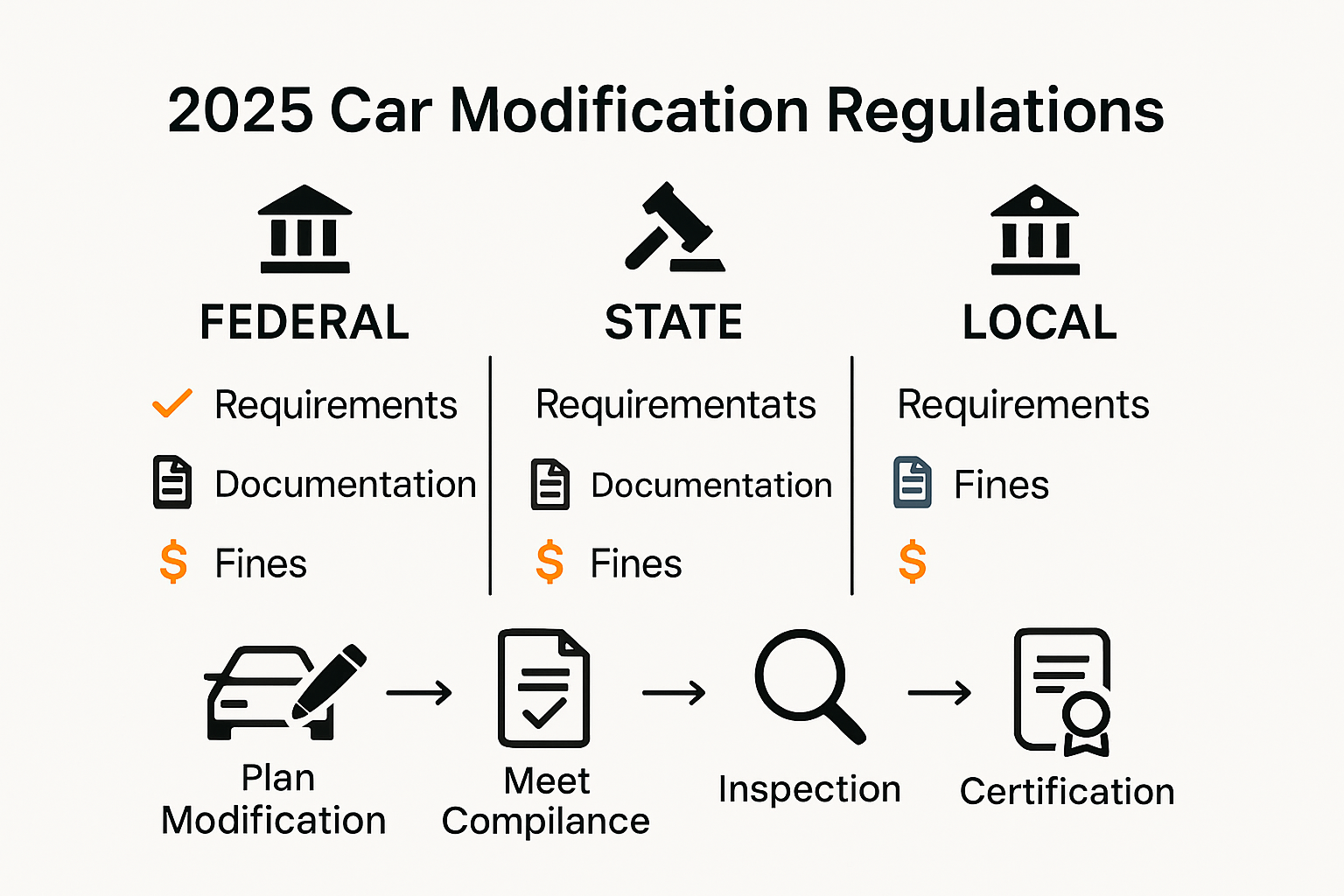
Key strategies for understanding regulatory frameworks include:
- Comprehensive Research: Systematically review federal, state, and local modification guidelines.
- Regular Compliance Updates: Establish a routine for monitoring regulatory changes.
- Professional Consultation: Engage with legal experts specializing in automotive regulations.
The interplay between federal and local regulations creates a nuanced compliance landscape that demands meticulous attention to detail. What might be permissible at a federal level could be explicitly prohibited in specific state or municipal jurisdictions.
Documentation and Compliance Preparation
Effective regulatory navigation hinges on robust documentation and proactive compliance strategies. Research from the National Highway Traffic Safety Administration emphasizes the critical importance of maintaining comprehensive modification records that demonstrate adherence to safety and emissions standards.
Essential documentation preparation involves:
- Detailed Modification Logs: Create exhaustive records of every performance enhancement.
- Technical Specification Sheets: Develop comprehensive documentation for each modification.
- Emissions Testing Verification: Maintain current emissions testing reports.
Our comprehensive guide to ECU tuning provides additional insights into developing robust documentation strategies for automotive modifications.
Building Professional Relationships
Successful regulatory navigation extends beyond paperwork. Building strategic relationships with regulatory agencies, certification bodies, and professional automotive associations can provide invaluable guidance and support.
Recommended networking strategies include:
- Professional Association Memberships: Join automotive modification and performance organizations.
- Regulatory Agency Engagement: Attend workshops and informational sessions.
- Continuous Education: Participate in certification and training programs.
These relationships can offer critical insights into emerging regulations, potential compliance challenges, and innovative modification techniques that align with evolving legal standards.
Ultimately, successfully navigating automotive modification regulations requires a holistic approach that combines technical expertise, legal understanding, and proactive communication. Enthusiasts who view these regulations as opportunities for innovation rather than obstacles will be best positioned to continue pushing the boundaries of automotive performance within established legal frameworks.
Frequently Asked Questions
What are the key changes in car modification laws for 2025?
The 2025 car modification laws introduce stricter emissions standards, require extensive documentation and certifications for modifications, and ensure that safety systems remain intact. Non-compliance can result in fines exceeding $50,000 per violation.
How do emissions compliance protocols affect car modifications?
Emissions compliance protocols require that all aftermarket parts demonstrate equivalent or lower emissions compared to original specifications, necessitating comprehensive emissions testing and documentation to ensure compliance with EPA standards.
What should tuners and shops do to meet certification and compliance requirements?
Tuners and shops must invest in advanced diagnostic tools, maintain detailed modification logs, and ensure their technicians receive ongoing training to navigate the evolving regulatory landscape, achieving necessary certifications for operation.
How can car enthusiasts ensure their modifications do not compromise vehicle safety?
Enthusiasts must maintain the integrity of safety technologies, including electronic systems and original safety protocols, when making modifications. This includes comprehensive evaluations of potential impacts on vehicle performance and safety features.
Ready to Meet 2025 Car Modification Laws with Confidence?
Worried about keeping up with stricter emissions standards and complex certification requirements mentioned in the article? If you are a tuner, shop owner, or performance enthusiast, navigating these new regulations can feel overwhelming. Staying compliant now demands precise ECU documentation, emissions-proven files, and reliable technical resources. Failure to adapt puts your shop or build at risk of hefty fines and legal problems. The good news is you do not have to face these challenges alone.

With over 20 years of experience, ECUFlashFiles.com powers tuners and professionals with fully tested and verified ECU files. We offer original manufacturer files, custom-tuned solutions, and DAMOS datasets to help you prove compliance, document every modification, and pass emissions checks. Instantly access the exact ECU remapping or recovery solution matched to your vehicle’s make, model, and hardware version using our advanced search. Professional support is available to guide you through any regulatory hurdle.
Do not risk costly setbacks or non-compliance. Explore ECUFlashFiles.com today and stay ahead of changing laws with secure, proven data and trusted expertise. Take control of your builds and shop’s future — get compliant ECU files and start your next project with absolute peace of mind.
Recommended
- ECU Tuning for Beginners: Essential Guide for 2025 – Ecu flash files
- How Does ECU Work? 2025 Guide for Car Performance – Ecu flash files
- ECU Tuned File | stage 1 | Yamaha VISTAR Mitsubishi MITSUBISHI MITSUBISHI
- A Compact Guide to ECU Reading & Chiptuning Tool Fundamentals – Ecu flash files
- Garage Door Code Requirements for Seattle and King County 2025 – Summit Garage Doors | Seattle’s #1 Garage Door Repair & Installation
- Requirements for Auto Loans in 2025: What Every Buyer Needs – Credit Correct Auto